Image: Wikipedia / Wikimedia Commons
Image: Wikipedia / Wikimedia Commons
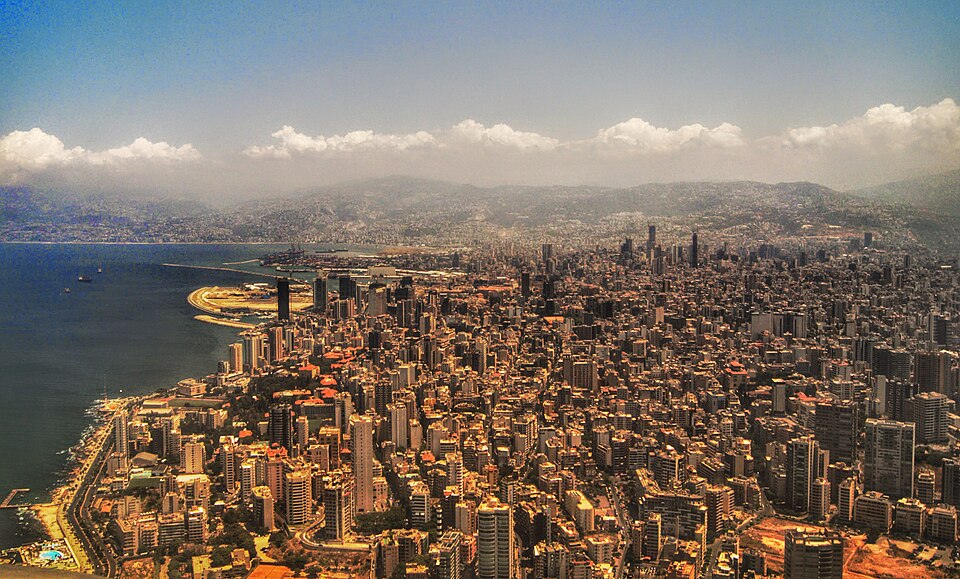
Beirut stands as the vibrant heart of Lebanon, a Mediterranean city where ancient history meets contemporary energy. With a metropolitan population of approximately 2.4 million people, Beirut dominates Lebanese life and culture, accounting for just under half the nation's total population. This is a city of extraordinary resilience and cultural depth, positioned at the crossroads of Europe, Asia, and Africa, where diverse influences have shaped its distinctive character over millennia.
Beirut sits on a peninsula that juts into the Mediterranean Sea at the approximate midpoint of Lebanon's coastline. Positioned at coordinates 33.89332N, 35.50157E, the city rises gently from sea level—standing at just 40 metres above sea level—creating a natural amphitheatre of urban landscape that slopes upward from the waterfront. This peninsular setting has historically made Beirut a natural harbor and trading point, advantages that have shaped its development since ancient times. The city occupies the Asia/Beirut timezone, and its Mediterranean climate brings warm, dry summers and mild, wet winters, though the nearby Lebanon Mountains rising to the east provide cooler elevations accessible within short distances.
Greater Beirut extends well beyond the historic city center, sprawling across surrounding areas and making it the twelfth-largest metropolitan area in the Levant region and the sixteenth-largest in the Arab world. The geography varies considerably across this expanded urban zone, from dense residential neighborhoods built on hillsides to coastal districts and emerging modern developments. The proximity to both mountains and sea gives the metropolitan area a diverse topography that has influenced how different communities have settled and developed their neighborhoods over generations.
Few cities in the world can claim continuous habitation spanning more than five millennia, yet Beirut stands among them. Archaeological evidence suggests human settlement here dating back thousands of years, with the city serving variously as a Phoenician port, a Roman trading hub, and a center of Hellenistic culture. This layered history is embedded in the city's very foundations, though much ancient architecture lies beneath modern development or was lost during periods of conflict.
The most visible heritage sites reflect Beirut's more recent centuries, particularly its Ottoman and early modern periods. The National Museum, housed in a distinctive building that survived significant damage, contains artifacts spanning the full sweep of Lebanese history. Islamic and Christian monuments, archaeological sites, and heritage quarters scattered throughout the city offer glimpses into different eras. Yet Beirut's recent decades have been transformative and difficult—the city experienced devastating civil conflict that fundamentally reshaped its physical landscape and social fabric. Reconstruction and urban renewal have been ongoing priorities, with new public spaces, waterfront developments, and restored buildings gradually reshaping the cityscape while efforts continue to preserve what remains of older quarters and architectural heritage.
Beirut's appeal lies as much in its urban character and Mediterranean setting as in specific monuments. The waterfront promenade offers a gathering place for residents and visitors alike, with views across the sea toward the horizon. The historic downtown district contains restored Ottoman-era buildings, traditional souks where merchants sell everything from spices to textiles, and religious sites representing the city's Christian, Muslim, and other communities. The Corniche, the coastal road that rings much of the city, provides both practical transportation and scenic walking or driving routes with sea views throughout.
Natural attractions lie within easy reach. The Lebanon Mountains rising immediately to the east of the city create a dramatic backdrop and offer cooler air and pine forests accessible via short drives. Parks and green spaces, though limited in the dense urban core, exist in various neighborhoods and provide respite from street-level activity. The Mediterranean beaches, though urban rather than secluded, remain central to the city's lifestyle and recreation. Beirut's cultural scene—including galleries, performance venues, universities, and creative districts—reflects its historical role as a center of Arab intellectual and artistic life. Neighborhood exploration reveals how different communities have established their presence and character across the city's varied districts, each with distinctive architecture, commerce, and social rhythms.
Beirut is served by Rafic Hariri International Airport, located south of the city and connected by road. Regional transport links connect the city to other parts of Lebanon and neighboring countries, though conditions vary. Within the city itself, transportation relies primarily on personal vehicles and shared taxis, supplemented by buses operating various routes. The coastal location means that water-based transport historically played roles in commerce and movement, though modern transport is predominantly land-based.
For its residents, Beirut functions as the economic and cultural engine of Lebanon. The city concentrates banking, finance, education, media, and commerce at scales found nowhere else in the country. Universities here educate students from across the Arab world. The port remains significant for trade. Small businesses, family enterprises, shops, and service sectors employ hundreds of thousands of people. Daily life involves navigating traffic, maintaining family and community connections, working in an urban economy, and participating in the distinct rhythms of different neighborhoods. Despite significant challenges, residents maintain vibrant social and cultural practices, gathering in public spaces, conducting business, and sustaining the networks that hold urban society together.
Beirut's metropolitan area encompasses approximately 2.4 million people, with the city proper containing around 1.9 million residents. The city sits at 40 metres elevation above sea level. The local timezone is Asia/Beirut. The city operates on Middle Eastern time and observes local holidays and customs. Visitors should check current conditions and official guidance before traveling, as circumstances in Lebanon can change and regional factors affect access and safety.
View larger map — © OpenStreetMap contributors
Flight delayed or cancelled?
You could be owed up to €600 compensation. Check your eligibility for free.Do you know Beirut, Beyrouth?
Share local tips, recommend a hotel, list a business or add a photo.
✏️ Share your knowledge about Beirut, BeyrouthDo you know Beirut, Beyrouth?
Share local tips, recommend a hotel, list a business or add a photo.
✏️ Share your knowledge about Beirut, Beyrouth