In This Guide
Cardiff is the capital and largest city of Wales, with a population of around 384,000. It sits in the south-east corner of the country where the River Taff runs down from the South Wales valleys toward the Bristol Channel. The city earned its place on the map as one of the world's great coal-exporting ports in the late nineteenth and early twentieth centuries, was granted city status in 1905, and was officially proclaimed the capital of Wales in 1955. Today it functions as the country's centre of government, media, higher education and financial services — compact enough to cover much of the centre on foot, substantial enough to hold several days of things worth seeing.
Setting and Orientation
Cardiff occupies low-lying ground close to the coast, which keeps the city centre open and relatively uncluttered. The South Wales valleys rise to the north; the coast, the town of Penarth and the Bristol Channel estuary lie to the south. Two areas account for most visitor time: the city centre, built around Cardiff Castle, the Victorian shopping arcades and the civic buildings of Cathays Park; and Cardiff Bay, around two miles to the south, where the old Tiger Bay docklands have been transformed into a major waterfront district centred on Roald Dahl Plass. Both are reachable on foot from Cardiff Central railway station, though the Bay is a brisk 25–30 minute walk or a short bus or rail journey away.
Cardiff Castle and the City Centre
Cardiff Castle stands at the heart of the city centre, occupying a site with Roman origins that was subsequently shaped by Norman, medieval and Victorian building work. The Victorian Gothic interiors — funded by the Marquess of Bute, who drew much of his wealth from Cardiff's coal trade — are among the more extravagant examples of that period's decorative excess in Britain. The castle sits alongside Bute Park, a large green space that follows the River Taff northward. Visitors should check current opening arrangements and admission details directly with the castle, as these can change.
The Victorian and Edwardian covered shopping arcades running through the city centre between St Mary Street and the Hayes are one of Cardiff's more distinctive features. Sources describe this as the finest collection of such arcades in Britain — a network built between 1858 and 1921 and still in active commercial use. The Castle Quarter Arcades, which have been part of the city since first opening in 1885, are home to independent shops, specialist businesses and cafés. The arcades give the city centre a particular quality: walkable, covered and human in scale in a way that conventional retail streets are not.
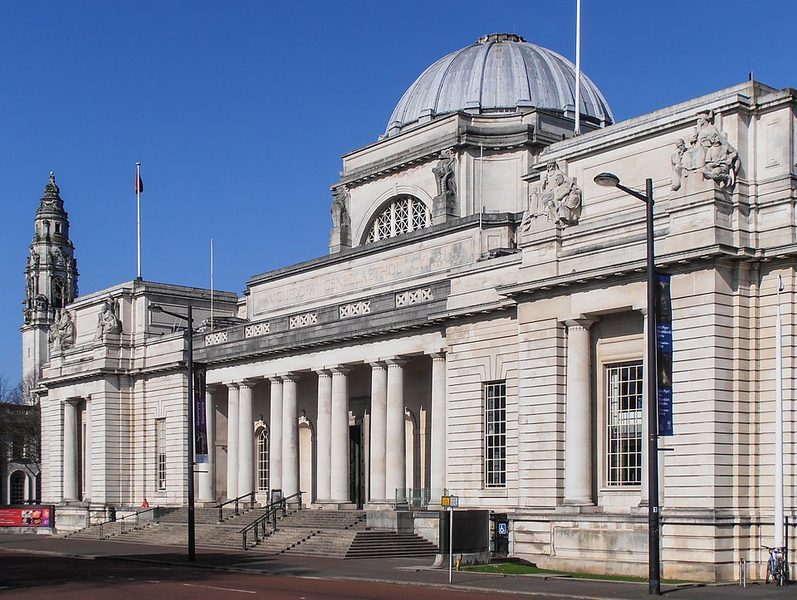
Cathays Park, a short walk north of the castle, holds the main cluster of civic and national institutions: the National Museum Cardiff, Cardiff City Hall and several government buildings. The National Museum holds collections spanning art, natural history and archaeology and is a national institution for Wales. Admission to the national collections is free.
Cardiff Bay
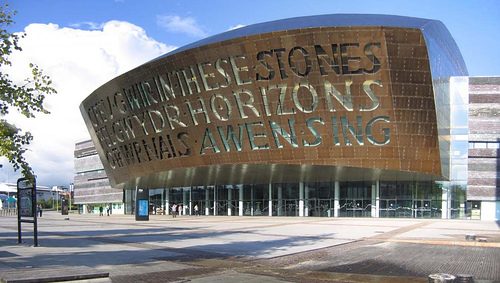
Cardiff Bay represents the most substantial piece of urban regeneration in Wales. The former Tiger Bay docklands — once the industrial engine of the coal export trade — were redeveloped from the 1980s onward into a mixed waterfront district. The central public space is Roald Dahl Plass, named after the Cardiff-born author who grew up in the nearby Llandaff district. The square is flanked by two major buildings: the Senedd, which houses the Welsh Parliament, and the Wales Millennium Centre, a large arts venue whose steel facade carries the inscription In these stones horizons sing in Welsh and English. The Norwegian Church, a nineteenth-century sailors' church on the waterfront that has been renovated and now hosts a gallery named the Dahl Gallery, adds another layer of connection to the author, whose family had Norwegian roots and whose father used the church.
The Senedd is the working home of the Welsh Parliament (Senedd Cymru) and is generally open to visitors when the Parliament is not in session; check current visiting arrangements on the Senedd's official website before travelling. The Wales Millennium Centre is open to visitors outside performance times.
Roald Dahl's Cardiff
Roald Dahl was born in Llandaff, now a district within Cardiff, in 1916. Cardiff has acknowledged this connection through a number of named and mapped locations: Roald Dahl Plass in Cardiff Bay, the Dahl Gallery at the Norwegian Church, and a mapped trail of locations across the city associated with his life and early years. The trail includes the site of his childhood home on Fairwater Road in Llandaff. For visitors with an interest in Dahl's work, Cardiff Bay offers a self-guided route that can be combined with a visit to the Senedd and Wales Millennium Centre.
Welsh Language and Identity
Welsh is an official language of Wales alongside English, and Cardiff — as the national capital — gives it visible expression. Bilingual signage is standard across the city. Welsh is heard in conversation, particularly in certain neighbourhoods and institutional settings, and major Welsh-language cultural events take place in and around the city. The Tafwyl festival, organised in part through Cardiff University's Welsh-language programme, is one of the regular events that brings Welsh-language music and culture into public spaces. The National Eisteddfod, Wales's principal Welsh-language cultural festival, visits different locations across Wales each year but has deep institutional ties to Cardiff. For visitors unfamiliar with Welsh, a few words of greeting are generally well received.
Economy and Institutions
Modern Cardiff's economy is based principally on financial and professional services, higher education, public administration and media. Admiral Group, the FTSE 100 insurance company whose brands include Confused.com, has its headquarters in the city. Cardiff University, founded in 1883 and now a leading research university, is a major civic institution that shapes the character of large parts of the city centre and the Cathays district to its north. The Welsh Government and the Senedd base their operations here. The city is part of the Cardiff Capital Region, a city-deal framework covering southeast Wales that channels long-term investment into infrastructure and economic development.
Getting There and Around
Cardiff is on the main rail line to London Paddington, with direct services operated by Great Western Railway; journey times from London are typically around two hours. Trains also connect Cardiff to Bristol, Swansea and other cities across England and Wales. Valley Lines services run north into the South Wales valleys. The M4 motorway provides road access from Bristol and London to the east and from Swansea and west Wales to the west. Cardiff Airport lies to the south-west of the city; check current airline routes and operators before travelling, as these change. Within the city, the centre is walkable. Cardiff Bay is served by local buses and the Cardiff Bay line from Cardiff Queen Street station. Visitors should confirm current timetables and fares with operators before travelling.
Practical Notes
Cardiff uses pound sterling (GBP) and operates on Greenwich Mean Time, shifting to British Summer Time in the warmer months, in line with the rest of the United Kingdom. The US State Department rates the United Kingdom at Level 1 (Exercise Normal Precautions), with no specific restrictions applying to Cardiff or to Wales. Standard urban awareness applies, as in any city of this size, but no elevated security concerns are associated with Cardiff specifically. The UK Foreign, Commonwealth and Development Office advises normal precautions for the United Kingdom. Visitors are advised to check current official guidance from the UK FCDO and the US State Department before travelling.
Roald Dahl and Cardiff
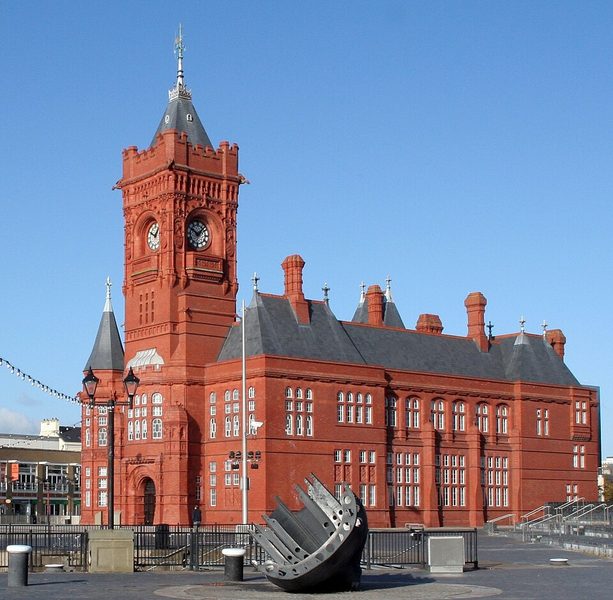
Roald Dahl was born in 1916 on Fairwater Road in Llandaff, Cardiff, to Norwegian parents who had settled in the city through the coal-export trade. He was christened at the Norwegian Church in Cardiff's docklands — a building established in 1868 by the Norwegian Seamen's Mission — which now operates as the Norwegian Church Arts Centre and contains a plaque and painting commemorating his christening. The Dahl Gallery upstairs hosts temporary art and photography exhibitions.
The large public square at the centre of Cardiff Bay is named Roald Dahl Plass, using the Norwegian word for plaza, and is framed by the Senedd and the Wales Millennium Centre. Cardiff City Council has documented a walking trail connecting ten Cardiff locations linked to Dahl, running from the bay through to Llandaff. Dahl attended the Cathedral School in Llandaff at the age of nine before leaving Wales for boarding school in England. The official Roald Dahl Museum is in Great Missenden, Buckinghamshire, but Cardiff holds the sites of his birth, christening and early education.
Read the full Roald Dahl and Cardiff guide
Sources: Roald Dahl Plass - Wikipedia • Roald Dahl and the Norwegian Church in Cardiff Bay - Visit Wales • Roald Dahl - Cardiff, Llandaff and Welsh connections - Visit Wales • Our History - Norwegian Church Cardiff • Roald Dahl Trail in Cardiff - Wales Online • Roald Dahl - the Cardiff Connection - BBC Wales History
Cardiff Castle and the Marquess of Bute
Cardiff Castle stands at the centre of the city, occupying a site with nearly 2,000 years of continuous occupation. It began as a Roman fort, accumulated Norman stonework, passed through centuries of aristocratic ownership, and was transformed in the nineteenth century into one of the most elaborate examples of Gothic Revival architecture in Britain — before being gifted to the city in the twentieth century. The result is a layered monument that rewards careful attention.
Sources: Cardiff Castle history - Cardiff Castle official site • Bute Park - official site • Cardiff Castle - Wikipedia • Work of William Burges at Cardiff Castle - Wikipedia • Cardiff Castle - Visit Cardiff • Cardiff Castle - Histories and Castles
Cardiff Bay Regeneration and Waterfront
Cardiff Bay's transformation from derelict docklands into a waterfront district containing the Welsh Parliament, a major arts centre and a large public square is one of the more consequential urban regeneration projects in British history. The scale was significant — and so was the disruption to the communities that had previously lived there.
From Tiger Bay to Derelict Docks
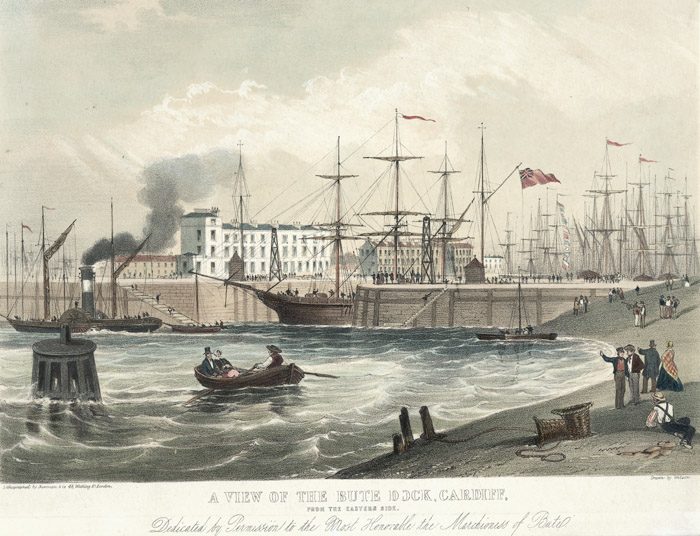
Cardiff's docks were the engine of the city's Victorian expansion. The South Wales coal trade made Cardiff one of the world's busiest coal-export ports by the early twentieth century, and the docklands neighbourhood — known as Tiger Bay — developed its own distinct identity as a maritime community with residents from numerous countries. Tiger Bay's name is said to derive from the currents of the natural harbour at the mouth of the River Taff. By the 1980s, with the coal trade long finished, the area had become, in the words of a BBC News report, 'an abandoned wasteland of derelict docks and mudflats'.
The Regeneration Project
Regeneration began in earnest from the late 1980s under the Cardiff Bay Development Corporation (CBDC), a body created with British government funding. The centrepiece was the construction of the Cardiff Bay Barrage, which Wales Best Guides describes as the biggest regeneration project in Europe at the time of its construction in 1988. The barrage held back the tidal waters of the Taff and Ely rivers, creating a 500-acre freshwater lake at the heart of the bay. The CBDC's stated mission, as set out by the then Secretary of State for Wales Nicholas Edwards, was to put Cardiff 'on the international map as a superlative maritime city'. Wales Online has documented both the successes of that project and its more contentious aspects, including the displacement of the existing Butetown community to make way for new development.
The Senedd and Wales Millennium Centre
The most prominent public buildings in the regenerated bay are the Senedd — the Welsh Parliament building — and the Wales Millennium Centre. Both face onto Roald Dahl Plass, the large public square at the heart of the waterfront. The Wales Millennium Centre is a major arts venue whose steel facade carries the inscription 'In these stones horizons sing' in English and Welsh. The Senedd, which houses the devolved Welsh legislature, is open to visitors on non-sitting days; visitors should check the Senedd's website for current public access arrangements. The Norwegian Church Arts Centre, with its connection to Roald Dahl, also stands in the bay area.
Visiting the Bay Today
Cardiff Bay is accessible from the city centre by train (Cardiff Bay station) or by the Bay Car bus service. Roald Dahl Plass is a freely accessible public space and serves as the natural orientation point for the area. The waterfront has restaurants, bars and open spaces along the impounded lake. Visitors should check current transport schedules and any changes to bay-area services locally before travelling.
Sources: Cardiff Bay - 30 years of development - BBC News • Roald Dahl Plass - Wikipedia • Wales Millennium Centre - Wikipedia • The history of Cardiff Bay regeneration - Wales Online • Cardiff Bay guided walk history - Wales Best Guides
Cardiff's Victorian Shopping Arcades
Cardiff has the most extensive collection of Victorian and Edwardian covered shopping arcades in Britain, a network of historic passages running through the city centre that predate the modern high street and remain in active daily use. Built between 1858 and 1921, they run between St Mary Street and the Hayes and give the city centre a distinctive walkable character unlike most British retail cores.
History and Origins
The oldest of the arcades, Royal Arcade, dates to 1858, making it Cardiff's oldest shopping arcade and, as the Royal Arcade's own records note, the city's first shopping centre. The network expanded through the Victorian and Edwardian periods as Cardiff grew rapidly on the back of the coal trade. Castle Arcade, which runs close to Cardiff Castle, is noted for its balcony providing split-level shopping and views of the Victorian architecture. Morgan Arcade was originally built by the department store magnate David Morgan to connect his store on St Mary Street to the broader shopping network. A small passageway links Royal Arcade with Morgan Arcade, making them part of what is now called the Morgan Quarter. Sources differ slightly on the exact number of arcades: wales.org cites seven historic arcades, while the Academy of Urbanism counts five Victorian arcades specifically (Castle Arcade, High Street and Duke Street Arcades, the Wyndham Arcade, the Morgan Arcade and the Royal Arcade).
What Is There Today
The arcades continue to operate as retail spaces, with a mix of independent shops, cafes, specialist retailers and food outlets. Visit Cardiff notes that Royal Arcade is home to Spillers Records, which claims to be the world's oldest record shop — a specific detail that gives the arcade a cultural footnote beyond its architecture. The arcades are not preserved museums but functioning commercial streets, which means their character shifts with trading conditions and retail trends. Independent and specialist businesses sit alongside more mainstream tenants.
Visiting the Arcades
The arcades run through the heart of the city centre and are accessible on foot from Cardiff Central station. They are generally open during standard retail hours, though individual shop hours vary; visitors should confirm current opening arrangements locally. The network's position between the main shopping streets means most visitors pass through at least one arcade without specifically seeking them out, but walking the full sequence between St Mary Street and the Hayes gives a clearer sense of the scale of the collection.
Sources: List of shopping arcades in Cardiff - Wikipedia • Cardiff arcades - Visit Cardiff • Royal Arcade - City of Arcades • Cardiff arcades visitor guide - wales.org • The Arcades Cardiff - Academy of Urbanism
Swn Festival and Cardiff Music Scene
Cardiff has a music culture that runs well beyond its major venues, and at its centre sits Sŵn Festival, an annual multi-venue event that has operated since 2007 as one of Wales's principal showcases for new and emerging music. The festival is grounded in the city's independent music infrastructure and has become a fixture in the wider UK festival calendar.
Sŵn Festival
Sŵn — the Welsh word for sound or noise — was established in 2007 by BBC Radio 1 DJ Huw Stephens and independent music event producer John Rostron. Cardiff Music City describes it as 'a cornerstone of Cardiff's cultural landscape since 2007', and the festival's own records confirm it has been running continuously since that year. It is a multi-venue event, spreading across numerous Cardiff music spaces for a weekend each autumn; the 2026 edition is listed on the festival's own website. The festival's format is deliberately city-wide rather than contained on a single site: Visit Wales describes the experience as 'wandering up and down Womanby Street', a street in the city centre that functions as the symbolic hub of Cardiff's independent music scene, 'bumping into people you haven't seen for ages, striking up conversations with friendly strangers'. Womanby Street, in particular, has developed a strong association with live music venues and has been subject to local debate about protecting its character as the city centre has developed around it.
Cardiff Music City
Sŵn operates within the broader Cardiff Music City framework, which Visit Wales also lists as offering a programme of local and international music. Cardiff Music City is the umbrella brand for Cardiff's music economy and cultural identity, and Sŵn is described as one of its flagship events. The festival has historically used a wide range of Cardiff venues, including Clwb Ifor Bach — a Welsh-language venue in the city centre that has been a cornerstone of Cardiff's independent scene — Chapter Arts Centre in Canton, and various pubs and smaller spaces.
Fringe and Programming
Beyond the main music programme, Sŵn has historically included fringe events such as industry mixers, cabaret, themed karaoke and other social events, according to Visit Wales. This gives it a community character distinct from larger commercial festivals. The festival focuses specifically on new and emerging artists rather than established headliners, which shapes both its programme and its audience.
Practical Notes
Sŵn Festival takes place in autumn; the 2026 edition is listed as 15-17 October on the festival's official website, though visitors should confirm current dates, ticketing and venue details at swnfest.com before travelling. The multi-venue format means the festival is navigated on foot through the city centre. Most venues are within walking distance of Cardiff Central and Cardiff Queen Street stations.
Sources: Swn Festival official site • Swn - Wikipedia • Swn Festival 2024 - Cardiff Music City • Swn Festival - Wales Online • Swn Festival - Visit Wales