Image: Wikipedia / Wikimedia Commons
Image: Wikipedia / Wikimedia Commons
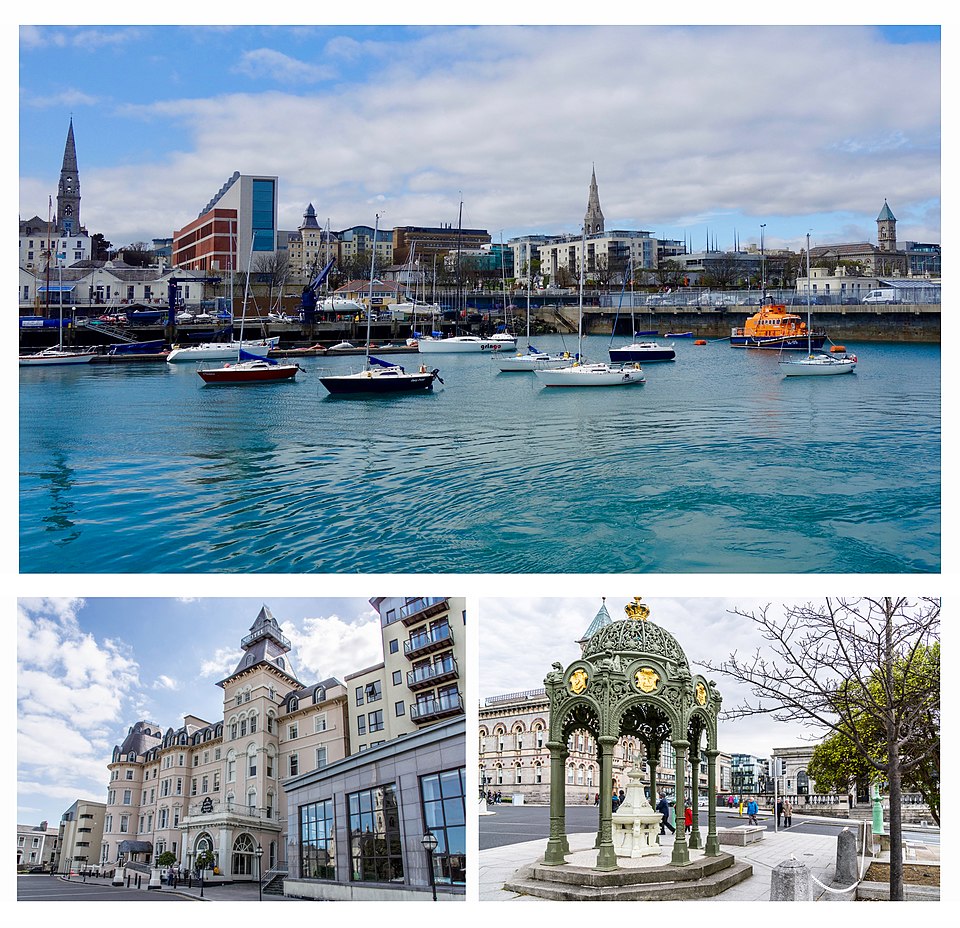
Dún Laoghaire is a vibrant coastal town on Dublin's southside that blends seaside charm with suburban convenience. Home to nearly 26,500 residents, this elegant harbour town serves as both a residential hub and a gateway to the Irish Sea, retaining a distinctive character shaped by its role as a working port and historic landmark. With its grand Victorian architecture, natural harbour setting, and strong maritime heritage, Dún Laoghaire offers visitors and residents alike a compelling mix of history, outdoor space, and urban amenities.
Situated at coordinates 53.29395 degrees North and 6.13586 degrees West, Dún Laoghaire occupies a commanding position on the Leinster coast. The town rises gently from sea level to an elevation of 16 metres above sea level, positioned on a headland that projects into Dublin Bay. This geography made it an ideal location for the ambitious harbour development that transformed the area in the nineteenth century. The town operates in the Europe/Dublin timezone and enjoys the Atlantic weather patterns typical of Ireland's east coast, with relatively mild temperatures year-round but frequent rainfall and changeable conditions.
The surrounding landscape is characterised by suburban residential developments interspersed with parkland and coastal access points. To the south lie the Wicklow Mountains, visible on clear days, while the bay extends northward towards Dublin city centre. The natural harbour and breakwaters create distinct waterfront environments—the inner harbour with its leisurely pace and the outer harbour where ferries operate.
The story of Dún Laoghaire is fundamentally tied to maritime ambition and imperial commemoration. In 1816, legislation enabled the construction of a major new harbour designed to serve Dublin's growing commercial needs and provide a strategic naval advantage. The town that grew around this ambitious project was initially known as Dunleary, its name derived from the Irish "Dún Leary"—the fort or stronghold of Leary. The settlement would undergo a significant identity shift in 1821 when King George IV visited Ireland. To mark this occasion and honour the monarch, the town was renamed Kingstown. This English-language designation remained official until Irish independence, when in 1920 the town reclaimed its original Irish identity and became Dún Laoghaire once more.
Beyond the harbour itself, the town became associated with a significant milestone in Irish transport history: it became the terminus of Ireland's first railway line. This connection to early rail infrastructure cemented Dún Laoghaire's importance to the wider Dublin area. Over the course of the twentieth century, the character of the town evolved from purely commercial and maritime functions toward a mix of residential living and tourism. The establishment of the borough of Dún Laoghaire reflected its growing administrative importance, a status formalised in 1994 when it became the centre of the larger administrative county of Dún Laoghaire–Rathdown.
The waterfront is undoubtedly the heart of Dún Laoghaire's appeal. The harbourside promenade offers accessible walks with views across the bay, with the Victorian-era breakwaters providing both practical function and distinctive character. Walking or cycling along these structures rewards visitors with changing perspectives of the coastline and distant vistas. The harbour itself remains active with commercial and leisure maritime activity, giving the waterfront an authentic working atmosphere rather than purely recreational polishing.
The town centre contains Victorian and Edwardian architecture that reflects its prosperous heritage, with period buildings providing visual character to streets and squares. Coastal parks provide greenspace for residents and visitors alike, with opportunities for casual recreation, picnicking, and observation of bay wildlife. The proximity to Wicklow Mountains makes Dún Laoghaire an accessible base for those interested in exploring further afield into more dramatic landscapes, while the town itself offers that rare combination: genuine seaside atmosphere within Dublin's suburban orbit.
Cultural life centres on the town's role as a creative hub within the broader Dublin metropolitan area. Various galleries, community spaces, and performance venues reflect the artistic interests of the resident population and draw visitors from across Dublin.
Dún Laoghaire benefits from excellent transport connections despite its seaside location. The DART (Dublin Area Rapid Transit) railway connects the town directly to Dublin city centre and other coastal destinations, with stations providing frequent service throughout the day. Bus services link Dún Laoghaire to Dublin and surrounding areas. For those arriving by car, the town is accessible via the N11/M11 corridor. Ferry services operate from the harbour, providing connections to Wales and other destinations. The compact town centre is readily navigable on foot, with the waterfront accessible via walking routes from residential areas.
For the people who live here, Dún Laoghaire represents a particular kind of Dublin existence—seaside proximity combined with urban accessibility. The population of 26,525 reflects a mix of long-established families, commuters, and retirees attracted by the coastal setting. The maritime heritage remains significant to local identity, though the economy has diversified considerably from its port-dependent past. The ferry services continue to provide employment and maintain the town's international connectivity, while retail, service industries, and creative sectors have become increasingly important. The town functions as the administrative centre for Dún Laoghaire–Rathdown, reinforcing its significance within the wider Dublin structure.
Dún Laoghaire has a population of approximately 26,525 residents. The town sits at an elevation of 16 metres above sea level and operates on Europe/Dublin timezone (Irish Standard Time in winter, Irish Standard Time or Irish Summer Time depending on the season). The town centre is compact and welcoming to visitors, with clear signage and helpful information available from local services.
View larger map — © OpenStreetMap contributors
Flight delayed or cancelled?
You could be owed up to €600 compensation. Check your eligibility for free.Local tips, hotel recommendations, business listings or photos — help make this guide better.