


Official Travel Advisory and Current Safety Context
The United States State Department advises Level 4: Do Not Travel to Afghanistan. The UK Foreign, Commonwealth and Development Office advises against all travel to Afghanistan with no regional exceptions. These advisories apply to Kabul, the capital and largest city of Afghanistan.
Official sources cite volatile security conditions, ongoing armed clashes particularly in border regions, heightened risk of terrorism and kidnapping, and the presence of armed militant groups as reasons for these restrictions. The UK advisory notes a specific heightened risk of British nationals being detained for months or years. Border crossings remain unstable, and travel throughout the country is assessed as extremely dangerous. Potential travellers should consult current official advisories before any consideration of travel and should expect that consular assistance may be extremely limited.
Recent Conflict and Risk Background
Afghanistan has experienced sustained conflict for decades. The Taliban, which ruled the country from 1996 to 2001, returned to control of Kabul and the broader country in 2021. Since their return, security conditions have remained volatile. Official sources report ongoing tensions and armed clashes between Afghanistan and Pakistan, particularly in border regions, contributing to the dangerous conditions that inform travel restrictions.
The security environment involves multiple armed groups and the risk of sudden violence. These conditions affect the entire country, including Kabul itself. Visitors should be aware that official advisories reflect assessments that the security situation remains fundamentally unstable.
Historical Context
Kabul's history spans over three and a half millennia as a significant settlement. The city's strategic position at a crossroads of major trade routes between India, Iran, and Central Asia made it a centre of political and economic power across successive periods. The Persian Empire, Alexander the Great, Arab and Turkic conquests, Mongol invasions, and later the British and Soviet empires all influenced the city's development.
In the nineteenth century, Kabul was the focal point of the First Anglo-Afghan War (1838–1842), when British forces occupied the city. The conflict resulted in the near-complete destruction of the British-Indian force during its retreat from Kabul in 1842, marking a significant historical turning point in Central Asian geopolitics.
During the twentieth century, Kabul developed as Afghanistan's undisputed capital and centre of government, commerce, and culture. The city experienced significant growth and modernization in periods of relative stability, but has also endured extensive damage from conflict, particularly during the Soviet occupation (1979–1989) and the civil wars of the 1990s. The Taliban's first period of rule (1996–2001) and subsequent conflict with international forces shaped the city's infrastructure and social conditions. Following the fall of the Taliban in 2001, reconstruction efforts and foreign aid supported some economic and infrastructural recovery, though progress has been uneven and interrupted by ongoing instability.
Geography and Settlement Setting
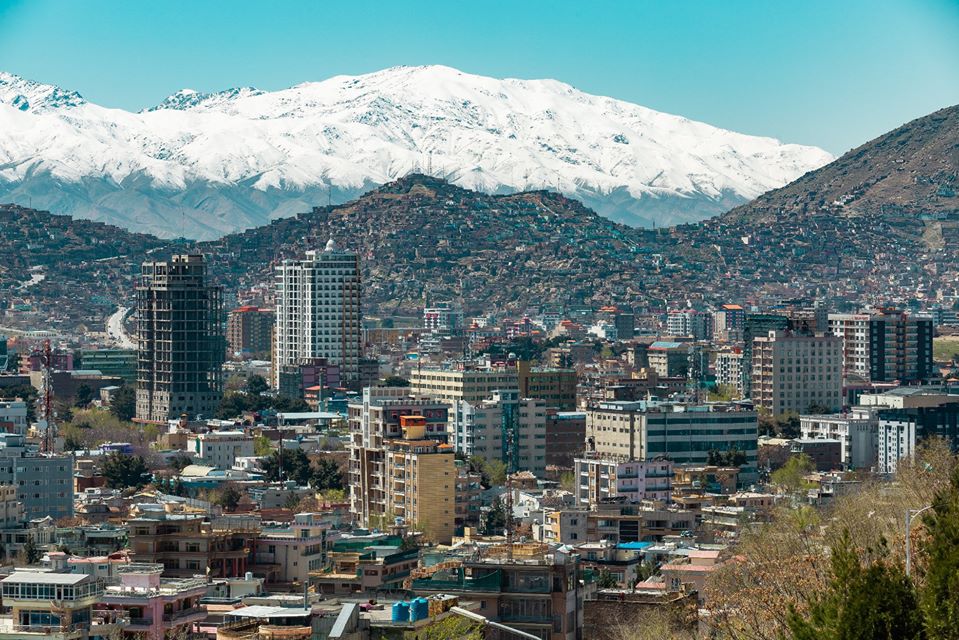
Kabul sits in a narrow mountain valley within the Hindu Kush range at an elevation of approximately 1,790 metres above sea level, making it one of the world's highest capital cities. The city is bounded by the Kabul River and lies surrounded by steep mountain slopes that define its geography and climate. This highland setting produces cold winters and hot summers.
The city's geographic position has long made it a point of control over vital mountain passes connecting northern and southern Afghanistan and the approaches to the Khyber Pass. This strategic importance has been central to the city's role throughout its history.
Administratively, Kabul is divided into 22 municipal districts across five zones. The city's estimated metropolitan population is in the millions, making it the country's primate city. The oldest neighbourhoods, including Bala Hisar, Deh Afghanan, and Murad Khani, form the historic centre. The native population predominantly speaks Persian, locally referred to as Dari, with a distinctive Kabuli accent.
Daily Life and Local Context
Kabul is home to diverse ethnic groups, including Pashtuns, Tajiks, and Hazaras, with Islam as the predominant religion. The city has served as Afghanistan's cultural and intellectual centre, and the Afghanistan National Museum houses a comprehensive collection of Central Asian historical artefacts spanning prehistoric times, including the Bagram Collection of over 1,800 pieces from Rome, Greece, Egypt, India, and Central Asia.
Employment and economic conditions in Kabul reflect the wider instability affecting the country. Unemployment remains high, and wealth disparities have been exacerbated by prolonged conflict. Reconstruction initiatives and foreign aid have supported development projects, though progress remains fragile. Social conditions have been significantly affected by policy changes since the Taliban's return to power in 2021, including restrictions on women and girls that affect daily life and the accessibility of institutions.
Many of Kabul's historical landmarks have suffered damage or neglect as a result of conflict, and their current condition and accessibility should not be assumed.
Practical Notes
Current official travel advisories should be consulted before any consideration of travel. The UK FCDO and US State Department websites provide detailed, regularly updated guidance. Consular services may be severely limited or unavailable. Travellers should verify all current conditions, border crossing status, and security assessments through official government sources, as the situation remains subject to rapid change.