In This Guide
Setting and First Impressions
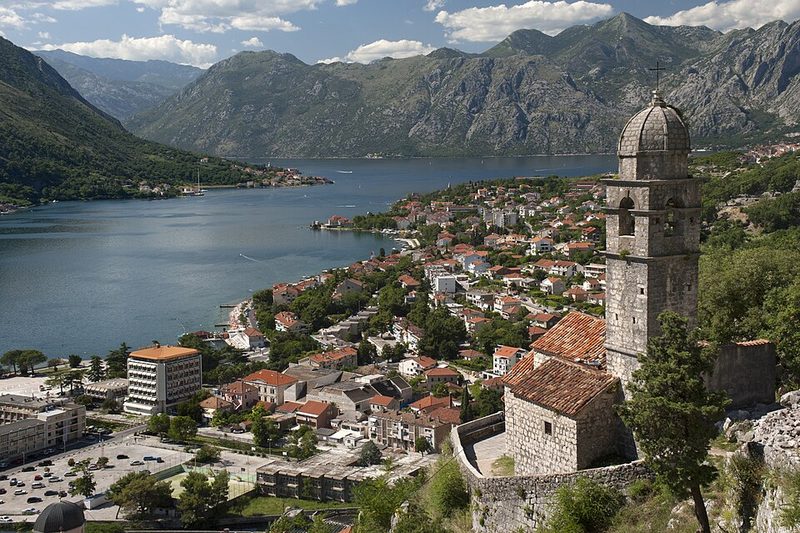
The physical framing of Kotor is immediate and hard to miss. Limestone fortification walls rise directly from the waterfront and continue almost vertically up the grey-green flanks of the mountains behind the town. Boka Kotorska (the Bay of Kotor) is a deep, enclosed inlet — almost fjord-like in character — and Kotor sits at one of its most sheltered reaches. Ridges and peaks including Ðerinski Vrh, Volujak and Goražda close in on three sides, giving the town a framed, encircled quality that is apparent at most hours of the day. The nearby inlets of Uvala Mala Rijeka and Uvala Velika Rijeka indent the coastline to the south, adding to the calm-water character of the wider bay.
Small communities such as Škaljari, Muo and the villages dotted along the water add texture to what is, at its core, a compact and historically layered small town. The old town itself is walkable in an hour or two, though the walls and hillside climbs require reasonable footwear and some physical readiness. Arriving in peak summer, visitors should expect meaningful crowds in the old town streets — the narrow lanes concentrate foot traffic quickly. Off-season visits, particularly in winter, offer a quieter pace and occasionally cold or wet conditions, though the old town retains its architectural interest year-round.
History and Identity
Historically known as Cattaro, Kotor carries centuries of Venetian, Byzantine and Slavic influence. The old town forms part of the UNESCO-listed Natural and Culturo-Historical Region of Kotor, recognised for its medieval urban fabric and the way it integrates natural topography with human construction. The town operated as a self-governing republic for a significant period of its history — a fact that historians and locals return to when explaining the independent character of the place, and one that distinguishes Kotor from straightforwardly Venetian or Ottoman coastal settlements. The 1301 Statute of Kotor is the concrete legal marker behind that civic identity: one of the medieval municipal-code traditions that shows Kotor functioning as a city with its own written institutions rather than only as a scenic harbour.
That civic identity is most tangible in the old town squares and their civic buildings. The main square just inside the Sea Gate is still where much of the town's public life concentrates.
Clock Tower
Kotor's Clock Tower stands in the Square of Arms immediately inside the Sea Gate and is one of the old town's most useful orientation points. Sources consistently date it to the early seventeenth century, when the town was under Venetian rule. Its fame is not only architectural: it marks the civic centre of Kotor, the space where arrivals through the sea-facing gate, cafe life, processions and everyday meetings all converge. For visitors, it is the simplest place to understand how the walled town still works as a living public space rather than only as a preserved monument.
Saint Tryphon Cathedral
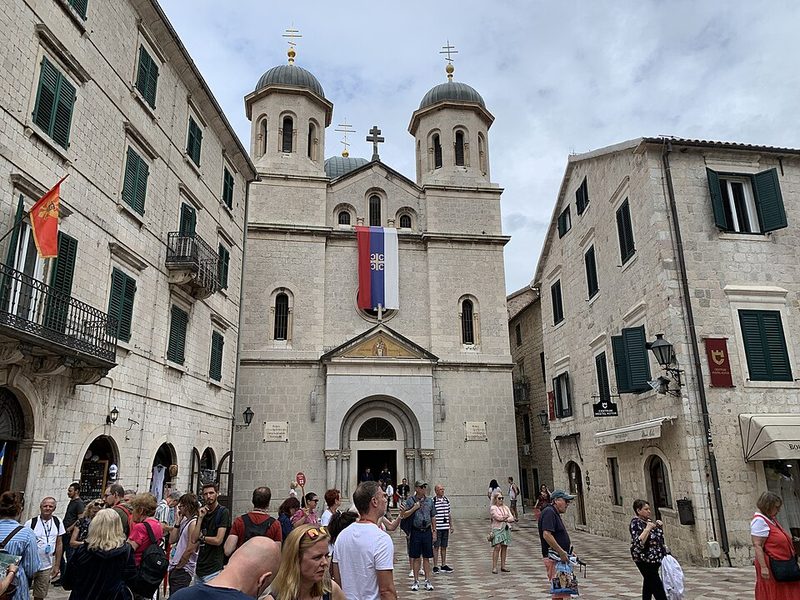
The Cathedral of Saint Tryphon is Kotor's defining religious and architectural landmark. Dedicated to the town's patron saint, it is one of the oldest Catholic cathedrals on this part of the Adriatic and sits at the heart of the old town. Its twin Romanesque bell towers are the most recognisable silhouette in Kotor. According to the Kotor Cathedral Wikipedia entry and the Visit Montenegro authority pages, the cathedral holds relics of Saint Tryphon and contains notable artistic and ecclesiastical treasures, including frescoes and a pre-Romanesque ciborium. The structure has been damaged and rebuilt over centuries — most significantly following earthquakes, including the 1667 and 1979 events — giving the building its layered architectural character. The 15 April 1979 Montenegro earthquake also explains why Kotor entered UNESCO history so urgently: the Natural and Culturo-Historical Region of Kotor was inscribed in 1979 and also placed on the World Heritage in Danger list, turning recognition into a conservation rescue rather than a routine heritage badge. Alongside the cathedral, the Church of Saint Nicholas represents the town's Orthodox tradition; the two churches stand as evidence of Kotor's long history of coexisting religious communities.
Festivals, Music and Evening Life
Kotor has a cultural calendar that visitors should factor into when they travel. The Kotor Winter Carnival in February fills the old town's narrow streets with Venetian-style masks and costumes; according to adriacom.me, this is one of the most distinctive events of the local year. The feast of Saint Tryphon on 3 February is a significant occasion in its own right, honouring the town's patron saint with ceremonies that reflect the town's Catholic and civic identity. Further along the summer calendar, the Kotor Art Festival brings performances and exhibitions to historic venues within the old town.
For a town of its size, Kotor's evening scene is broader than many visitors expect. The old town contains bars ranging from casual local spots to rooftop venues with bay views. The Visit Montenegro site lists nightclubs alongside jazz bars and more intimate spaces, and several sources note that the scene concentrates inside and immediately around the old town walls. Visitors looking for quieter evenings should note that the busiest periods are summer weekends when cruise ship and day-tripper numbers amplify the usual crowd.
What to See and Do
Kotor's cats are part of the old town's public memory as much as its postcard life. Visitors notice them in squares, shopfronts and souvenir displays, and the small Cats Museum / Museo del Gatto di Cattaro reflects how strongly the town has adopted the animal as an unofficial symbol. The exact origin stories are best treated as local tradition rather than hard history, but the cats are too visible and too searched-for to omit from a practical guide.
Walking is one of the most rewarding ways to understand Kotor. The old town walls can be climbed, and the ascent to the fortress of Saint John provides a viewpoint that places the bay and its surrounding mountains into sudden, clarifying perspective. The hills of Volujak, Goražda and the ridgeline of Praćište rising close behind the town give more ambitious walkers options that extend beyond the walls, though these routes should be confirmed locally for current access and conditions.
On the water, boat trips on the bay are a natural activity from the waterfront, and the sheltered inlet supports watersports. Visitors should confirm current operators and seasonal availability on arrival rather than relying on advance assumptions. A car or vehicle ferry operates within the bay — sources identify this as a car ferry crossing rather than a passenger boat tour — and can be a practical option for onward movement around the bay's perimeter without retracing the road route.
The Kotor Maritime Museum reflects the town's long seafaring tradition and the communities that built their identity around the bay. The nearby village of Perast, accessible along the bay road, is frequently mentioned alongside Kotor and has its own small museum drawing visitors interested in the maritime history of the wider region. Perast also gives the bay one of its strongest legends: Our Lady of the Rocks, or Gospa od Skrpjela, the artificial island where local tradition says sailors began dropping stones after finding an icon on a reef in 1452. The Fašinada custom on 22 July still sends boats out with stones, so this is not just a pretty excursion but a living bay ritual. Current visitor information for both museums is best checked through muzejikotor.me or locally on arrival, as hours and access can vary by season.
The Historical Archives of Kotor, noted in several visitor sources, offers access to documentary heritage for those with a particular interest in the town's civic and administrative history.
Lovćen National Park
Lovćen National Park is the strongest mountain day-trip context for Kotor. The park rises above the Bay of Kotor and contains the Njegoš Mausoleum on Jezerski Vrh, the memorial to Petar II Petrović-Njegoš, the Montenegrin prince-bishop and poet whose reputation is central to Montenegro's national story. That gives the excursion a different weight from a simple viewpoint drive: the route links Kotor's Venetian-Adriatic old town with the mountain landscape and political memory of inland Montenegro. Travellers should check current road conditions and opening arrangements before setting out, especially outside summer or after poor weather.
Getting There and Around
Kotor does not have its own airport. Tivat Airport (TIV) is the nearest gateway, close to the bay and offering seasonal and year-round international connections; sources identify airlines including Scandinavian Airlines and Iberia as route operators, though exact routes and schedules should be verified with the airport or airlines directly before booking. Podgorica Airport (TGD) is the other main option, about 85 km inland by road from Kotor. Dubrovnik Airport (DBV) across the Croatian border — around 20 km from the Montenegrin frontier — is a further alternative used by visitors approaching from the north.
A ferry connection also links Kotor with Dubrovnik; sources identify Adriatic Lines as an operator on this route, with the crossing arriving near the old town. Journey time is approximately three hours. Additional seasonal ferry options from Croatia (including from Hvar via TP Line/Krilo-Kapetan Luka) are noted in route evidence, though visitors should check current operating schedules and ticket availability before travel.
Road access follows the coastal route around the bay. Bus connections link Kotor with other Montenegrin coastal settlements, and the Blue Line d.o.o operator is noted as serving local routes. For current timetables, autobuskastanicakotor.me and zcg-prevoz.me are the locally relevant transport authority domains. A short car or vehicle ferry crossing within the bay can save around 30 km of driving compared with the full road circuit, according to montenegro.org's ferry guide.
Visitors should note that protests in the municipality of Zeta have at times disrupted access to Podgorica Airport. Both the UK and US governments currently maintain their lowest travel advisory levels for Montenegro, recommending normal precautions. Travellers using Podgorica Airport should monitor local media and allow extra time. Official guidance is available from the UK FCDO at gov.uk and the US State Department at travel.state.gov.
Practical Notes
The bay's enclosed geography means Kotor can be significantly warmer and more humid in summer than exposed coastal spots — a real factor when climbing the walls or the hillside in July or August. The old town streets are narrow enough that summer crowds feel pressing. Winter brings cooler, occasionally cold conditions; sources note snow and ice as seasonal factors, which can affect walking conditions on the wall climb and hillside routes. Off-season visits typically feel noticeably quieter, and some seasonal businesses operate reduced hours or close entirely outside the main tourist period.
Information on current opening arrangements for the cathedral, museums and wall access is best checked through kotor.me, muzejikotor.me, or locally on arrival.