

When 17 million people decide to build a city on islands, lagoons and a narrow ribbon of mainland at the edge of the Gulf of Guinea, the result is less a conventional metropolis and more a sprawling, electric argument between water and ambition. Lagos doesn't announce itself quietly. It arrives as noise, motion, economic velocity and the kind of cultural weight that shapes how millions of Africans think about music, film, fashion and possibility itself. This is Nigeria's former capital, its eternal financial engine, and one of the world's fastest-growing cities—a place where fishing villages and oil terminals, gleaming tech districts and centuries-old neighbourhoods exist not in sequence but simultaneously.
**First Impressions and Setting**
Lagos hits you with its geography before anything else. The city fragments across islands and peninsulas separated by lagoons, creeks and the open sea, connected by bridges, ferries and roads that often flood during heavy rains. The landscape is humid and tropical, dense with water and sky. Arriving by air, you notice the sprawl first—not orderly, but reaching, layered, organic. The water is everywhere: beneath elevated highways, threading between compounds, defining districts by accessibility and isolation.
The city proper sits low, just eleven metres above sea level, which shapes how it grows upward and sideways simultaneously. Some neighbourhoods feel almost vertical with their tower blocks and compressed energy; others spread horizontally across reclaimed land and older residential areas. The dominant impression for most visitors is movement—people, vehicles, boats, construction, commerce—all negotiating the same constrained space with remarkable density and negotiated chaos.
**History, Identity and Local Stories**
Lagos was not built as a capital. It evolved from a fishing village into a slave-trading port, then a British colonial station, then something far larger than colonial planners ever imagined. The modern city's structure was formally established in 1967 when Lagos State was created, bringing previously separate administrative areas under unified governance. A year later, Lagos was designated Nigeria's federal capital—a role it held until 1976, when the capital shifted to Abuja in the country's centre. That decision did not diminish Lagos; if anything, it freed the city to become purely, fully economic rather than political.
The post-independence waves of migration that shaped Lagos included descendants of formerly enslaved people from the diaspora returning to West Africa, alongside expatriate communities drawn by opportunity. The city hosted the 1977 FESTAC festival, a massive Pan-African arts celebration, and over time accumulated over 250 ethnic groups speaking hundreds of languages. This isn't diversity in the abstract; it's lived daily in markets, churches, mosques, restaurants and the simple fact that you're as likely to hear English, Yoruba, Igbo, Hausa and hybrid languages all in the space of a commercial block.
**Daily Life, Economy and Culture**
Lagos is Nigeria's economic heartbeat. It houses major financial institutions, multinational corporations, oil refining operations, pharmaceutical manufacturers, automotive plants and a booming film industry that has earned global recognition. The Nollywood sector in particular has become a defining cultural export, with Lagos as its epicentre. Beyond these formal sectors, Lagos thrives on trade, small business, food processing, timber and construction—the visible economy of street traders, markets, workshops and the informal sector that sustains millions.
The city's cultural life is correspondingly intense. Live music venues, art galleries, museums and performance spaces exist across multiple districts. The National Arts Theatre represents the architectural and cultural ambition of the post-independence period. Food culture reflects the city's multiplicity—you'll find Yoruba, Igbo, Northern Nigerian and diaspora cuisines alongside newer fusion approaches. Beaches offer a social release valve, though they also function as working waterfronts where fishing communities maintain older livelihoods alongside modern tourism.
**What Visitors Notice**
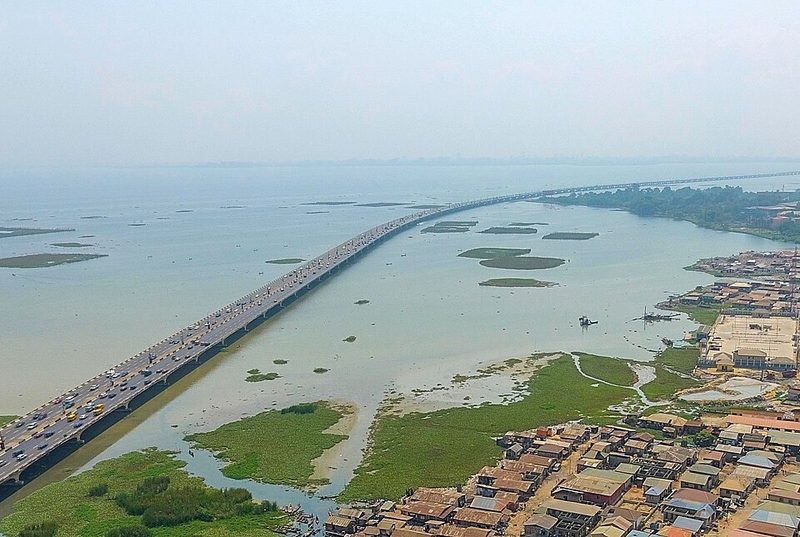
The Third Mainland Bridge, stretching three kilometres across lagoon water, is both functional infrastructure and iconic symbol of Lagos's ambition. From it, the city's scale becomes apparent in a way that ground-level movement cannot convey. Beaches like Lekki and Ikoyi attract swimmers and surfers alongside local families. The urban landscape mixes gleaming office towers, colonial-era administrative buildings, sprawling residential compounds, and dense informal markets where goods from across Nigeria and beyond flow through narrow lanes.
Transport defines how you experience the city. Minibus networks (danfo buses) move enormous numbers of people on fixed routes through congested streets. Taxis and ride-hailing services offer alternatives for those who can afford them. The lagoon remains a living transport corridor—ferries and water taxis serve neighbourhoods and offer crossings that sometimes move faster than road traffic. Tricycle taxis (serving shorter journeys) proliferate in certain areas. Walking any distance involves negotiating crowded pavements, construction sites and the simple intensity of density.
**Recent History and Local Context**
Lagos faced the 2014 Ebola outbreak with immediate proximity to affected regions in West Africa. Despite the danger, the city's response and distance from the epidemic's epicentre meant it avoided the catastrophic outbreak experienced elsewhere in the region. More recently, rapid urban growth has created significant challenges: infrastructure struggles with expansion, pollution affects water and air quality, and informal settlements exist alongside wealthy neighbourhoods. Ongoing urban regeneration and infrastructure projects reflect attempts to manage growth—new transit systems, waterfront developments and commercial expansion continue.
**Getting There and Around**
International flights arrive at Murtala Muhammed International Airport, located on the mainland with road access across bridges to island districts. Water transport remains culturally and practically important; ferry terminals operate across the lagoon connecting major hubs. Road networks include the Lagos-Ibadan Expressway heading inland and multiple bridges connecting island areas. Within the city, transport is primarily road-based: minibus danfo services dominate mass transit, taxis and ride-hailing apps serve shorter-distance needs, and tricycles handle neighbourhood journeys. Ferry crossings offer both transport and a distinct way of experiencing the city's water-centred geography.
**Practical Notes**
Lagos operates on West African Time, shared across the region. The climate is tropical and humid year-round, with a rainy season that peaks mid-year. Infrastructure improvements continue, though traffic congestion remains significant. Before travelling, consult current travel advisories; while Lagos itself is not listed in UK or US restricted zones, Nigeria as a nation does carry heightened security warnings for certain northern and interior regions. Official sources should be consulted for current conditions.