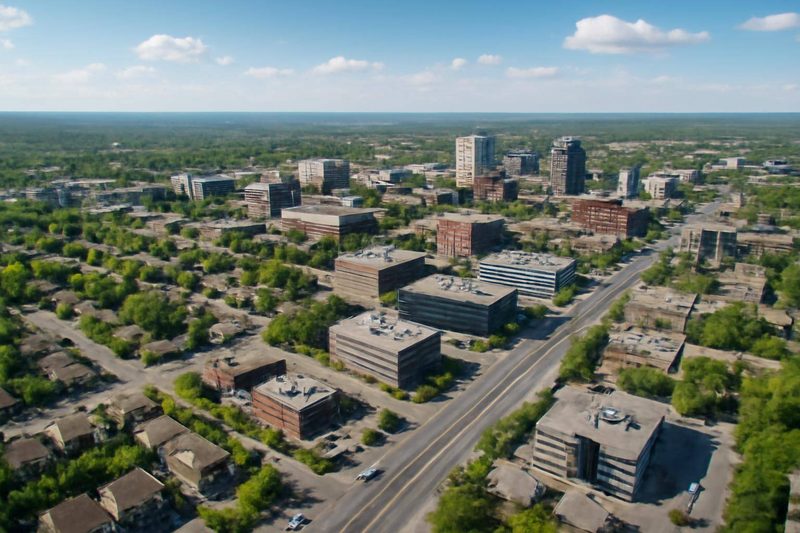
Laval sits just north of Montreal, separated from the island city by the Rivière des Prairies, and for anyone arriving by bridge from the south, the transition feels almost seamless — a sprawling, confident suburban city that has long since outgrown the label of bedroom community.
First Impressions and Setting
What strikes most arrivals is the sheer scale of the place. Laval occupies an island of its own — Île Jésus — entirely surrounded by water, with the Rivière des Prairies to the south and the Rivière des Mille Îles to the north. The land is flat and low-lying, the kind of terrain that makes distant skylines visible from a long way off. The cityscape is predominantly low- to mid-rise, built out rather than up, with wide commercial boulevards, residential neighbourhoods that blend seamlessly into one another, and pockets of greenery along the riverbanks. Winters are cold and serious. Summers are warm and genuinely pleasant.
History, Identity and Local Stories
Laval as a unified city is relatively young — it was created in 1965 through the merger of fourteen separate municipalities on Île Jésus, a consolidation that was controversial at the time but ultimately gave the island a single administrative identity. Before that, the territory had been inhabited and settled for centuries, with a history rooted in French colonial agriculture along the St. Lawrence lowlands. The city takes its name from François de Laval, the first Roman Catholic bishop of Quebec, whose influence over New France was considerable. That layered past — Indigenous presence, French settlement, centuries of agricultural life, then rapid twentieth-century suburbanisation — gives Laval an identity that is neither purely historic nor purely modern, but something still working itself out.
Daily Life, Economy and Culture
Laval is, above all, a place where people live. It is the third-largest city in Quebec by population, after Montreal and Quebec City, and the scale of its everyday life reflects that: shopping centres, schools, healthcare facilities, and community infrastructure serve a large and diverse population. The city has attracted significant immigration in recent decades and today has substantial communities with roots across the world, particularly from South Asia, the Middle East, and North Africa. French is the official language and dominates public and commercial life, though you will hear many languages spoken depending on where you go.
The local economy is closely linked to Montreal but Laval has developed its own commercial and industrial base. The public transit system, operated by the Société de transport de Laval, connects residents across the island and into Montreal via the regional metro network, which was extended to serve Laval in the 2000s — a development that significantly changed how residents commute and travel.
What Visitors Notice
Visitors coming from Montreal often remark on how quickly the built environment shifts once you cross the river — more space, more parking, more of a sense that the car remains central to daily movement, though this has been changing incrementally with transit investment. The riverbanks of the Rivière des Prairies and the Rivière des Mille Îles offer green corridors and some access to waterfront landscapes that can feel surprisingly quiet given the urban density nearby. The island's relatively flat topography means cycling is physically easy, though infrastructure varies. Commercial strips along major arteries hold the standard mix of large retailers, restaurants, and services that reflect a prosperous suburban city. Neighbourhood feel changes considerably depending on which part of the island you are in.
Getting There and Around
Laval is connected to Montreal by several bridges and by the Montreal Metro, specifically the Orange Line, which serves stations in the southern part of the city. This makes car-free travel between central Montreal and Laval genuinely practical for many journeys. The Société de transport de Laval operates a bus network across the island, with routes designed to connect neighbourhoods to metro stations and commercial centres. For those arriving by car, Laval is accessible via major highways that cross the island as part of the broader Montreal regional road network. Montreal-Trudeau International Airport is the nearest major airport, located in Montreal to the southwest; visitors should check current transport links and travel times, as these vary significantly by route and time of day.
Practical Notes
Laval operates on Eastern Time, which it shares with Montreal and the broader Quebec region. The city is French-speaking by law and culture, and while many residents in diverse neighbourhoods may speak English or other languages, engaging in French — or at least attempting to — is appreciated and often makes daily interactions easier. Healthcare, education, and municipal services are all provided within the city. Visitors planning travel during June and July 2026 should be aware that Canada is co-hosting the FIFA World Cup that year, which may affect accommodation availability and transport capacity across the Greater Montreal region; checking official sources and booking well in advance is advisable. Both the US State Department and the UK Foreign Office currently advise normal precautions for travel to Canada, with no specific concerns raised for Laval or the Montreal region.
Travel advisories for Canada are at their standard baseline level. For the most current advice, consult the US State Department at travel.state.gov or the UK FCDO at gov.uk/foreign-travel-advice/canada.
Information on Laval's local neighbourhoods, cultural venues, markets, and community events is limited in the sources available for this guide. If you live in or know Laval well, contributions from people with direct local knowledge would make this article significantly more useful for others. Practical details that change quickly — transit fares, local services, specific venue hours — should always be verified locally before your visit.
Frequently Asked Questions
What is the population of Laval, Quebec?
Laval had a population of approximately 438,366 at the time of the most recent verified data, with census figures from 2021 recording 443,192 residents.
What timezone is Laval in?
Laval is in the America/Toronto timezone, also known as Eastern Time (ET).
How high above sea level is Laval?
Laval sits at approximately 34 metres above sea level.
Where exactly is Laval located?
Laval is at approximately 45.57 degrees north, 73.69 degrees west, on Île Jésus north of Montreal in southwest Quebec, Canada.