

What Taichung is known for
Taiwan's second-largest city sits on the western coastal plain, surrounded by mountains that rise close enough to shape the skyline. More than 2.86 million people live here, making Taichung the population centre of central Taiwan and the core of the island's second-largest metropolitan area. This is a working city first—manufacturing hubs produce bicycles, machinery, aerospace components, and tools that supply global markets—but one that has made deliberate room for parks, cultural venues, and the daily rhythms that make urban life liveable.
What Kind of Place This Is
Taichung functions as Taiwan's industrial heartland with less of the tourist overlay found in Taipei. The 2010 merger of Taichung City with the surrounding Taichung County doubled the municipality's footprint to approximately 163 square kilometres and brought rural townships under the same administration as dense urban districts. The result is a genuinely mixed landscape: high-rise residential blocks near older shophouse streets, express highways crossing beside agricultural plots, and industrial zones within sight of green belts and temple complexes.
The city's character emerges from this combination of economic purpose and managed green space. Major industrial clusters—tool machines, photoelectronics, bicycles, woodworking machinery, aerospace—provide employment and regional economic weight. National Chung Hsing University adds an academic presence and brings international students into the city mix. The harbour and surrounding agricultural areas supply fresh produce and seafood to daily markets, creating practical links between port, countryside, and urban core.
Arrival and Geography
The Taichung HSR station in Wuri District serves as the main high-speed rail connection to the rest of Taiwan. Taiwan High Speed Rail trains link the city to Taipei and other major destinations, whilst the Green Line of the Taichung MRT connects the HSR station to Xinwuri station on the conventional Taiwan Railway network. These rail connections integrate Taichung into the island's transport infrastructure and make arrival straightforward.
The coastal plain setting gives the city a more open feel than Taipei's basin geography. Mountains are visible on clear days, and the proximity to both highlands and coast means day trip options extend to natural features as well as urban destinations. The city sprawls rather than compresses, with motorcycles far outnumbering cars and traffic flowing on wider roads than in the capital.
History and Identity
Taichung's rapid modern growth accelerated through the late twentieth century. By 1984, it had already become Taiwan's third-largest city with a population approaching 630,000. The 2010 administrative merger that created Greater Taichung marked the most significant recent change, transforming the municipality into Taiwan's second-largest special municipality by instantly incorporating surrounding county areas. That expansion still shapes the city's identity—genuinely mixed rather than purely metropolitan, with rural townships sharing governance with dense urban districts.
Local sources describe the city as rich in traditional Chinese arts and crafts, though specific craft traditions are not widely documented in English-language materials. The city's tourism slogan, "Humanity Beauty", reflects an official intention to balance industrial identity with cultural and human-centred development.
What Visitors Find
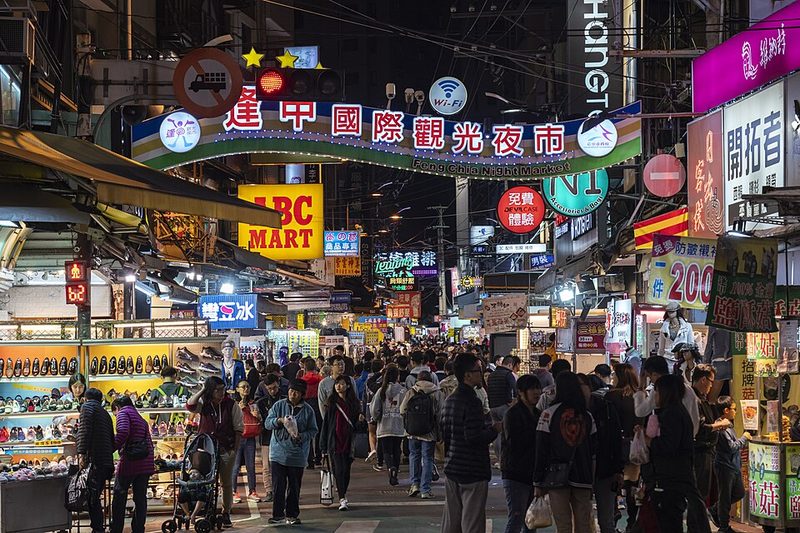
Taichung draws visitors with a combination of accessible parks, night markets, cultural venues, and proximity to natural features rather than a single iconic attraction. Chungshan Park offers boating and green space within the city. The ChungCheng Pagoda functions as a recognisable landmark. Night markets follow the standard Taiwanese pattern—concentrated food stalls, clothing vendors, and games operating in the evening hours. The National Taichung Theater, a modern architectural project, hosts performances and exhibitions. Rainbow Village, a small compound decorated with colourful murals by a former soldier, appears frequently in visitor itineraries despite its small scale and distance from the city centre.
The city tourism bureau organises visitor information into categories for families, seniors, couples, cyclists, hikers, and those interested in sustainable tourism, suggesting that variety matters more than any single destination. The surrounding geography offers practical day trip options: Sun Moon Lake lies to the southeast in Nantou County, Gaomei Wetlands stretch along the coast to the west, and mountain routes lead into the highlands.
Practical Character
Taichung's size and industrial base mean it functions as a working city first and tourist destination second. This can be an advantage for independent travellers: the city is less crowded than Taipei, more affordable, and offers a representative view of everyday Taiwan without the filtering that happens in tourism-focused destinations. The scale of the city means different districts require different transport strategies—bus services cover most areas, but timetables and route details are best checked locally with the Taichung City Government Tourism Bureau or at transport hubs upon arrival.
Safety and Advisories
Taiwan, including Taichung, remains at the lowest official travel advisory levels. The UK Foreign, Commonwealth and Development Office maintains "Normal Precautions" guidance for Taiwan, whilst the US State Department designates the island as Level 1: Exercise Normal Precautions. No current travel restrictions apply to Taichung specifically. The primary concern cited in official advisories is natural disaster risk—earthquakes, typhoons, and seasonal flooding—hazards inherent to Taiwan's geography rather than security or political instability. Visitors should check current official guidance before travel.
Orientation
The city's sprawl can make orientation challenging for first-time visitors. The HSR station in Wuri District sits south of the main urban core, and the MRT Green Line provides the most direct connection to central districts. Different visitor interests cluster in different areas: night markets operate in various districts, cultural venues concentrate near Calligraphy Greenway and the civic centre, and natural attractions lie outside the main urban area. Tourism service centres at major stations provide maps and practical information, and local staff generally offer reliable advice.