Image: Wikipedia / Wikimedia Commons
Image: Wikipedia / Wikimedia Commons
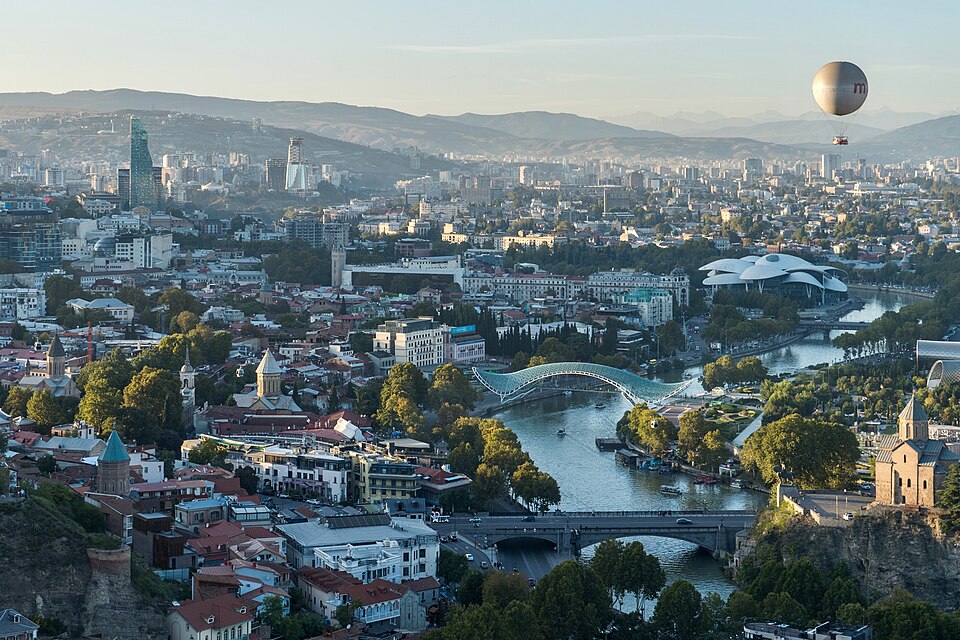
Tbilisi is a city of contradictions that somehow work in harmony. The Georgian capital sprawls across the Kura River with dramatic contrasts—medieval churches stand alongside Soviet apartment blocks, traditional bazaars operate steps away from contemporary galleries, and ancient fortress walls overlook a vibrant, youthful urban landscape. This is a place where centuries of history remain visibly present, where East and West have collided and mingled for over 1,500 years, and where locals move through their daily lives with a particular warmth and openness that defines the Georgian character.
Tbilisi sits at coordinates 41.69143N, 44.83412E, cradled in a valley formed by the Kura River as it flows through the South Caucasus. The city's geography has always shaped its destiny—positioned between the Black Sea and the Caspian, it has served as a natural crossroads for trade, culture, and conquest. The Kura River divides the city into distinct zones, with older neighborhoods clinging to the slopes on both banks while newer districts extend outward across the valley floor. Surrounding hills create a natural amphitheater effect, and on clear days, views toward the Caucasus Mountains remind residents of the dramatic landscape that frames their home.
The city's location in the South Caucasus puts it firmly in a region of profound geographic and cultural significance. Tbilisi operates in the Asia/Tbilisi timezone, reflecting its position as a bridge between European and Asian influences. The elevation sits at a level typical of river valleys in the region, positioning the city in a temperate zone that experiences distinct seasonal variations, from warm summers along the Kura to cool winters in the surrounding hills.
Tbilisi was founded in the fifth century AD by Vakhtang I of Iberia, a legendary figure whose name and deeds still echo through Georgian consciousness. According to tradition, Vakhtang established his capital here after his hunting falcon brought down an eagle near the warm springs that still flow in parts of the old city—the name Tbilisi itself derives from "tbili," meaning warm in Georgian. From these legendary origins, the city grew into a center of religious and political significance for Georgian Christian kingdoms.
The centuries that followed shaped Tbilisi through conquest and cultural exchange. The city flourished as a major stop on trade routes connecting Europe and Asia, attracting merchants, craftspeople, and scholars. Between 1801 and 1917, when Georgia fell under Russian Imperial rule, Tbilisi served as the seat of the Caucasus Viceroyalty, a position that brought administrative significance but also colonial transformation. The architectural legacy of that period remains visible in the neoclassical buildings that line certain quarters. Through the twentieth century, Tbilisi experienced dramatic upheaval—Soviet occupation, independence, civil conflict, and ultimately a gradual remaking of civic identity. Each of these chapters left marks on the cityscape and on the sensibility of its people.
Tbilisi rewards wandering. The old city, clustered on the southern bank of the Kura, preserves narrow winding streets, traditional wooden balconies, and buildings that seem to lean toward one another as if in conversation. Churches and monasteries scatter throughout the city and its outskirts, many dating back centuries and representing different periods of Georgian religious architecture. The fortress of Narikala dominates views from many quarters, perched on a hillside overlooking the old town and the river. Walking along the riverbanks themselves offers a different perspective on the city—the Kura is a working river that has witnessed every chapter of Tbilisi's story.
The cultural landscape reflects both deep tradition and contemporary creativity. Museums explore Georgian history, art, and culture with varying approaches and quality. The city hosts theaters, concert halls, and galleries that engage both with classical Georgian traditions and contemporary artistic practices. Street art appears throughout neighborhoods, particularly in younger districts where creative culture flourishes. Gardens and green spaces provide respite from urban density—some carefully maintained, others wilder and more organic. The sulfur baths in the old city remain a distinctive local tradition, fed by geothermal springs that have attracted visitors for centuries. Markets offer a genuine glimpse into daily urban life, where residents shop for produce, textiles, and goods while engaging in the social performance that markets represent in Georgian culture.
Tbilisi has good transport connections to other parts of Georgia and the broader region. The city is served by Shota Rustaveli International Airport, which connects to various destinations in Europe, the Middle East, and Asia. Within Georgia, Tbilisi functions as the primary hub for trains, marshrutkas (shared minibuses), and buses serving other cities and towns. The city itself can be navigated by marshrutka, metro, bus, or on foot—the density of the old city makes walking the most rewarding way to experience its character, while the metro provides quick connections across longer distances. Taxis and ride-sharing services operate throughout the city.
With a population of 1,049,498 within city limits and over 1.3 million in the metropolitan area, Tbilisi contains nearly one third of Georgia's entire population. This concentration makes it the undisputed center of Georgian economic, cultural, and political life. The city drives the country's economy, hosting business, tourism, and creative industries. For locals, Tbilisi represents opportunity and cultural vitality—young people migrate here from smaller towns seeking education and employment. Yet beneath the urban energy, the social fabric remains tight. Georgians are notably hospitable and maintain strong family and community connections even in metropolitan circumstances. The city's cafes, wine bars, and streets serve as public living rooms where socializing and conversation are central to how people experience urban life.
Current population: 1,049,498 (metropolitan area significantly larger)
Elevation: At river valley level in the South Caucasus region
Tbilisi invites both the casual visitor and the extended explorer—there is simply too much layered history, too much contemporary energy, and too much human warmth to take in quickly.
View larger map — © OpenStreetMap contributors
Flight delayed or cancelled?
You could be owed up to €600 compensation. Check your eligibility for free.Do you know Tbilisi?
Share local tips, recommend a hotel, list a business or add a photo.
✏️ Share your knowledge about TbilisiDo you know Tbilisi?
Share local tips, recommend a hotel, list a business or add a photo.
✏️ Share your knowledge about Tbilisi