

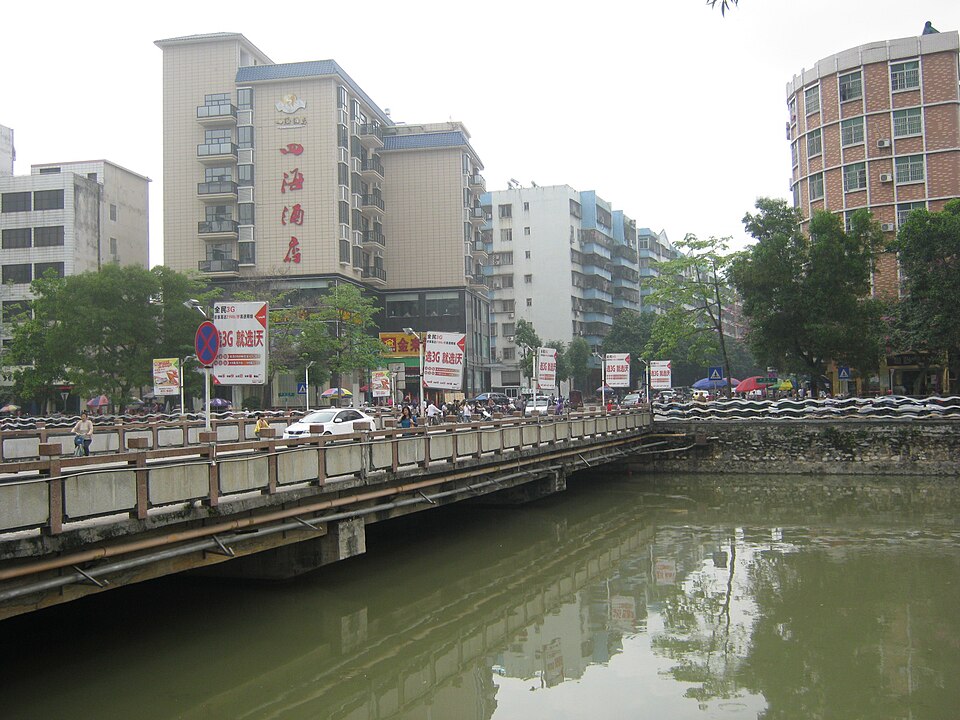


What Yunfu is known for
Yunfu occupies the western edge of Guangdong province, a prefecture-level city of 2.4 million people positioned between the developed Pearl River Delta to the east and the Guangxi border to the west. The city's identity centres on its stone industry—Yunfu is known as the "Capital of Stone in China"—and its role as a regional crossroads for commerce and transport. Historically called Dong'an until 1913, the city functions primarily as a working regional hub rather than a tourist destination, though it holds significance for Chan Buddhism heritage in neighbouring Xinxing County.
Landscape and Setting
The city covers nearly 7,800 square kilometres across terrain that transitions from the Pearl River Delta lowlands into the hills and valleys of western Guangdong. The landscape is visibly agricultural and forested, with rolling hills shaping the countryside. Yunfu borders Zhaoqing to the north, Foshan to the east, Jiangmen to the southeast, Yangjiang to the south, Maoming to the southwest, and Guangxi to the west. This geographic position has historically made it a natural junction for cross-provincial trade.
Visitors arriving by road from the eastern industrial cities notice the shift into a region where settlement, industry and agriculture exist in closer balance. The terrain is less flat than the Delta itself, and the surrounding hills and valleys give the city a particular character—neither coastal nor mountain wilderness, but embedded in active countryside.
Stone Carving and Industrial Identity
Yunfu's reputation centres on stone processing and carving, an industry with a legacy spanning over four centuries. The city supplies stone for architectural projects and home design across China and internationally, from monumental structures to decorative work. Local stone carving workshops and factories have won awards in regional competitions, and the industry has adapted to include eco-friendly production methods and digital design in recent years.
This industrial identity shapes the city's economy and daily life. Manufacturing, wholesale trade and cross-provincial commerce remain significant, with the proximity to Guangxi making Yunfu a practical point for regional distribution.
Historic Names and Regional Role
The city's former name, Dong'an—romanized during colonial times as Tong On—remained official until 1913. The current name, Yunfu, is less widely known outside the province, reflecting the city's inward-facing regional role. The area has been part of Guangdong's evolving administrative geography for centuries, though publicly documented heritage sites within Yunfu city itself remain limited in international sources.
Nearby Attractions and Onward Travel
The broader Yunfu prefecture includes several natural and cultural sites outside the central city. Xinxing County, part of Yunfu's administrative area, holds significance for Chan Buddhism, with Guoen Temple and sites connected to the Sixth Patriarch of Chan Buddhism drawing visitors interested in Zen heritage. Panlong Cave, a karst cave known for stone formations, and Jinshuitai Hot Spring are mentioned in regional tourism information. Tianlu Mountain, described as the highest peak in central Guangdong, offers leisure facilities.
These sites are located in the counties surrounding Yunfu city rather than in the urban centre itself. The city functions as a base for regional access rather than as a destination with concentrated tourist infrastructure.
Transport and Access
Yunfu connects to neighbouring prefectures via the provincial highway network. Road-based travel by bus or private vehicle is the primary means of access. The city's position on routes between Guangdong's eastern cities and the Guangxi interior makes it a practical waypoint. Specific details on rail services, bus terminals and local transport should be verified with current local sources before arrival.
Practical Information
Official travel advice for mainland China notes seasonal typhoon risks affecting southern and eastern coastal regions from May to November. Yunfu's inland position places it beyond the primary typhoon-affected coastal zone, though weather conditions during storm season should be monitored. Standard travel precautions and travel insurance appropriate to your itinerary remain advisable. Medical screening or temperature checks may occur at entry points to China.
Visitors should check current UK Foreign Office and US State Department travel advice for China before departure. No specific regional restrictions apply to Yunfu at present.