In This Guide
A story guide follows the Bamberg Horseman and Rauchbier through an October evening in the old town.
Read the guide as a story
The Horseman and the Smoke: An October Evening in Bamberg
Bamberg, Bavaria
Bamberg is one of the most intact medieval towns in central Europe and one of the few places in Germany where a single visit covers three genuinely distinct reasons to be there: a UNESCO-listed old town of extraordinary preservation, a cathedral containing one of the most discussed sculptures of the Middle Ages, and a local brewing tradition with no real equivalent anywhere else. The city is compact, walkable from the station, and honest about what it is — a functioning university town of around 70,000 people that happens to wear its history unusually well.
The Old Town and its UNESCO Status
Bamberg's historic centre was inscribed on the UNESCO World Heritage List in 1993. The listing recognised the town's organic medieval development rather than any single monument: approximately 2,400 timber-framed buildings survive from the medieval and early modern periods, and the street pattern, water channels and hillside topography together read as a coherent urban landscape that industrialisation largely bypassed. The UNESCO World Heritage Centre's entry for Bamberg describes the town as an outstanding example of early medieval town planning, shaped by the influence of the Holy Roman Emperor Henry II, who founded the cathedral diocese here in 1007.
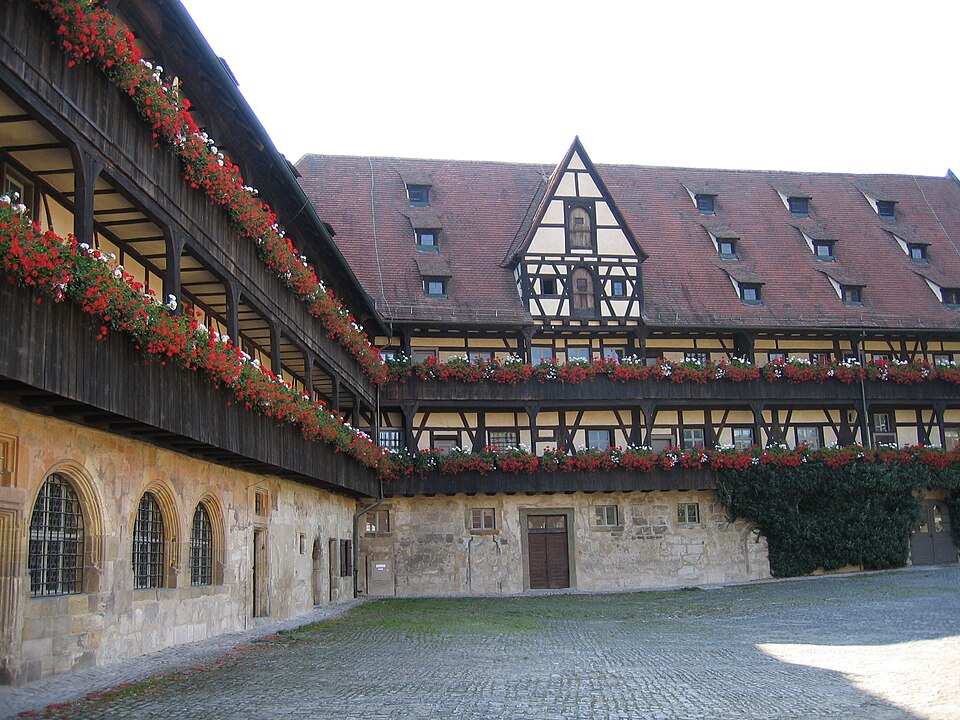
The name Bamberg is believed to derive from the nearby Babenberch castle, attested from at least the ninth century. That origin — a hilltop fortification giving its name to a settlement that grew into a significant episcopal and imperial centre — is still legible in the city's layout. The Alte Hofhaltung, a former imperial and episcopal residence beside the cathedral square, survives as a physical reminder of that administrative weight. The World Heritage status has shaped planning decisions ever since 1993; the texture of the old town owes something to those constraints.
Bamberg Cathedral and the Bamberg Horseman
Bamberg Cathedral — the Bamberger Dom — dominates the hill at the centre of the old town. The cathedral was consecrated in 1012 under Henry II, destroyed by fire and rebuilt in its current Romanesque-transitional form, completed around the early thirteenth century. Its four towers define the skyline approach from the station and from the surrounding hills.
Inside the cathedral stands the Bamberg Horseman (Bamberger Reiter), an equestrian figure carved in stone around 1230. It is among the most celebrated works of medieval sculpture in the German-speaking world, and its interest lies partly in what nobody knows: the rider's identity has never been definitively established. Scholarly debate has placed candidates ranging from King Stephen I of Hungary to various Holy Roman Emperors, but no identification has achieved consensus. That open question gives the statue an enduring pull for art historians and curious visitors alike. The cathedral also contains the tomb of Henry II and his wife Kunigunde, carved by Tilman Riemenschneider in the early sixteenth century — a second major work that rewards a longer look once you have found the Horseman.
Rauchbier: The Smoked Beer Tradition
Bamberg's Rauchbier is the most distinctive regional speciality in German brewing, and probably the most distinctive in Europe. The flavour comes from malting barley over an open beechwood fire — a technique that was once standard across Germany but survived industrialisation almost exclusively here, where two historic breweries continued the practice after indirect kilning made it commercially unnecessary everywhere else.
The two addresses most closely associated with the tradition are Schlenkerla and Spezial. Schlenkerla, whose full name is Heller-Bräu Trum, operates from a building in the old town that has been connected to brewing for centuries and serves its Rauchbier drawn directly from wooden casks. The Schlenkerla brewery's own account describes the smoky character as a product of malting over beechwood in the traditional way, producing a flavour profile that has no real commercial parallel in regular production. Spezial, a smaller family-run brewery, produces its own version — generally described as lighter and subtler than Schlenkerla's, making it a useful comparison for visitors willing to try both. Whether smoked beer becomes immediately appealing or takes adjustment, tasting it in Bamberg is a genuine encounter with a brewing lineage that has outlasted a very long list of reasons it should have disappeared.
Visitors should be aware that Rauchbier is a polarising flavour: the smokiness is pronounced and is not background character. Some visitors find it immediately compelling; others find it an acquired taste that takes more than one glass. Both reactions are documented and entirely reasonable.
What Visitors Notice on Foot
The old town rewards slow movement and does not require a plan beyond a rough sense of direction. The Upper Bridge (Obere Brücke), a three-arch stone bridge crossing a channel of the Regnitz near the old town hall, frames one of the most photographed views in the city — the town hall itself sits on an artificial island between two channels, a result of a medieval compromise between the episcopal and civic authorities over which jurisdiction the building would fall under. The story may be embellished in its retelling, but the building's position is genuinely unusual.
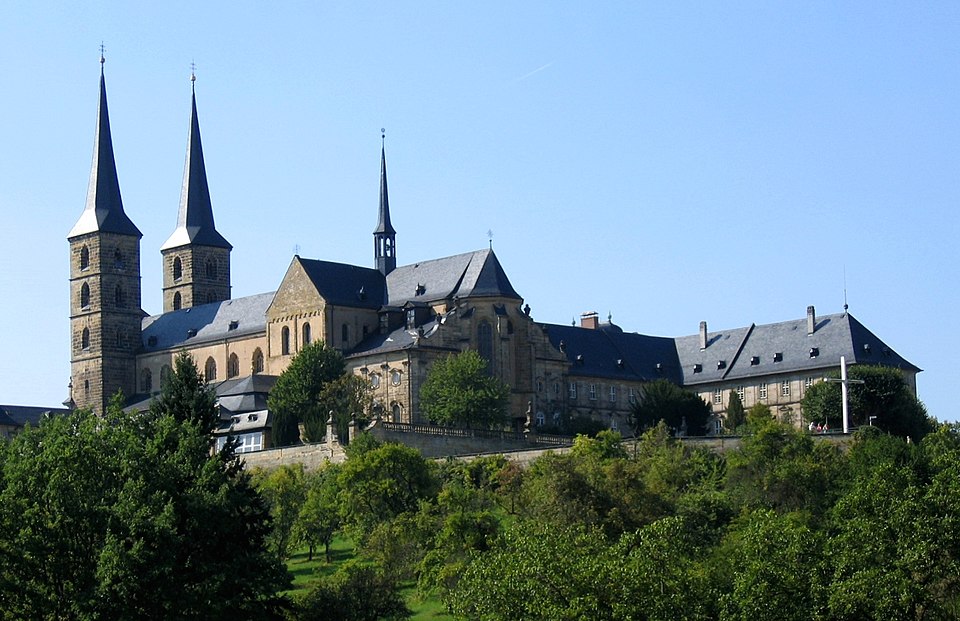
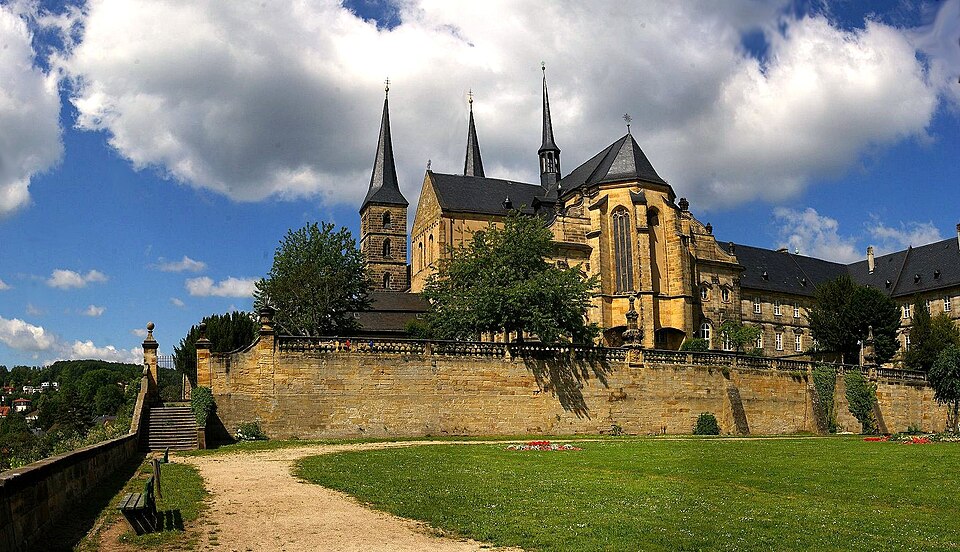
The Benedictine monastery of St Michael, reached by climbing the hill above the market district, offers a broad view back over the rooftops. The Kloster Michaelsberg parkside and the monastery church are worth the ascent. The Alte Hofhaltung courtyard, the cathedral square and the market area below form a natural walking circuit that covers most of the architectural set pieces. St.-Otto-Kirche is among the churches that punctuate the city's geography and can be reached on foot from the centre. The Hollergraben stream channel and the rise of the Pfisterberg close to the urban core are reminders that the old town's shape was determined as much by terrain and water as by planning.
The city is built across seven hills — a local reference to Rome that locals cite with some self-awareness — so routes that look flat on a map may involve a genuine climb. Comfortable shoes are more useful than a cycling map for first-time visitors exploring the old town.
E.T.A. Hoffmann and the Literary Strand
E.T.A. Hoffmann, the writer and composer whose stories provided the source material for Tchaikovsky's Nutcracker, Delibes's Coppélia and Offenbach's Tales of Hoffmann, lived and worked in Bamberg from 1808 to 1813. He arrived as a theatre musician and kapellmeister, and his time here shaped some of his most significant fiction. The Bamberg State Library holds Hoffmann manuscript material and related historical collections; the library functions primarily as a scholarly institution but its holdings document the depth of the city's intellectual history. The E.T.A. Hoffmann Theater carries his name and continues an active theatrical programme; visitors should check current scheduling directly with the venue before making plans around it.
Bamberg Witch Trials and the Surviving Records
Bamberg also has a darker historical layer that belongs beside the cathedral, UNESCO old town and Rauchbier tradition rather than outside the guide. Between 1626 and 1631, the prince-bishopric became one of the most intense centres of witch persecution in early modern Germany. The scale is disputed across sources, but it was in the hundreds, and the accusations reached far beyond marginal figures into the city elite.
The best-known personal document is the farewell letter written in 1628 by Johannes Junius, a former Bamberg mayor, shortly before his execution. The Staatsbibliothek Bamberg and Stadtarchiv Bamberg both treat the Junius letter as a central document of the Bamberg witch trials, alongside surviving interrogation records and related material. Nearby Zeil am Main also has the Zeiler Hexenturm documentation centre, listed by Bamberg tourism, which presents the persecution history through primary-source material. The surviving records make this one of the best-documented dark chapters in Bamberg history and a subject better understood through evidence than folklore.
Music and Culture
Bamberg's music culture is wider than the tourist circuit suggests. The Bamberger Symphoniker — the Bamberg Symphony Orchestra — is an internationally regarded ensemble with a dedicated concert hall in the city. The orchestra's origins lie in the displacement of the German Philharmonic of Prague after 1945, when many of its musicians settled in Bamberg; that history gives the ensemble an unusual provenance for a city of this size. Beyond classical programming, a grassroots live music scene is documented on musikszene-bamberg.de, and Bamberger Festivals e.V. supports local bands and venue infrastructure. Current listings for both classical and live music are maintained at en.bamberg.info and kultur.bamberg.de. The city also has a documented jazz following; current venue and event details should be checked locally.
Bamberg's medieval music heritage has a separate thread: the Digital Image Archive of Medieval Music records significant manuscript holdings associated with the city, adding a scholarly dimension to the musical culture that runs deeper than the modern scene.
Getting There and Around
Bahnhof Bamberg sits approximately 240 metres from the edge of the historic centre — a straightforward walk with luggage. The station connects directly to Nuremberg on the main intercity rail corridor, and from Nuremberg onward connections reach Munich, Frankfurt and the wider German network. The station is the natural arrival point for most visitors; Deutsche Bahn (bahn.de) and the VGN regional network (vgn.de) are the relevant booking and timetable sources.
There is no commercial passenger airport in Bamberg. Bamberg Breitenau Airport (QCB/EDQA) is a small general aviation field. The nearest major airports are Nuremberg Airport, approximately 60 kilometres south, and Frankfurt Airport (FRA), roughly 230 kilometres west. Munich Airport (MUC) is another practical option for travellers arriving internationally.
Coach arrivals should note that the official routing guidance for Bamberg directs coaches via the A70 Autobahn exit 14 (Bamberg-Hafen) for the quickest access to the central bus park; this applies whether arriving from the north or, counterintuitively, from the south via the A73 from Nuremberg. The central bus station (Zentraler Omnibusbahnhof, ZOB) is in the city centre and serves as the hub for local bus routes. Bus routes 935 and 936 are identified in transport sources as serving the urban area from the ZOB. The Stadtwerke Bamberg service centre at the town hall can supply bus tickets and local transport information, including the TagesTicket Plus day pass for Bamberg and its surroundings. Full current timetables are at vgn.de.
Within the old town, walking is the practical mode for almost everything. The river-level areas and market district are relatively flat; routes to St Michael's monastery and the hillside areas involve real gradients. Cycling is feasible along the canal and river paths in the wider district, but the hilltop old town sections are steep enough to make a bicycle more hindrance than help for sightseeing on foot.
Driving visitors should be aware that parking in and immediately around the old town is limited and can be a source of friction, particularly at peak periods. The historic core is not designed for vehicle access in the way modern retail districts are.
Seasonal Notes
Bamberg draws visitors year-round, but source evidence points consistently to peak crowding in summer, particularly in July and August. Spring and early autumn are generally described as more comfortable for exploring the old town on foot. The Christmas period brings seasonal markets to the city centre. Crowd levels in the old town can be significant during peak summer weekends; visitors who prefer quieter conditions may find weekday visits or shoulder-season travel more rewarding. Weather in Upper Franconia is continental: warm summers, cold winters, with rainfall spread across the year. The hilltop and monastery routes are more enjoyable in dry conditions.
Practical Notes
Germany falls within the Schengen area. Visitors from outside the EU should check current passport and visa requirements before travel. The UK Foreign, Commonwealth and Development Office maintains a travel advisory for Germany; the US State Department currently rates Germany at Level 2 (Exercise Increased Caution) as a countrywide precaution. Neither advisory identifies Bamberg or Upper Franconia as subject to specific local restrictions. Standard travel insurance covering your planned itinerary is advisable. Opening hours, ticket prices and current programming for all attractions should be checked directly with venues before visiting.