The train from Nuremberg takes just over half an hour, and by the time it pulls into Bahnhof Bamberg the light is already doing something interesting — that flat, amber October quality that arrives earlier in Bavaria than you expect. The station is unremarkable: a working commuter hub rather than a heritage building, functional in the way that Bavarian railway infrastructure tends to be. What happens within two minutes of stepping outside is less expected. The old town begins almost immediately. The cathedral towers are visible before you have properly decided which direction to walk.
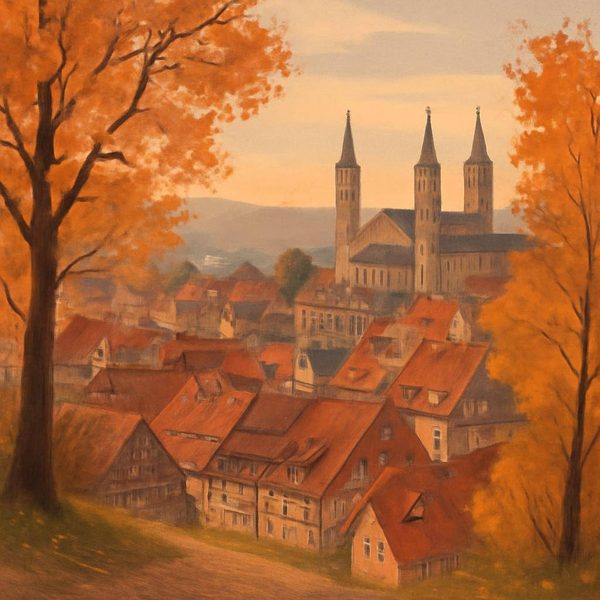
The climb to the Domberg takes less effort than the skyline suggests. The streets up from the station area move through ordinary Bamberg first — cafés, a bakery, the kind of German town life that is happening entirely without reference to the medieval skyline above it — and then, as the gradient increases, the fabric shifts. Half-timbered houses press close on both sides. The pavement stones are old and uneven. By the time you reach the cathedral precinct and the open square of the Alte Hofhaltung, the scale of what has survived here has had a chance to settle.
The Bamberger Dom is large and quiet on a weekday afternoon. The four towers read as two pairs from different centuries, Romanesque heaviness giving way to Gothic points, the whole thing more complex up close than it appears from the valley below. Inside, past the cool stone air of the nave, the Bamberg Horseman stands in a niche on the north pillar of the choir crossing. He is smaller than the idea of him — perhaps life-size for horse and rider together, but not the monument you might have imagined. The stone is pale limestone, and the carving is confident in a way that makes the anonymity of the subject strange. A king, an emperor, an ideal: nobody has settled it. The uncertainty feels intentional, though it almost certainly is not. You stand there longer than you planned to.
The Pfisterberg on the way down offers a brief pause and a different angle on the rooftops — the seven hills working as advertised, each slight rise giving the city a new arrangement of towers and chimneys and slate. The Hollergraben appears below, a narrow stream threading between buildings, reflecting the sky in a strip of silver light. In October there are still leaves on the lindens.
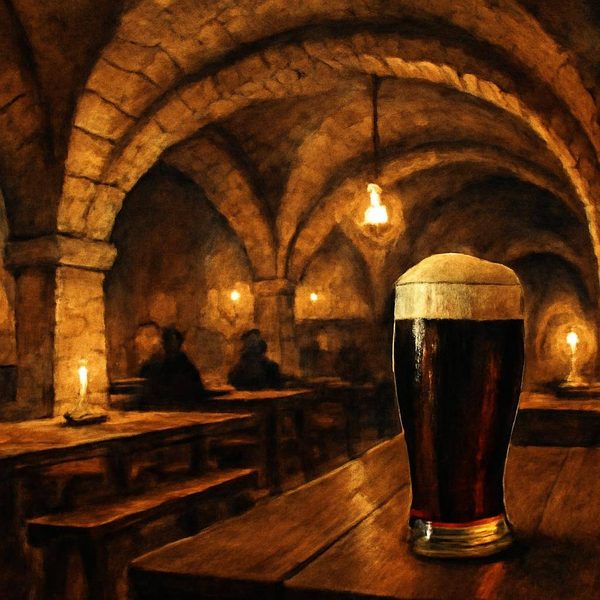
Schlenkerla is on Dominikanerstrasse, in the old town, inside a building that has been a tavern and brewery for longer than most European cities can point to for anything. The smoke hits you at the door — not unpleasant, more like a memory of something older than your experience of it, beechwood and malt and decades of the same process. The Märzen arrives dark in a ceramic mug. The first sip is genuinely surprising: smoky, dry, with a finish that takes some adjustment. The second is better. By the third it has started to seem logical, even necessary, as an ending to an October afternoon in a medieval city that has spent centuries being precisely what it is.
Outside, the Upper Bridge is quieter than the tourist literature implies. The Old Town Hall sits on its three arches above the Regnitz, half-timbered section hanging over the water, Baroque frescoes fading in the last of the light. A few cyclists cross. The reflection in the river is still and exact. You do not need to have come a long way for this to feel worth it.
Frequently Asked Questions
Can visitors follow The Horseman and the Smoke: An October Evening in Bamberg as a real route?
Use it as an atmospheric orientation route for Bamberg, not as a live itinerary. The named places are source-backed, but current opening hours, tickets and transport should be checked before travelling.
What practical planning should I do after reading this Bamberg story?
Use the main guide for transport, where-to-stay, safety and day-planning decisions, then confirm any venue access with the linked official sources.
What does this route help visitors understand about Bamberg?
It turns source-backed places, route anchors and local context into a readable visitor route, so the story supports the main guide rather than replacing practical planning.
This is a fictional visitor story generated from source-backed place facts, image evidence and visitor-feel signals. It is not a first-hand WorldTownGuide visit. Named places, routes and historical references are source-backed; the visitor character and narrative events are invented.
Sources: Bamberg Cathedral and the Bamberg Horseman - bavaria.travel • Aecht Schlenkerla Rauchbier - schlenkerla.de • Upper Bridge - Obere Brücke - bambergstadtfuehrung.de • Town of Bamberg - UNESCO World Heritage Centre • Fahrpläne - Bahnhof Bamberg - bahnhof.de • Best Time to Visit Bamberg - bambergstadtfuehrung.de