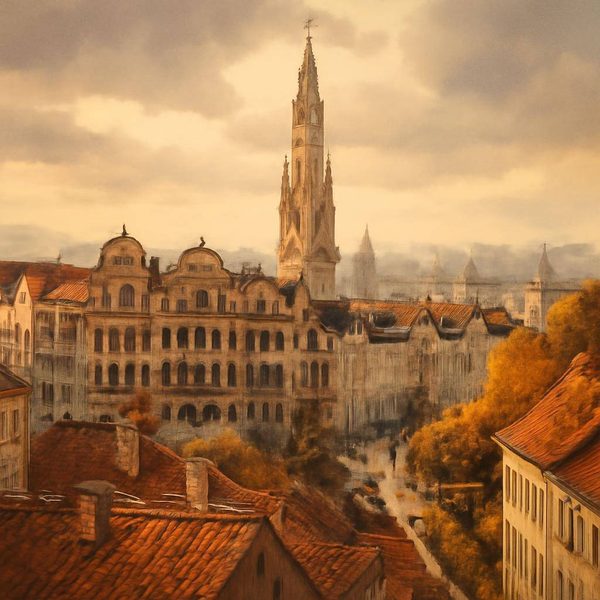
October in Brussels has a particular quality of light — grey and close, with the gilded facades of the Grand Place catching whatever sun breaks through. The guild houses are at their least performative in autumn: no summer crowds pressing to the centre, no outdoor tables colonising the cobbles, just the architecture doing what it has always done, which is to stand there and be extraordinary.
The square's buildings date mostly from the late 17th century, rebuilt after French bombardment in 1695. The Gothic Town Hall survived. Most of the guild houses had to be reconstructed, and the city did it with an attention to gilded excess that was probably deliberate — a statement made in stonework. Walk into the square from the Rue au Beurre and the effect is immediate: the proportions are tighter than photographs suggest, and the facades taller, and for a moment the whole thing feels less like a public space and more like a room.
Somewhere near the entrance to the city museum, a small panel describes the Ommegang. The procession has wound through Brussels at least since the 16th century — the Corinthia Hotel's cultural heritage guide records two competing origin stories: that it commemorates the arrival of Spanish rule in Brabant, or that it recalls the theft of a statue of the Virgin brought to Brussels by water in 1348. Both versions agree on the route. Both agree on the giants.
Brussels has more than a hundred giant figures, according to the Brussels intangible heritage inventory, and their appearances in processions and civic pageants go back to the Renaissance. The most famous are the giants of the Ommegang and the Meyboom. They are not decorative. They carry a specific weight of civic memory, the kind that a city accumulates when it has been ruled in succession by Burgundians, Habsburgs, Spaniards, Austrians, the French and the Dutch, and has learned that its own traditions are something it holds for itself. In December 2019, the Ommegang was added to the UNESCO Representative List of Intangible Cultural Heritage.
From the Grand Place, the walk up to the Mont des Arts takes about ten minutes and about fifty vertical metres. At the top, the view across the lower city opens up — rooftops, the distant outline of the Atomium, the spire of the Town Hall below. The Musical Instruments Museum is on this slope, in the Old England building: Art Nouveau iron and glass from 1899, now holding more than 8,000 instruments from every inhabited continent. In October the museum is quieter than in summer. Inside, the wireless headphones mean you move through the instrument galleries in a kind of individual silence, hearing each instrument as you pass — a zither, a mbira, a medieval theorbo — while the city carries on below the windows.
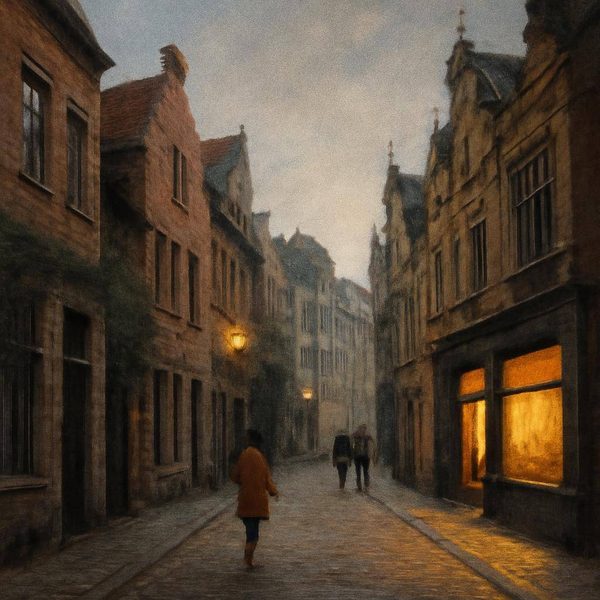
Later in the afternoon, the walk west toward the Dansaert area takes you through the city's quieter residential face: narrower streets, fewer tourists, a neighbourhood that knows what it is. The design quarter has its own rhythm. By four o'clock the sky is already considering evening, and the friteries are opening — the chip stands that have been part of daily life here long enough to be a civic institution. A paper cone of frites with mayonnaise near the Dansaert quarter is not a tourist performance. It is just dinner.
Brussels doesn't insist on being loved. It carries its history and its institutions and its multiple languages with a certain matter-of-factness, and it leaves the city centre just scruffy enough that the grand gestures — the Grand Place, the Art Nouveau facades, the UNESCO pageant — feel genuinely earned rather than maintained for display. The giants come out when the occasion demands it. For the rest of the year, the city gets on with things.
Practical note: The Ommegang takes place in the first week of July; the Grand Place and Mont des Arts are walkable from Brussels-Midi and Brussels-Central stations. The MIM and the Dansaert quarter are both on the STIB/MIVB bus and tram network. Check current event schedules and transport status before visiting.
Frequently Asked Questions
What practical route does this Brussels story follow?
It follows source-backed places and route anchors from the guide, giving orientation and atmosphere while leaving live transport and opening details to the linked sources.
Which live details should I check before using this Brussels route?
Check current transport, access, opening and weather information from the linked official or operator sources before travelling.
What does this route help visitors understand about Brussels?
It turns source-backed places, route anchors and local context into a readable visitor route, so the story supports the main guide rather than replacing practical planning.
This is a fictional visitor story generated from source-backed place facts, image evidence and visitor-feel signals. It is not a first-hand WorldTownGuide visit. Named places, routes and historical references are source-backed; the visitor character and narrative events are invented.
Sources: Musical Instrument Museum, Brussels - Wikipedia • Het Brusselse culturele erfgoed: een stad van legendes en folklore - Corinthia • De reuzentraditie - Patrimoine/Erfgoed Brussels • Brussels Annual Cultural Events - Visit Brussels