In This Guide
Read the guide as a story
October on the Corrib: An Evening in Galway
Galway, Connacht
Few cities in Ireland announce themselves quite like Galway. Step off the train at Galway Ceannt station and within minutes you can be standing in Eyre Square, listening to a busker tearing through a reel, with the Atlantic air carrying the faint smell of salt in from the bay. It is a city that feels permanently mid-festival, where medieval stone lanes give way to painted shopfronts, and the River Corrib pushes cold and clear through the heart of things on its way to the sea.
First Impressions and Setting
Galway sits where the River Corrib drains out of Lough Corrib and meets Galway Bay, positioning the city between freshwater and the open Atlantic. It is a compact urban centre — the most populous city in Connacht — but it carries the energy of somewhere twice its size. The western waterfront opens out toward the Aran Islands, which sit visible on clear days in the mouth of the bay, and the city has long served as the principal gateway to Connemara and the wider west of Ireland. Lough Atalia, a tidal lake, borders the city to the east and is part of the layered water geography that defines daily life here. The landscape is low and open, the sky enormous, and the light off the bay changes fast.
The station area itself is functional rather than scenic — Galway Ceannt sits just off Eyre Square and the surroundings are workday commercial — but the medieval core is minutes away on foot, and the transition from arrival point to historic lanes is one of the quickest in any Irish city.
History, Identity and the Claddagh Ring
Galway grew as a walled medieval trading town with strong commercial ties to Spain and continental Europe. The city was dominated for centuries by fourteen powerful merchant families known as the Tribes of Galway, whose influence shaped its streetscape, its trade routes and its distinctly outward-facing identity. The Spanish Arch, a remnant of the old city walls near the mouth of the River Corrib, marks the spot where Spanish trading vessels once unloaded their goods, and it remains one of the most visited historic sites in the city. The Collegiate Church of St Nicholas of Myra has stood in the city centre for centuries and still holds services — one of the largest medieval parish churches in Ireland.
A long-standing Galway tradition links Christopher Columbus to that church: local and church accounts say he visited Galway in 1477 and prayed at St Nicholas before his later Atlantic voyages. The wider claims about what he learned in Galway belong to tradition rather than settled evidence, but the association gives the church a second fame story beyond its medieval fabric.
The Claddagh, a historic fishing settlement that once stood outside the old city walls at the mouth of the river, gave the world one of Ireland's most recognisable objects: the Claddagh ring, a gold or silver band featuring two hands clasping a crowned heart, representing love, loyalty and friendship. The most widely told origin story involves a Galway man named Richard Joyce, said to have been captured by Barbary pirates in the late seventeenth century and taken into slavery in Algiers, where he learned the goldsmith's trade before eventually securing his freedom — reportedly after William III's accession prompted the release of British subjects — and returning to Galway. According to this tradition, Joyce crafted the distinctive design on his return and settled back in the Claddagh. The story is deeply embedded in local identity and widely repeated, though it rests primarily on legendary tradition rather than documented record; the ring's symbolism and its Galway origin are not in question, but the precise biographical detail of Joyce's journey should be understood as part of a founding legend rather than verified history. The ring has since become one of the best-known symbols of Irish identity worldwide, with its origin firmly rooted in this specific corner of the city.
Arts, Music and Culture
Galway was designated a European Capital of Culture for 2020, a recognition that formalised what locals and regular visitors had already understood: that the city carries significant weight in arts, theatre, literature and live music. The designation was disrupted by the pandemic, with many planned events postponed or restructured into 2021 and 2022, but the underlying cultural infrastructure remains intact. The Galway International Arts Festival, held annually in July, draws performers and audiences from across Europe and beyond and is one of the largest arts festivals in Ireland. Druid Theatre, founded in 1975, has built an international reputation for new Irish writing and has toured productions to major venues worldwide. Its Broadway transfer of Martin McDonagh's The Beauty Queen of Leenane won four Tony Awards, including Best Direction for Garry Hynes — the first woman to win that Tony category.
The busking culture on Shop Street and in the Latin Quarter is not manufactured for visitors. Traditional music sessions in the city's pubs are a regular feature of daily life, and the concentration of independent venues, performance spaces and music-friendly pubs reflects a culture in which live performance is genuinely woven into the social fabric. Visitors should note that July in particular can see significant crowd pressure: the Arts Festival and the Galway Races occasionally overlap in the same fortnight, and accommodation books out well in advance during that period. Race Week at Ballybrit is more than a date clash: it is one of Galway's major social events, mixing racing, fashion, betting and late-night city-centre crowds. Even visitors with no interest in racing feel its effect on hotel prices, restaurant bookings and street energy.
The Waterfront and the River
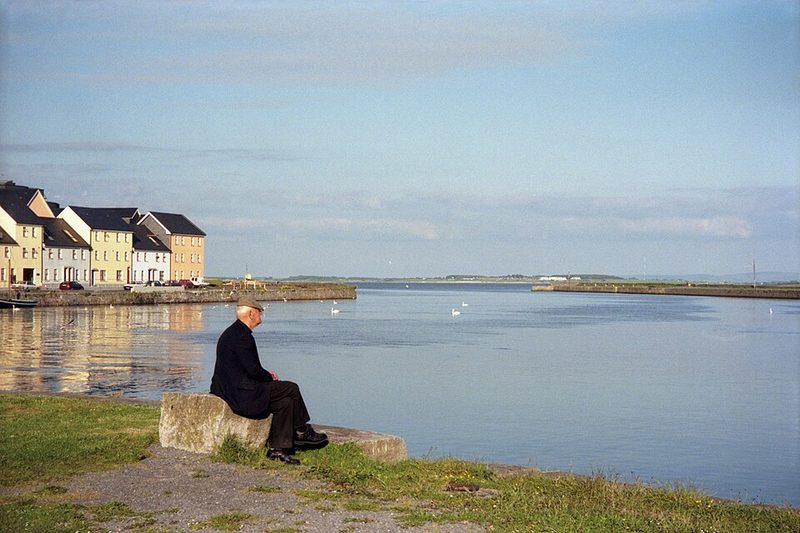
The River Corrib is striking — fast-moving, wide and exceptionally clear — and the walkways along its banks offer some of the most pleasant urban walking in the west of Ireland. The Spanish Arch area, where the river meets the sea, is a natural gathering point, particularly in summer when people sit on the old stone walls. The river is also well known for salmon fishing; the Corrib is one of the more significant salmonid rivers in the west of Ireland, and anglers use it in season alongside the urban foot traffic.
Lough Atalia, a tidal lake immediately east of the city centre, is a quieter alternative waterfront for those who want to step away from the busier tourist core. It borders the city near Galway Ceannt station and offers a different register entirely — wetland character, wading birds and a functional rather than polished shoreline. It is not a visitor attraction in the formal sense, but it is a useful marker of Galway's broader water geography and a practical stop for walkers heading east from the city centre.
What Visitors Notice
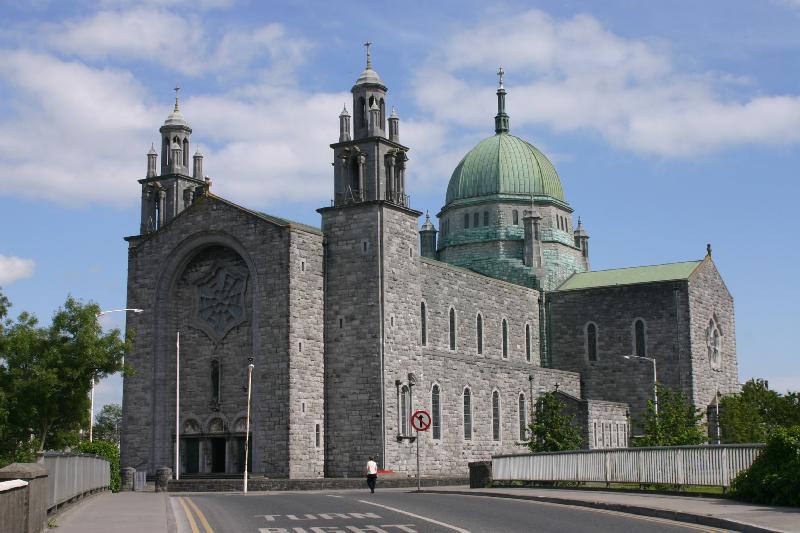
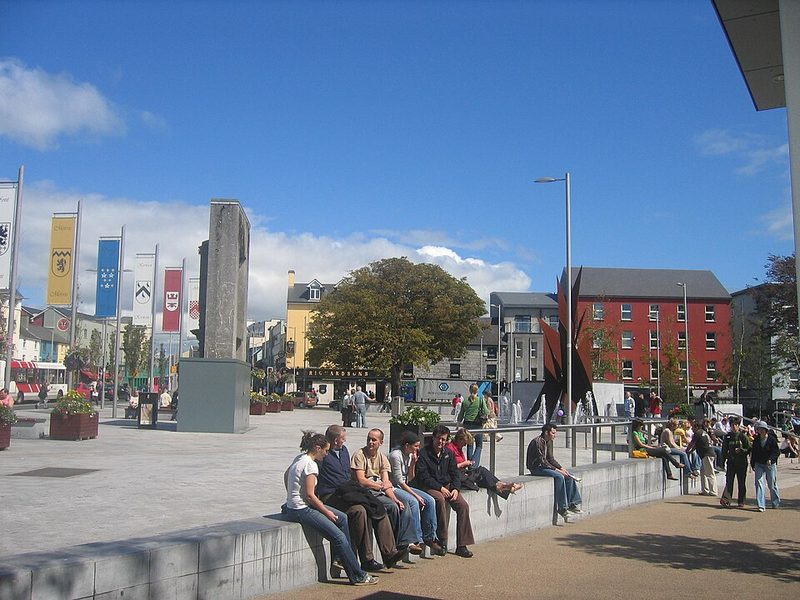
The medieval street pattern is tight and walkable, and most of the historic landmarks are within comfortable distance of one another on foot. Shop Street and the surrounding pedestrian lanes form the commercial and social core. Eyre Square, formally known as John F. Kennedy Memorial Park, anchors the eastern approach to the city centre — the open green space closest to the train station. The Cathedral of Our Lady Assumed into Heaven and St Nicholas, completed in 1965 in an unusual Roman Renaissance style, stands on the west bank of the Corrib and is a distinctive presence on the city's skyline given its relatively recent construction date.
The city is home to University of Galway (formerly NUI Galway), which shapes both the demographic character of the city and its economy. A large student population keeps the streets lively outside of the formal festival calendar, and the city also functions as a regional services hub for a large part of Connacht, with University College Hospital Galway serving as a major healthcare facility for the west of Ireland.
Getting There and Around
Galway Ceannt railway station sits just off Eyre Square and connects the city to Dublin by rail — one of the most straightforward intercity rail journeys in Ireland, operated by Iarnród Éireann (Irish Rail). Bus services operate from beside the station; Bus Éireann and the private operators Citylink and GoBus run regular coach services to Dublin, Shannon, Limerick and other cities. Services toward the Connemara coast are available, though visitors should verify current routes and timetables with operators directly before planning around them. Ireland West Airport Knock, in County Mayo, serves as a regional air gateway for the west; check current routes before planning around it. Within the city, most central sights are walkable, and cycling infrastructure has been expanded in recent years. Local bus services cover the wider urban area.
For ferry connections toward the Aran Islands, services have historically operated from Rossaveal on the Connemara coast, with connecting buses from Galway city. Verify current services with operators before travelling, as routes and schedules are subject to seasonal change.
Practical Notes
Both the UK FCDO and the US State Department currently rate Ireland at their lowest advisory level, recommending only normal travel precautions. There are no elevated security concerns or regional restrictions in place for Galway or anywhere in the Republic of Ireland at the time of writing. Travellers should consult the official UK advice at gov.uk/foreign-travel-advice/ireland and the US advisory at travel.state.gov before departure, as conditions can change. Galway operates on Irish time (GMT in winter, IST/UTC+1 in summer), follows the euro, and experiences a mild but reliably wet Atlantic climate. A waterproof layer is considered standard equipment by anyone who has spent a weekend here.