The train from Dublin pulls into Galway Ceannt in the middle of the afternoon, and the station empties quickly. There is nothing scenic about the arrival — the area around Ceannt is workday commercial, a ring of bus stops and car parks — but Eyre Square is thirty seconds on foot, and the city changes register almost immediately once you cross it.
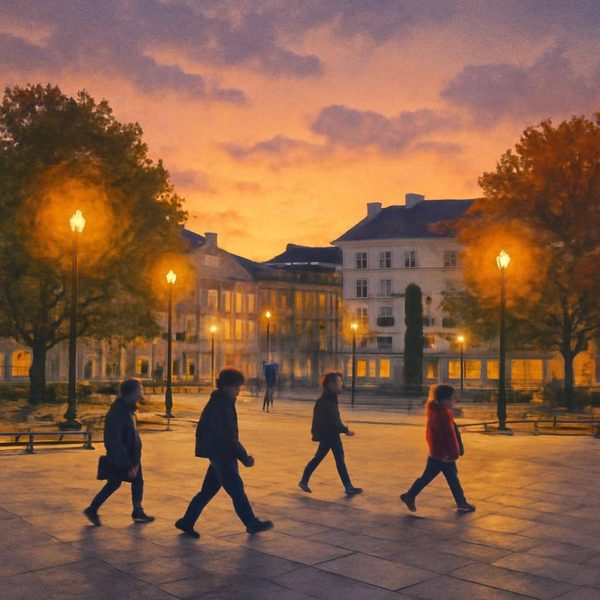
Eyre Square in October is windier than it looks. The open green of John F. Kennedy Memorial Park catches whatever is coming in off the bay, and in autumn the bay is usually sending something. The trees at the square's edge are turning. The benches are occupied mainly by people on their phones and pigeons with an opinion about the situation. It is not a contemplative park. It is a crossroads, and it works as one.
The walk down Shop Street toward the river takes about ten minutes if you do not stop. Stopping is harder than it sounds. The buskers on Shop Street are working — not performing for tips in a hopeful way, but actually working, playing reels at speed with a concentration that discourages interruption. A fiddle player near the junction with High Street does not look up. The music is fast and precise and the pedestrians divide around her like water around a stone.
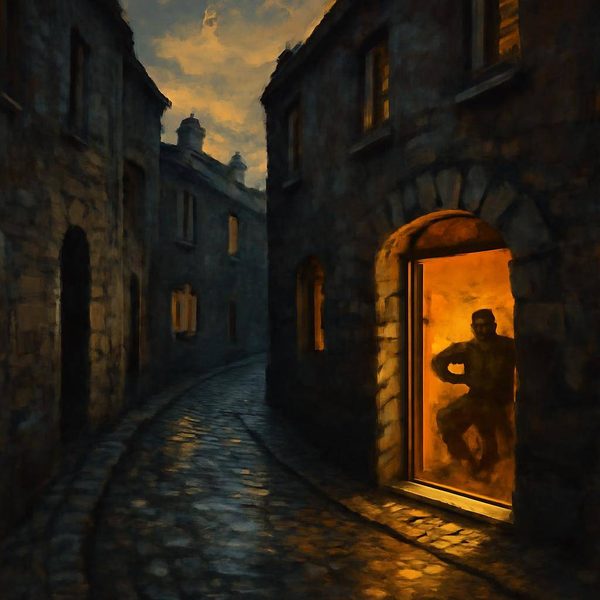
The Latin Quarter, the tangle of lanes between Shop Street and the river, is where the city concentrates. The painted shopfronts are genuine rather than restored — faded at the edges, slightly misaligned, the kind of colour that comes from repeated repainting over decades rather than a single decision. It is not a preserved district. It is a district that has been lived in for a long time and looks like it.
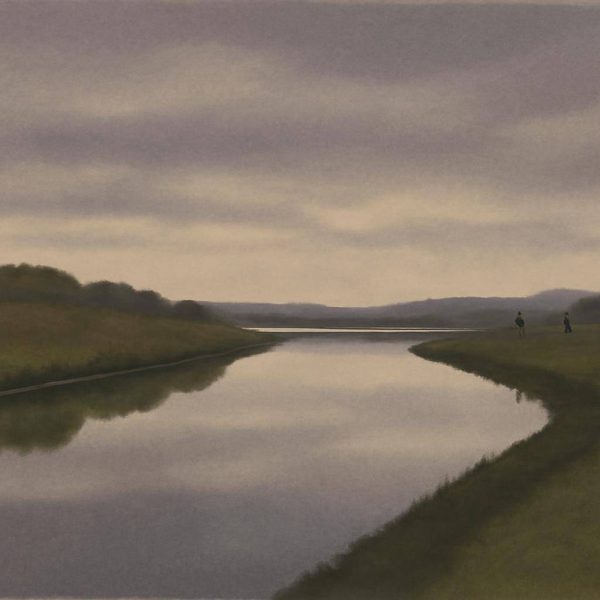
The River Corrib arrives as a surprise even when you know it is coming. The river is fast and wide and the water is a colour that reads as almost too clear for a city river — pale green over stone, moving with visible purpose toward the bay. Salmon have used this river for a long time. In season, anglers stand on the banks with a patience that the current does nothing to encourage.
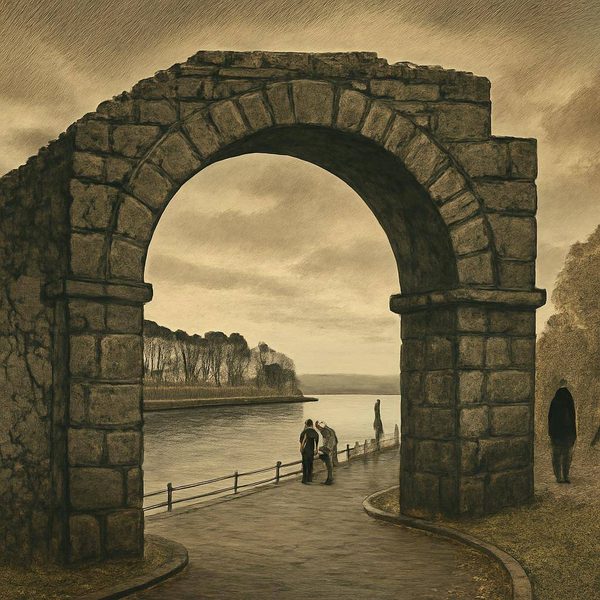
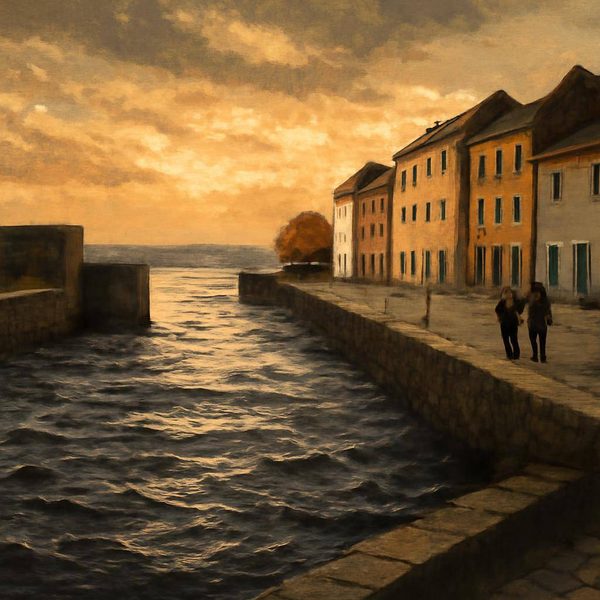
At the Spanish Arch the river opens. The arch itself — a remnant of the old city walls, the place where Spanish ships once unloaded wine and salt for the merchant families of medieval Galway — stands at the point where the Corrib finally reaches the sea. In October the stone is dark with recent rain. A few people are sitting on the old walls despite the cold, looking at the water. The Aran Islands are not visible today; the bay is grey and the horizon is indistinct.
Lough Atalia, back toward the station and east of the centre, is a different kind of waterfront entirely. It is tidal — a lake that opens to the sea — and the shoreline is working rather than polished: wading birds, rough grass, the functional edge of a city that has more pressing concerns than prettifying its eastern margin. Walking there in October, with the light going early and the birds doing whatever birds do at low tide, it feels far from Shop Street without being far at all.
The evening session starts earlier than you expect. By seven o'clock the pubs in the Latin Quarter are already full, and the music has moved indoors. The particular quality of a Galway session — the way the musicians face each other rather than the room, the way the conversation and the tunes occupy different layers of the same space without conflicting — is something that takes a while to understand. You are not the audience. You are present, which is different.
The Collegiate Church of St Nicholas of Myra is locked by the time the session gets going, but its exterior is worth the detour — a large medieval building at the centre of the city, in active use for centuries before Galway was anything more than a walled trading post on the Atlantic edge. The Cathedral of Our Lady, completed in 1965 on the west bank of the Corrib in Roman Renaissance style, is a stranger presence: large, pale, slightly unexpected in a city this size. It is lit at night and visible from the river bridges.
Galway in October is not quiet, but it is manageable. July — when the Arts Festival and the Galway Races can coincide — is a different calculation entirely. October is the city at a pace at which you can actually use it: the lanes passable, the sessions unhurried, the Corrib visible from the bridge without a crowd blocking the view.
The train back to Dublin leaves from Ceannt in the morning. The walk from wherever you are staying to the station is short enough that you can leave it late, which is exactly what most people do.
Frequently Asked Questions
What is October on the Corrib: An Evening in Galway?
The train from Dublin pulls into Galway Ceannt in the middle of the afternoon, and the station empties quickly.
Why does October on the Corrib: An Evening in Galway matter in Galway?
There is nothing scenic about the arrival — the area around Ceannt is workday commercial, a ring of bus stops and car parks — but Eyre Square is thirty seconds on foot, and the city changes register almost immediately once you cross it.
How does October on the Corrib: An Evening in Galway fit into a Galway visit?
There is nothing scenic about the arrival — the area around Ceannt is workday commercial, a ring of bus stops and car parks — but Eyre Square is thirty seconds on foot, and the city changes register almost immediately once you cross it.
This is a fictional visitor story generated from source-backed place facts, image evidence and visitor-feel signals. It is not a first-hand WorldTownGuide visit. Named places, routes and historical references are source-backed; the visitor character and narrative events are invented.
Sources: UK FCDO Travel Advice - Ireland • Galway - Wikipedia • GeoNames - Galway