The train from the north arrived at Hyderabad Railroad Station sometime after nine in the morning, and the first thing the city offered was noise: auto-rickshaws competing for pavement, a vendor with a cart of guava calling out in Telugu, two pigeons conducting a territorial dispute on the station canopy overhead. October in Hyderabad sits in the ideal window — the monsoon has just released its grip, the air has a thin brightness to it, and the temperature at this hour was the kind that made walking seem like a reasonable idea.
From the station, roughly 1.6 kilometres puts you at the edge of the old city if you go south. The Hyderabad Metro Rail is the sensible option for anything longer, but for the old city at this hour, an auto-rickshaw through the traffic felt right — a baptism rather than an avoidance. The driver took a route that skirted the western shore of Hussain Sagar, and for a moment the lake opened up on the right: flat water reflecting a pale sky, the stone silhouette of the 1992 Buddha statue standing on its island midway out. It looked entirely settled there, as if it had always been part of the skyline rather than placed three decades ago.
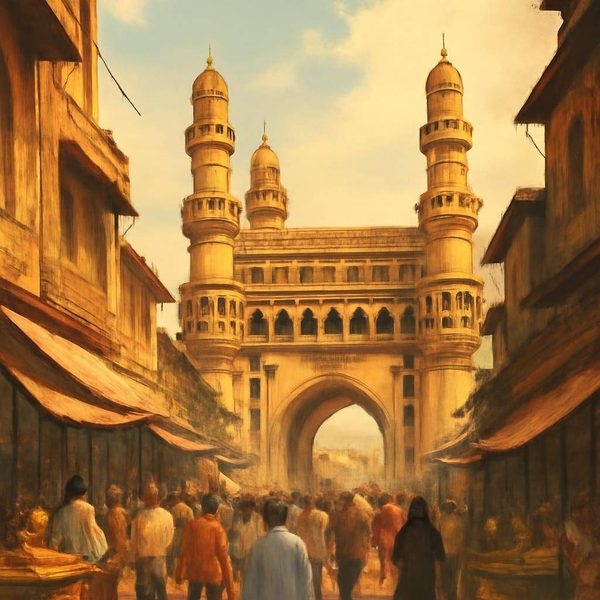
The Charminar announces itself before you see it. The lanes narrow, the sounds change — fabric shops and glass-bangle stalls crowd in — and then the arch appears above the rooftops, its four minarets going straight up into the sky. It was built in 1591 by Muhammad Quli Qutb Shah at what was then the geometric and symbolic heart of his new city. Standing underneath it, watching the four arches frame four different compressed urban scenes simultaneously, you understand why it survived as the city's central image. It is not subtle, and it was not meant to be.
Fifty metres to the south-west, Mecca Masjid took over seventy years to complete — begun under the Qutb Shahis in 1617, finished under the Mughal emperor Aurangzeb in 1694. The bricks in the central arch are said to carry soil from Mecca. Construction spanning two dynasties and a Mughal conquest is a particular kind of continuity. The forecourt was quiet at this hour; by Friday prayers or during Ramadan, this space becomes one of the most significant congregation points in southern India.
Back towards the Charminar, Laad Bazaar pressed in from the west — stall after stall of glass bangles in every colour, lacquerware, wedding goods, pearls. The lane is narrow enough that the stalls on either side nearly touch overhead. A woman selecting bangles with the focused precision of someone who has done this many times; a teenager filming the scene on a phone. The market has been here, in one form or another, for as long as the Charminar has.
Chowmahalla Palace, a short walk deeper into the old city, was where the Nizams held their formal audiences. The Khilwat Mubarak — the great hall — has high ceilings and a sense of cooled silence after the market lanes. The vintage automobiles lined up in one of the courtyards seemed like something from a different chapter of the same long story: the Nizam's court, one of the wealthiest in the world in the early twentieth century, expressed through imported European vehicles now standing still under fluorescent light.
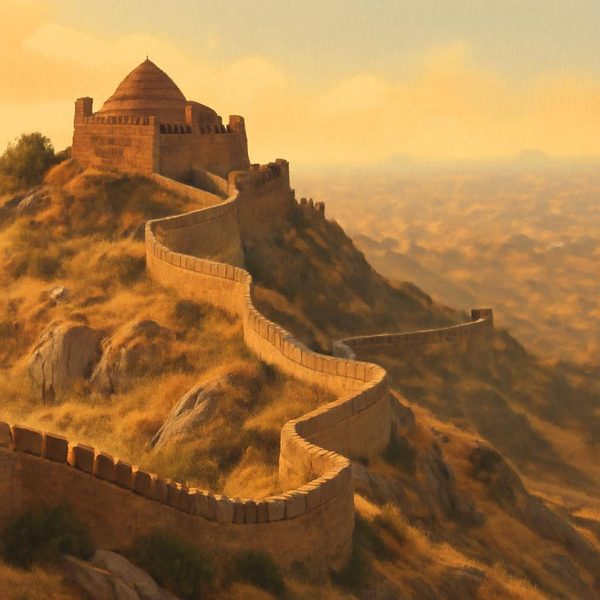
By early afternoon, the city's western edge called. Golconda Fort sits on a granite hill about nine kilometres out, and the Qutb Shahis ruled from here before they built Hyderabad. Aurangzeb besieged the fort for eight months in 1687 before it fell. The scale of the ramparts, climbing across multiple ridges, makes clear why it took that long. From the highest point — the Bala Hisar pavilion — Hyderabad spreads out to the east in the afternoon haze: the glass towers of Hi-Tech City just visible on the far edge, the lake, the old city somewhere underneath the smear of distance.
Coming down, a guard demonstrated the acoustic trick at the main entrance gates — a single clap, and somehow the sound carries to the hilltop. No one agrees exactly how. The Qutb Shahis never fully explained it either.
Back in the city by evening, the metro from Khairatabad station ran smooth and cool back towards the old city. Hussain Sagar was dark now, the Buddha lit from below. Somewhere in the lanes around the Charminar, someone was cooking biryani — the smell came through the auto-rickshaw's open side like a reminder that the city had been doing this, one version or another of this exact evening, for four hundred years.
Frequently Asked Questions
What practical route does this Hyderabad story follow?
It follows source-backed places and route anchors from the guide, giving orientation and atmosphere while leaving live transport and opening details to the linked sources.
Which live details should I check before using this Hyderabad route?
Check current transport, access, opening and weather information from the linked official or operator sources before travelling.
What does this route help visitors understand about Hyderabad?
It turns source-backed places, route anchors and local context into a readable visitor route, so the story supports the main guide rather than replacing practical planning.
This is a fictional visitor story generated from source-backed place facts, image evidence and visitor-feel signals. It is not a first-hand WorldTownGuide visit. Named places, routes and historical references are source-backed; the visitor character and narrative events are invented.
Sources: Hussain Sagar Lake - Hyderabad District, Government of Telangana • Tourist Places - Hyderabad District, Government of Telangana • Chowmahalla Palace - Hyderabad District, Government of Telangana • Khairatabad Metro Station - Wikipedia • Hyderabad Heritage and History Timeline - Mapunity