

What Miami is known for
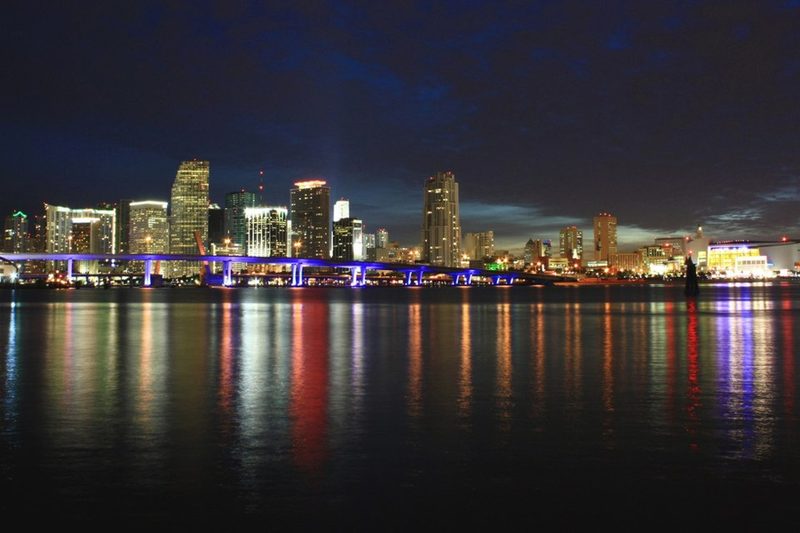
Miami rises from mangrove swamps on Florida's southeast coast as one of the youngest major cities in America—a place that transformed from sparse, mosquito-ridden scrubland into a thriving metropolis in just over a century. The city's population of 487,014 sits at the gateway to the Caribbean and Latin America, where Spanish echoes through daily conversation as much as English. The skyline holds over 300 high-rise buildings, seventy of which exceed 150 metres, making Miami the third-most built-up city in the United States.
Geography and Setting
Miami sits at sea level on Florida's southern tip, where the Atlantic Ocean and Biscayne Bay frame the urban landscape. The terrain is flat—the city's elevation barely registers above sea level—which means water shapes everything here. Mangrove shorelines, coastal inlets, and the shallow waters of the bay are as much a part of the geography as streets and buildings. The subtropical climate brings warm, humid conditions year-round, with hurricane season running from June through November.
The urban core sits along the Miami River, where the historical heart of the settlement took shape. Downtown towers cluster near the river mouth; beyond this central area, neighbourhoods sprawl outward in patterns reflecting different waves of development.
From Tequesta Territory to Magic City
The name "Miami" derives from the Mayaimi, a Native American tribe whose territory extended to this region. The word likely means "big water"—fitting for a place where water was abundant and central to survival. The Tequesta people inhabited the area for over 2,000 years before European contact, establishing villages along the Miami River and Biscayne Bay. Their main settlement sat near the river's mouth—the location where modern Miami's downtown would eventually develop. The Tequesta depended entirely on the river for food and survival.
Spanish explorer Juan Ponce de León arrived in 1513, followed by other expeditions. Spanish settlers built a mission at the mouth of the Miami River by 1567 and a fort in 1743, though these colonial efforts remained modest. Disease—particularly smallpox—devastated the Tequesta population. By the late 1700s, Seminole Indians had arrived in the region, along with runaway slaves seeking refuge.
The transformation from remote swampland to city came through Julia Tuttle. In 1896, this businesswoman and widow successfully lobbied for the incorporation of Miami as a city. She remains one of the only people to have founded a major American city, and the only woman to have done so. The railroad followed shortly after, and Miami's explosive growth earned it the nickname "Magic City" for the speed with which it developed from wilderness into urban centre.
Immigration and Identity
Waves of immigration in the 20th century reshaped Miami's cultural identity fundamentally. Cubans arrived in significant numbers, followed by migrants from across Latin America and the Caribbean. This immigration transformed the city's demographics, language, and cultural life. Spanish became deeply woven into Miami's identity—not a foreign language imported into an English-speaking place, but a foundational part of the city's own voice.
Little Havana developed as a historic Cuban-American neighbourhood along Calle Ocho (8th Street). The area preserves Cuban traditions through cigar shops, dominoes games, and restaurants serving ropa vieja and Cuban sandwiches. Walking along Calle Ocho, visitors encounter cigar shops rolling tobacco by hand using traditional methods Cuban torcedores have used for generations.
Economy and Urban Character
Miami's economy has always been shaped by its geography. The city developed as a major international port and gateway to global markets, particularly serving trade with the Caribbean and Latin America. PortMiami operates as a significant deepwater port, handling cargo and serving as a hub for companies establishing operations in the United States. This port function came after modern containerisation, giving Miami a different economic character than older East Coast ports that industrialised inland from the shore.
The University of Miami, located in nearby Coral Gables, operates as a significant research and educational institution with schools of medicine, marine science, and law.
Art Deco and Street Art
The Art Deco Historic District, located on Miami Beach between 5th Street and 23rd Street along Ocean Drive, Collins Avenue, and Washington Avenue, holds more than 800 preserved historic buildings—the largest concentration of Art Deco architecture in the world. Most were built in the early to mid-1920s. The district was listed on the National Register of Historic Places in 1979. The Miami Design Preservation League leads guided walking tours through the area.
Wynwood Walls, located in the Wynwood Arts District, operates as the world's largest outdoor street art museum. The collection features work by more than 120 artists representing over 25 countries. The neighbourhood once housed over 70 galleries, five museums, and multiple art studios.
Practical Matters
Miami is served by Miami International Airport, one of the region's major air gateways. PortMiami provides access by ship. For local transport, visitors should check current bus, rail, and metro options locally.
The city operates on Eastern Time (America/New_York). English and Spanish are both spoken throughout Miami, with Spanish dominating in many neighbourhoods. Visitors will notice the casual bilingualism of daily commerce and conversation.
Hurricane season runs from June through November. The National Hurricane Center and Miami-Dade County provide preparedness guidance and emergency alerts. Visitors planning travel during hurricane season should monitor weather forecasts and register for Miami-Dade emergency alerts.
Is Miami Worth Visiting?
Miami offers a distinct urban experience shaped by its position as a genuinely bilingual, culturally hybrid city. The Art Deco Historic District preserves an architectural concentration found nowhere else; the Cuban-American culture of Little Havana provides authentic access to Caribbean traditions; and Wynwood Walls presents street art at a scale rare in American cities. The subtropical climate, waterfront geography, and international character distinguish Miami from other US destinations. Visitors seeking either beach tourism or urban cultural exploration will find substantial options.
Where to Stay in Miami?
Accommodation positioning depends on priorities. Miami Beach, particularly near the Art Deco District between 5th and 23rd Streets, provides beach access and architectural interest. Downtown Miami sits along the Miami River near the urban core and port. Little Havana offers proximity to Cuban-American culture along Calle Ocho. Coconut Grove, Coral Gables, and South Miami are mentioned by locals as favoured residential neighbourhoods. Visitors should verify current transport connections when selecting accommodation, as the city sprawls considerably.
How Many Days Do You Need in Miami?
The Art Deco District can be explored in a half-day walking tour. Little Havana requires several hours for food and cultural exploration. Wynwood Walls and the surrounding arts district merit at least half a day. Beach access and waterfront areas occupy additional time depending on interest. Three to four days allows coverage of the main cultural districts, though visitors interested in deeper exploration of neighbourhoods, museums, or day trips to nearby areas would benefit from longer stays.
Is Miami Safe for Visitors?
The UK Foreign Office maintains normal travel precautions for the United States with no specific warnings for Miami or Florida. The US State Department provides standard travel guidance for US destinations without restrictions on Miami. As with any major urban area, visitors should exercise normal urban awareness. Hurricane season (June through November) presents weather-related risks; travellers during this period should monitor forecasts and follow official guidance. Current official travel advice should be checked before any visit.
Little Havana and Cuban Miami
Little Havana serves as Miami's Cuban cultural centre, a neighbourhood along Calle Ocho (Southwest 8th Street) where Spanish dominates conversation and where the history of Cuban immigration remains visible in memorials, family businesses, and daily life. Cuban exiles began settling here in significant numbers after the 1959 revolution, and six decades later the area retains its identity as a hub of Cuban-American culture.
Calle Ocho between 12th and 27th Avenues forms the visitor core, lined with cigar shops practising traditional hand-rolling methods, cafeteria windows serving Cuban coffee, and restaurants offering ropa vieja, Cuban sandwiches, and croquetas. Domino Park (Máximo Gómez Park) at 8th Street and 15th Avenue has served for over 35 years as a gathering place where local men play dominoes and chess daily. Cuban Memorial Boulevard along 13th Avenue commemorates the Bay of Pigs invasion with monuments including the Brigade 2506 Memorial.
The neighbourhood functions as a living community rather than a tourist attraction, with Spanish as the primary language of commerce and a rhythm of daily life that proceeds largely independent of visitors, though tourists are welcomed.
Read the full Little Havana and Cuban Miami guide
Sources: Domino Park - Miami & Miami Beach • Máximo Gómez Park - Wikipedia • Little Havana - Wikipedia • Things To Do In Little Havana - Miami Culinary Tours • The History of Little Havana - Miami Culinary Tours
Art Deco District Miami Beach
The Art Deco Historic District on Miami Beach preserves the world's largest concentration of Art Deco architecture, with over 800 buildings constructed during the 1920s and 1930s. The district extends from 5th to 23rd Street along Ocean Drive, Collins Avenue, and Washington Avenue, where pastel-coloured hotels with geometric facades, porthole windows, and stepped rooflines create the streetscape that has become synonymous with Miami Beach.
Ocean Drive between 5th and 15th Streets contains the most photographed section, where hotels such as the Colony Hotel and Hotel Breakwater face the beach. Art Deco architectural features include bold geometric patterns, symmetrical lines, sleek curves, and nautical motifs reflecting the area's seaside resort identity. The district also includes Mediterranean Revival buildings from the 1920s with Spanish and Italian influences.
Listed on the National Register of Historic Places in 1979, the district's preservation followed advocacy by the Miami Design Preservation League. The organisation offers guided walking tours explaining both architectural styles and Miami Beach's early history. The district remains a functional neighbourhood where preserved buildings house operating hotels, restaurants, and shops.
Sources: Art Deco District - Miami & Miami Beach • Miami Beach Architectural District - Wikipedia • Miami Design Preservation League Tours
Wynwood Walls Street Art
Wynwood Walls is an outdoor street art museum in Miami's Wynwood neighbourhood, featuring large-scale murals by over 120 artists from more than 25 countries. The site opened in 2009 as the vision of developer Tony Goldman, who transformed former warehouse exteriors into canvases for internationally recognised street artists. The project succeeded in elevating street art from often-illegal practice into a curated museum experience, earning the nickname "the Olympics of Street Art."
Notable artists with works at Wynwood Walls include Shepard Fairey, whose "Obey" wall has been continuously held since 2009 and currently features a 2022 Tony Goldman tribute mural. Documentary photographer Martha Cooper has captured over 150 murals created at the site. The Walls anchor the broader Wynwood Arts District, which developed with galleries, studios, and alternative art spaces between 23rd and 30th Streets. The Wynwood Art Walk takes place the second Saturday of each month with open galleries, exhibitions, and cultural programming.
Wynwood Walls operates as a free outdoor venue, accessible during daylight hours. The site has become one of Miami's most photographed locations and influenced the acceptance of street art as legitimate artistic expression.
Read the full Wynwood Walls Street Art guide
Sources: About Wynwood Walls • Wynwood Walls - Official Site • Wynwood Art District - Wikipedia • Wynwood Art Walk - Wynwood BID • Wynwood Walls: History, Art & Visitor Info - Bobby's Bike Hike
Miami Hurricane Season Guide
Hurricane season in Miami runs from 1 June to 30 November, with peak activity typically from August through October. Miami's sea-level location on Florida's southeast coast makes the city vulnerable to storm surge—the greatest threat to life during hurricanes—with evacuation zones determined by storm surge risk rather than hurricane category alone. Miami Beach and coastal areas have no hurricane shelters; evacuations direct residents to mainland facilities.
The National Hurricane Centre provides official forecasts and tracking, whilst Miami-Dade County's Emergency Operations Centre issues evacuation orders by zone based on specific storm threats. Preparation includes emergency supplies (water, food, medications, batteries, documents) and understanding whether a building is safe during storms. Mobile home residents and those dependent on electrically powered medical equipment should evacuate for any hurricane order.
Visitors should monitor official sources (miamidade.gov, NOAA) rather than general weather apps. Travel insurance covering hurricane cancellations is advisable for trips during hurricane season. Even when storms do not directly strike Miami, flight disruptions and evacuation orders can affect travel plans days in advance.
Sources: Storm Surge Planning Zones - Miami-Dade County • Hurricane Preparedness - University of Miami • Emergency Evacuations - Miami-Dade County • Evacuation - City of Miami Beach • National Hurricane Center - NOAA