In This Guide
Oakland occupies the eastern shore of San Francisco Bay, backed by the Oakland Hills and facing one of the busiest container ports in Northern California. It is the county seat of Alameda County, the most populous city in the East Bay, and the third most populous in the Bay Area overall. Visitors arriving from San Francisco—a short BART ride across the bay—generally find a city that feels less curated and more directly itself: older brick buildings alongside newer development, a port that is plainly functional rather than scenic, and a population that has shaped one of the more politically engaged civic cultures in the United States.
Oakland is not primarily a tourism-driven city. What it offers instead is genuine texture: a layered history, a significant arts and museum scene, substantial public green space, and a street culture that reflects decades of diverse communities living in close proximity. Anyone approaching it with that expectation is likely to find it rewarding.
Setting and Orientation
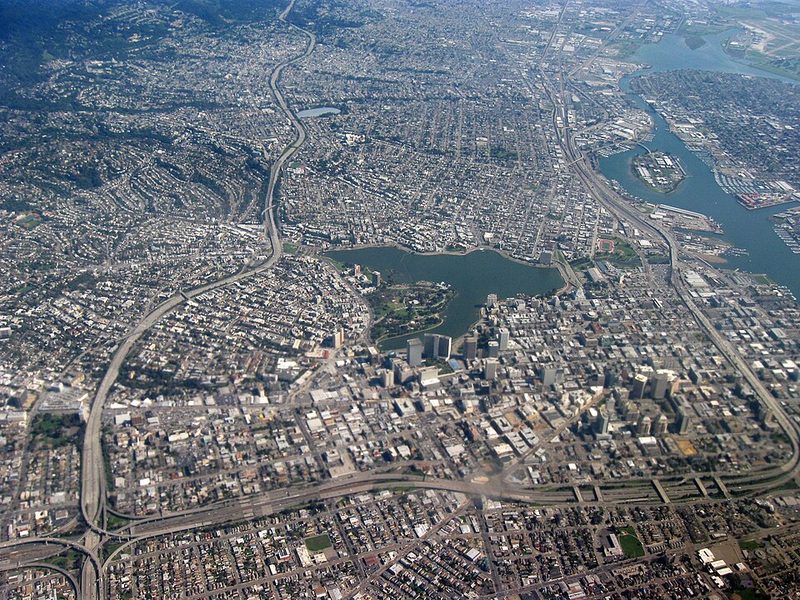
The city spreads across flatlands between the bay to the west and the Oakland Hills to the east. The port's enormous cranes are visible along the western waterfront—a working facility, not a leisure precinct, though the Jack London Square area nearby connects waterfront access with restaurants and the city's literary associations. Downtown Oakland has a mix of historic commercial architecture and newer development. Lake Merritt, a tidal lagoon near the centre of the city, functions as a popular local gathering point and provides a different character from the busier commercial streets. The hills to the east contain parks and trails, including Joaquin Miller Park, which locals frequently cite for its redwood forest.
History and Identity
Oakland was incorporated on 4 May 1852, driven by migration following the California Gold Rush. Its position on the bay made it a natural hub for trade, and the city grew around that commercial logic. The Port of Oakland became the busiest port in Northern California and remains among the leading ports in the United States by cargo volume.
The most internationally recognised chapter in Oakland's modern history is the founding of the Black Panther Party in October 1966. Huey P. Newton and Bobby Seale, then college students, established the organisation here in direct response to conditions facing Black residents in the city. The party initially drew attention for openly monitoring police activity while legally carrying firearms, and subsequently became a nationwide and internationally recognised political organisation. That history has a tangible presence in Oakland today: the Black Panther Party Museum in Downtown Oakland, operated by the Dr Huey P. Newton Foundation, holds the largest archival collection on the organisation in the world. Guided tours of historic party sites are available, including a walking tour led by original party members through the Black Panther Party Alumni Legacy Network.
Oakland has produced a notable number of figures across arts, politics, sport, and activism—a reflection of the density of creative and political energy the city has sustained across successive generations.
Oakland Museum of California
The Oakland Museum of California (OMCA), founded in 1969, is the city's principal museum and one of the more significant in the state. Its collections span art, history, and natural sciences, with more than 1.9 million objects across roughly 110,000 square feet of gallery space and a seven-acre campus that includes terraced gardens. The museum's galleries cover California art from the Craftsman movement through to the present, the state's natural ecosystems, and the social and political history of California communities. It is a practical first stop for visitors wanting context on the state and region before exploring the city itself. Check current opening hours and admission details directly with the museum before visiting.
The Port and the Economy
The Port of Oakland is the dominant economic institution in the city. It operates the Oakland Seaport and Oakland International Airport, and manages a significant commercial real estate portfolio including Jack London Square and waterfront property. The port's cranes—among the largest on the West Coast—are a defining element of the city's visual identity. For residents, the port is both major employer and physical backdrop. For visitors, it provides a constant reminder that Oakland's identity is rooted in industry and trade rather than leisure or finance.
Beyond the port, Oakland functions as the administrative and commercial centre of Alameda County and serves a broad regional role across the East Bay. The city's economy has diversified over recent decades, though the pressures of Bay Area housing costs have displaced some longtime residents and altered the character of certain neighbourhoods.
Culture and Annual Events
Oakland's cultural scene has developed organically from the city's communities rather than being built for outside audiences. The city has more than 50 art galleries and extensive street mural work. Annual events include the Black Joy Parade, the Día de los Muertos celebrations, Oakland Restaurant Week, and Hiero Day—a hip-hop block party celebrating the independent music scene that has its roots in Oakland. The Black Cowboy Parade and Heritage Festival, which has run for over four decades, marks the contributions of Black communities to California's western history. For current dates and schedules, check directly with organisers or the Visit Oakland website, as timings vary year to year.
Getting There and Around
Oakland International Airport, operated by the Port of Oakland, provides regional air access. The Bay Area Rapid Transit (BART) system is the most practical option for cross-bay travel: it connects Oakland directly to San Francisco and to other Bay Area destinations without requiring a car. For travel within Oakland, BART serves several stations across the city. Visitors should check current BART schedules and service notices at bart.gov before travelling, as service patterns change. The port handles cargo rather than passenger ferry services at scale, though ferry connections to San Francisco are available from other East Bay points.
Recent Context
Oakland has experienced significant social and economic change in recent decades, with Bay Area housing cost pressures displacing longtime residents and altering some neighbourhoods. The city's political culture remains active, reflecting a population with a long history of civic organisation around questions of equity and rights.
No specific travel advisory applies to Oakland from either US or UK authorities beyond standard national guidance. The UK Foreign, Commonwealth and Development Office (FCDO) advises normal precautions for travel to the United States as a whole, with no regional restrictions applying to Oakland or the wider Bay Area. Visitors should apply the same awareness they would use in any large American city, and consult the FCDO website at gov.uk/foreign-travel-advice/usa for current official guidance before travelling.
Jack London and Oakland
Jack London grew up in Oakland and worked around its waterfront docks, and the city's estuary shaped the themes of struggle and working-class life found throughout his fiction. Oakland has named a waterfront precinct — Jack London Square — in his honour, combining literary history with the active port backdrop that still defines this part of the city.
The most specific visitor point is Heinold's First and Last Chance Saloon, a wooden bar open since 1883 that London used as a regular writing and drinking spot. Johnny Heinold bought the building — originally an oyster workers' bunk room — for $100 and ran it as a bar for sailors. The floor tilts from the 1906 earthquake. In 1998, the saloon received a Literary Landmark designation from United for Libraries. The building has been maintained close to its original appearance since the Heinold family sold it in 1984. Visitors should check current opening hours directly with the saloon before visiting.
Jack London Square itself is accessible on foot from Oakland's waterfront and is served by BART. It functions as one of Oakland's main waterfront gathering points, with the Port of Oakland managing significant commercial real estate in the precinct.
Read the full Jack London and Oakland guide
Sources: Heinold's First and Last Chance Saloon - Wikipedia • Jack London - Wikipedia • History - Heinold's First and Last Chance Saloon • Heinold's First and Last Chance Saloon - Jack London Square • Jack London Square Then and Now - San Francisco Maritime National Park Association • Literary Landmark - Heinold's Saloon - United for Libraries
Lake Merritt
Lake Merritt sits near the centre of Oakland, roughly 3 kilometres east of the waterfront, and holds a distinction that most visitors do not expect: it is recognised as the first officially protected wildlife refuge in the United States. What looks like an urban park lake is, technically, a tidal lagoon — connected to San Francisco Bay through a channel — and it has been a public asset since the 1870s.
Sources: Lake Merritt - The Jewel of Oakland - City of Oakland • Lake Merritt - Wikipedia • 150th Anniversary of the Lake Merritt Wildlife Refuge - LakeMerritt.org • A Brief History - Lake Merritt Institute • Lake Merritt History - LakeMerritt.org
Black Panther Party History in Oakland
Oakland is where the Black Panther Party was founded in October 1966, and the city has treated that history with more sustained seriousness than most American cities apply to politically charged legacies. Visitors with an interest in twentieth-century civil rights history, American urban politics, or the cultural forces that shaped Oakland's identity will find specific, organised points of engagement here — not simply historical plaques.
The Founding
Huey P. Newton and Bobby Seale founded the Black Panther Party in Oakland in October 1966, establishing it as a direct response to the conditions facing Black residents in the city. The party's early actions — which included openly monitoring police activity while legally carrying firearms under California law — drew immediate public attention. It grew from a local organisation into a nationally and internationally recognised political movement. This history is acknowledged directly in the article as a living part of how Oakland understands its own politics, and that assessment is reflected in the ongoing institutional activity around preservation and interpretation of the party's sites and archives.
The Black Panther Party Museum
The Black Panther Party Museum was established in January 2024 by the Dr. Huey P. Newton Foundation, a nonprofit organisation that has worked to preserve and promote the party's legacy since 1995. The foundation describes itself as maintaining the largest archival collection on the Black Panther Party worldwide. In addition to the museum, the foundation offers a 90-minute bus tour that visits sites across Oakland where the party operated — an approach that treats the city itself as the primary exhibit rather than confining the history to a single building. The foundation has also commissioned a bronze bust of Dr Newton in West Oakland and secured the renaming of a street in Oakland in his honour.
Walking Tours and Historic Sites
The visit oakland tourism authority lists at least 12 Oakland locations connected to Black Panther Party history, and the organisation runs guided walking tours led by original party members through the Black Panther Party Alumni Legacy Network. These tours visit sites including locations of early party offices and organizing hubs in Oakland. The Alameda County Courthouse, where numerous trials involving party members took place, is among the sites integrated into the historical geography of the party's Oakland years. Visitors interested in these tours should book in advance and check current scheduling directly with the organising bodies, as availability and format can change.
Visiting
The Black Panther Party Museum is located in Downtown Oakland. The bus tour and walking tours operate on specific schedules; visitors should check current availability directly with the Dr. Huey P. Newton Foundation or the Black Panther Party Alumni Legacy Network before planning a visit. Group and private tours have specific booking requirements. The museum was newly established in 2024, so operational details should be verified with the institution directly.
Sources: Black Panther Party Museum • Black Panther Party Museum - Dr. Huey P. Newton Foundation • Black Panther Party Museum - Visit Oakland • Black Panther Party Legacy City Tour - Visit Oakland • Explore the Black Panther Party's History in Oakland - Visit Oakland
Oakland Museum of California (OMCA)
The Oakland Museum of California — known locally as OMCA — is one of the few institutions in the United States that brings art, history, and natural science under a single roof, all with an explicit focus on California as subject. Founded in 1969, it occupies a 110,000-square-foot gallery space on a seven-acre campus with terraced gardens in the area near Lake Merritt.
History and Collections
OMCA was formed in 1969 as a merger of three older Oakland institutions: the Oakland Public Museum, the Oakland Art Gallery, and the Snow Museum of Natural History. The Oakland Public Museum had itself opened in 1910 at the Camron-Stanford House, with its first curator, Charles P. Wilcomb, assembling a collection representing California's Native American cultures and settler history. The seeds of the 1969 merger were planted in 1954, when the three organisations formed a nonprofit association with the goal of eventually combining. The merged institution describes its founding ethos as being a museum for the people, and it has consistently framed its programming around community access and participation.
The collections total more than 1.9 million objects across the three disciplines. The art collection holds a notable body of paintings and decorative objects associated with the American Craftsman movement, including a large collection of work by Arthur Mathews and his wife Lucia Kleinhans Mathews. The natural science galleries cover California's plant and animal life, including species endemic to the state, with many of the original dioramas and habitat cases from the 1969 opening retained alongside newer material. The history galleries bring together first-person accounts and often undertold narratives of California life across different periods and communities.
What Visitors Will Find
The galleries cover California art, California history, and California natural sciences, each presented with an emphasis on connecting the collections to the lived experience of people in the state. OMCA also runs regular special exhibitions. The museum campus includes terraced gardens, which function as both public space and part of the overall site experience. The institution has used its programming to engage with Oakland's specific history: a recent event at the museum drew on the legacy of the Black Panther Party's community engagement strategies and Octavia E. Butler's writing, reflecting the museum's approach to connecting California's cultural history with current community narratives.
Practical Notes
OMCA is located in Oakland near Lake Merritt and is accessible via the Lake Merritt BART station. Visitors should check current opening hours, admission details, and special exhibition schedules directly with the museum, as these change. The museum's website (museumca.org) is the reliable source for current programming and access information.
Sources: Oakland Museum of California - Wikipedia • Oakland Museum of California - OMCA Official Site • About Us - Oakland Museum of California • Oakland Museum of California - Visit Oakland • What to Do at the Oakland Museum of California - Visit California
Oakland's Hip-Hop and Music Scene
Oakland's contribution to American popular music is substantial and well-documented, particularly in hip-hop, where the city produced a distinct body of artists and sounds from the late 1980s onwards that shaped both the West Coast regional scene and national rap culture more broadly.
Sources: The Oakland Museum Gives Hip-Hop Due Respect - KQED • Explore the Rich History of Oakland Hip Hop Artists - My Music Pie Chart • Bay Rising - Oakland Music's Moment in the Sun - The Ringer • Oakland's Underground Hip-Hop Scene - Onassis Krown • A Guide to Oakland's Top Events and Festivals - Executive Inn and Suites Oakland