

What Omaha is known for
Omaha sits along the Missouri River in the heart of the American Midwest, a city of nearly half a million people that punches above its weight in the nation's economic and cultural life. Named after the U-Mo'n-Ho'n Native American tribe whose territory once covered this region, it has evolved from a fur trading post into one of the country's most significant transportation and finance hubs. Today it remains Nebraska's largest city and a place where historical identity as a pioneer supply station and meatpacking centre has given way to a modern, diversified economy anchored by five Fortune 500 companies.
Arrival and First Impressions
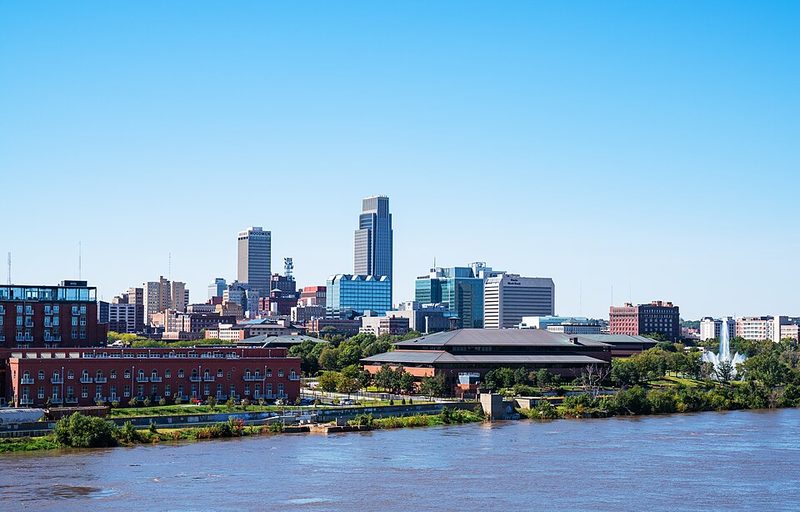
The city spreads across Douglas County along the Missouri River, which forms the border with Iowa and Council Bluffs. Eppley Airfield provides the main air access, with the airport situated close to the city centre. The landscape is gently rolling, with a continental climate that brings distinct seasons—Nebraska winters can be harsh, and visitors driving should check conditions during colder months. What strikes many visitors is the scale: Omaha has the infrastructure and cultural institutions of much larger cities, yet it remains compact and navigable. The metropolitan area encompasses roughly 2,400 square miles and approaches one million residents when nearby Iowa communities are included.
The Old Market district, with its preserved brick streets and 19th-century commercial architecture, anchors the downtown area and represents the city's most visited quarter. Historic Union Station, now home to The Durham Museum, stands as an architectural reminder of the railway heritage that once defined the city. Newer districts show how quickly the regional economy has grown, particularly since the early 1990s.
From Fur Trading Post to Finance Hub
Omaha's identity is rooted in its role as a crossroads. Indigenous peoples, including the Omaha tribe, occupied this territory before the United States government negotiated a treaty in 1854 that opened the land to settlement. The city was founded the following year as a fur trading post and quickly became a vital supply station for pioneers moving westward. It served as the Nebraska Territory Capitol from 1853 to 1867 during this formative period.
The decades after the Civil War brought dramatic change. Commercial development from 1868 onwards transformed Omaha into a meatpacking and shipping centre, capitalizing on its proximity to agricultural production and its position as a major rail hub. Stockyards and meat processing plants became the economic engine that defined the city for generations.
Between 1900 and 1941, Omaha entered what local historians call an "Establishment Era," marked by growth in sports, cultural institutions, and infrastructure. The symphony orchestra, art institute, and community playhouse were all founded during this period, with a 1920s newspaper predicting, with remarkable prescience, that "the cultural future of Omaha seems as certain of greatness as the commercial future."
Modern Economy and Medical Leadership
The shift from meatpacking and manufacturing to a modern service and finance economy has been one of Omaha's defining stories. Today, the city is home to five Fortune 500 companies and serves as a major centre for finance, insurance, telecommunications, and information technology. Banking and transportation remain significant sectors. This economic diversification has made Omaha more resilient and economically vibrant than many mid-sized American cities.
The city has also become known for its medical and research institutions. Home to both the University of Nebraska Medical Center and Creighton University Medical Center, Omaha holds the distinction of being the smallest city in America to support two major research hospitals—a point of local pride that speaks to the city's commitment to healthcare and scientific advancement. The University of Nebraska Omaha, founded in 1908 as a private non-sectarian college, has grown into a public research university that contributes significantly to the city's intellectual life.
Cultural Life and Institutions
Cultural life is reflected in museums, galleries, and the performing arts. Omaha's Henry Doorly Zoo attracts visitors from across the region and holds an international reputation for its conservation work and indoor exhibits. The Durham Museum, housed in the art deco Union Station, plots the history of Omaha through exhibitions on different facets of historic life in the city. The Old Market district represents another cultural anchor, preserving some of Omaha's older commercial character whilst offering galleries, restaurants, and shops.
El Museo Latino, the first Latino art and history museum in the Midwest, opened in the city, whilst the Strategic Air Command and Aerospace Museum displays military aircraft from the Cold War era. Boys Town, a national historic landmark on the city's outskirts, features an expansive campus, historic chapel, and museum documenting the social reform movement founded there in 1917.
The city's diversity is visible in its population, which includes substantial White, African American, and Hispanic communities, each contributing to local culture and identity. Distinct neighbourhoods such as Benson, the Jazz District, and South Omaha each maintain their own character, whilst districts like Blackstone and Aksarben have emerged as centres for dining and nightlife.
Getting Around
Public transit in Omaha is provided by local bus service, though the extensive streetcar network that once defined urban mobility—operating from 1886 until its closure in 1955—is no longer in operation. The city sits on major highways, making road access straightforward for those driving from other parts of the Midwest. Multiple bridges connect Omaha to Council Bluffs and Iowa; the Bob Kerrey pedestrian bridge allows visitors to walk across the Missouri River and straddle the border between the two states.
Practical Information
Omaha offers visitors an unusually complete city experience for its population size—major research institutions, cultural venues, a significant military presence at nearby Offutt Air Force Base, and the kind of economic vitality that shows in active downtown areas and new development. The city is notably affordable compared to larger American metros, making it accessible for extended visits.
The United Kingdom Foreign, Commonwealth and Development Office advises normal precautions for travel to the United States. No specific restrictions apply to Omaha or Nebraska. Visitors should consult current official travel advisories at gov.uk/foreign-travel-advice and travel.state.gov before departure.
Old Market District
The Old Market Entertainment District preserves several blocks of Omaha's 19th-century wholesale commerce area, where original brick and cobblestone streets now support the city's primary concentration of restaurants, art galleries, and independent shops. Buildings from the turn of the 20th century house over 45 dining and drinking establishments, working artist studios, and retailers selling locally made goods. The district's preservation began in the 1970s under developer Sam Mercer, whose commitment to adaptive reuse established the model for maintaining architectural integrity while allowing contemporary commercial use.
Visitors encounter a compact, walkable neighbourhood where covered sidewalks and horse-drawn carriages deliberately echo the area's commercial past. First Friday art walks provide monthly opportunities to visit galleries and meet artists, while the district's restaurants offer options from established fine dining to newer concepts focused on regional ingredients and craft beverages. Parking is available through metered street spaces (with 3-hour limits) and nearby city garages charging $1-$2 per hour. The Old Market Association maintains a historical walking tour with plaques identifying significant structures and explaining their role in Omaha's development. Peak activity occurs on Friday and Saturday evenings, though the district operates throughout the week without set hours.
Read the full Old Market District guide
Sources: The Old Market - Official Site • Old Market Historical Walking Tour • Old Market District - Visit Omaha • Old Market (Omaha, Nebraska) - Wikipedia • Old Market Parking Information
Strategic Air Command Museum
The Strategic Air Command & Aerospace Museum, located near Ashland approximately 25 miles southwest of Omaha on Interstate 80, houses one of America's largest collections of Cold War aircraft and missiles. The 300,000-square-foot facility preserves the history of the Strategic Air Command, which operated from nearby Offutt Air Force Base from 1948 until 1992. Nine bombers anchor the collection, including the B-36J Peacemaker, B-17 Flying Fortress, and B-1A Lancer, alongside the SR-71 Blackbird reconnaissance aircraft—a Cold War icon that flew at speeds above Mach 3 throughout its 1966-1998 service life.
Beyond aircraft, exhibits display missiles, Apollo Command modules, and supporting equipment that explain Strategic Air Command's role in nuclear deterrence strategy. The museum operates six days per week year-round, with opening times typically at 9:00 AM weekdays and Saturdays, later on Sundays. Visitors should verify current hours before travelling. Educational programmes focus on STEM subjects and connect historical aerospace achievements to contemporary innovation. The museum's position between Omaha and Lincoln makes it accessible from either city, and its location reflects Omaha's continuing defence infrastructure role through nearby Offutt Air Force Base.
Read the full Strategic Air Command Museum guide
Sources: Strategic Air Command & Aerospace Museum • SAC Museum Visitor Information • Strategic Air Command & Aerospace Museum - Wikipedia • SAC Museum - Visit Omaha
Henry Doorly Zoo
Omaha's Henry Doorly Zoo and Aquarium operates as a non-profit institution across 160 acres, distinguished by three record-holding indoor exhibits that enable year-round operation despite Nebraska's climate extremes. The Desert Dome, world's largest indoor desert at 84,000 square feet, recreates ecosystems from the Namib, Australian Red Center, and Sonoran Desert beneath a massive geodesic dome. Below it, Kingdoms of the Night functions as the world's largest nocturnal exhibit, with reversed day-night cycles allowing observation of cave, canyon, and swamp species during their active periods. The Lied Jungle, America's largest indoor rainforest, spans seven acres and rises 80 feet to accommodate full rainforest stratification from floor to canopy.
The zoo opens year-round except Thanksgiving and Christmas Day, with seasonal hours varying from 9:00 AM-5:00 PM (March-October) to 10:00 AM-4:00 PM (November-February). Major indoor exhibits close at 4:00 PM regardless of overall zoo hours. The facility's scale requires a full day for comprehensive visits. Beyond exhibition, the zoo maintains international recognition for large cat artificial insemination research, contributing to global conservation programmes. The seven acres of climate-controlled indoor space make winter visits particularly practical when outdoor exhibits elsewhere would be inactive or closed.
Sources: Omaha's Henry Doorly Zoo and Aquarium • Zoo Hours and Admission • Henry Doorly Zoo - Wikipedia
Berkshire Hathaway Annual Meeting
The Berkshire Hathaway annual shareholders meeting, held each spring in Omaha, has earned the informal title "Woodstock for Capitalists" for its scale and the dedicated following it attracts. The event typically draws tens of thousands of shareholders and observers from around the world to Warren Buffett's hometown for a weekend that combines the formal corporate annual meeting with shopping opportunities, networking events, and educational sessions about investing and corporate governance. The 2026 meeting marked a significant transition, as it was the first conducted without Warren Buffett at the helm following the leadership transition to CEO Greg Abel.
Sources: Berkshire Hathaway 2026 Annual Meeting Updates - CNBC • Berkshire Hathaway Official Visitor Guide • Visit Omaha - Annual Meeting Planning • Berkshire Meeting Under New CEO - Business Insider