In This Guide
Piran, Municipality of Piran
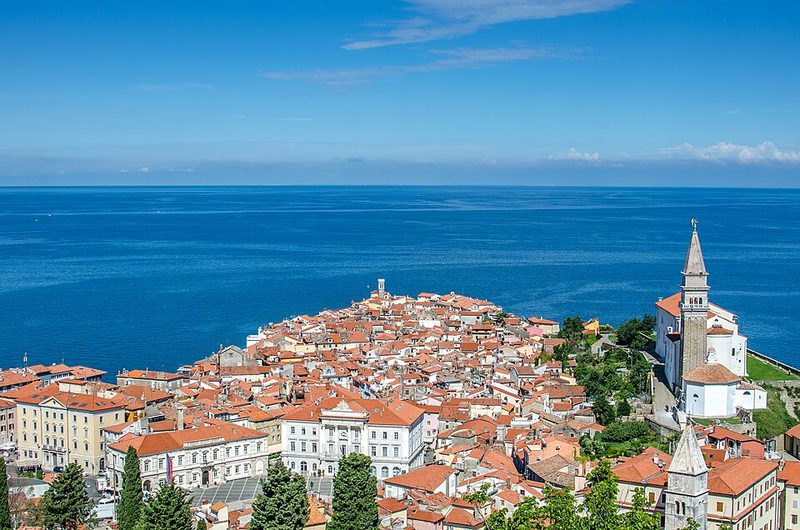
Jutting into the Adriatic on a narrow peninsula at the southern tip of Slovenia, Piran is a town of around 4,000 residents that carries a remarkable amount of cultural weight. The alleyways are tight enough that neighbours could shake hands across them; the stone buildings rise in warm ochres and terracottas that reflect centuries of Venetian rule; and the sea is never more than a short walk away in any direction. Piran is the birthplace of Giuseppe Tartini, the eighteenth-century Italian violinist and composer, and the town has claimed that connection proudly ever since — in its central square, its theatre, and the summer concerts that fill its monastery cloister.
First Impressions and Setting
Arriving in Piran, the first thing most visitors feel is the gentle compression of the town. Streets that look barely wide enough for two people open suddenly into small squares or deliver you to the harbour edge without warning. The town sits at the tip of a peninsula enclosed by the Gulf of Piran, with the bays of Strunjanski Zaliv, Portoroški Zaliv and Fiesa Bay forming a sheltered arc of coastline around it. On clear days the wider Adriatic stretches toward the Italian and Croatian coasts. The old town is closed to private vehicles, so the dominant experience once inside is pedestrian — which suits the medieval layout well. Visitors arriving by car will find parking areas outside the old city gates and should expect to walk in from there.
Tartini Square and the Theatre
The main square, Tartinijev Trg, was completed in 1894 and named after the town's most famous son. A bronze statue of Tartini stands at its centre. The square is widely regarded by local sources as the visual heart of the old town — both at ground level and, for those who climb the town walls, from above.
Opening directly off the square is the Tartini Theatre, which Culture of Slovenia identifies as one of the most acoustically distinctive performance spaces in the country. The theatre was opened on 27 March 1910, with the staging of the tragedy Phaedra by Umberto Bozzini. Decorative and painting work inside was carried out under the leadership of the Trieste artist Napoleon Cozzi (1867–1916). By removing the seating, the venue can also host dance events, receptions and gala dinners, and it remains in active use for concerts, theatrical performances, symposiums and multimedia shows. Visitors interested in what is scheduled should check locally, as this guide does not carry live programming data.
Venetian Architecture
Piran's medieval layout, compact harbour, loggia and Venetian Gothic facades all reflect the centuries during which this stretch of the Istrian coast was governed by the Republic of Venice. The Venetian Palace, standing on the old harbour, is one of the town's most photographed buildings and a natural orientation point for anyone exploring the old town on foot or arriving by water. I Feel Slovenia identifies it among the defining Venetian-era structures of the Slovenian Adriatic coast. The building is visible from the waterfront approach and from Tartini Square, making it a consistent reference point throughout the old town. A second Gothic building, the Venetian House on Tartini Square, features a fine late-Gothic facade and is noted in visitor sources as a distinct landmark; research into the precise relationship between these two buildings is ongoing, and visitors should treat them as separate structures unless a local guide confirms otherwise.
Music, Culture and the Monastery Cloister
Piran is bilingual in the most concrete sense: Slovenian and Italian are both spoken and both officially recognised within the municipality, a legacy of the town's history as part of the Italian cultural sphere before the post-war redrawing of borders. That dual identity shows in the town's daily life — in language, food, architecture and civic culture.
The Piran Musical Evenings series, organised by the Portorož Auditorium, is one of the more distinctive summer cultural offers on the Slovenian coast. According to Culture of Slovenia, it traditionally takes place in the cloister of the old Franciscan Monastery in Piran, with additional concerts at the Tartini Theatre, the Church of St Francis and the Church of St George (which has organ concerts). A classical music concert in an open Renaissance courtyard, with the sky overhead as the only roof, is a specific and unhurried experience of the kind the town's scale makes possible. Exact annual programming should be confirmed with the Portorož Auditorium before planning a visit around it.
For those interested in the town's own nightlife beyond concert programming, venue sources identify Round Midnight as a popular jazz-oriented bar with live music, and Tipico as a bar where local bands perform. The evening scene is modest in scale but genuine; it is not a place to arrive expecting large clubs or a late-night district.
Sergej Mašera Maritime Museum
The Sergej Mašera Maritime Museum holds collections covering Adriatic seafaring history, salt production and the naval heritage of Slovenian Istria. It is named after a Second World War Slovenian naval hero. Culture of Slovenia describes it as one of the more substantive cultural institutions on the Slovenian coast. The collections provide context for the salt-pan economy that shaped this coastline for centuries — a trade that was, for much of Piran's history, more economically significant than fishing. Current opening hours and admission details should be confirmed locally before visiting, as this guide does not carry live operational data.
The Waterfront and Nearby Coast
The harbour is the natural gathering point. Boats sit in the water directly below the old town walls, and the promenade along the waterfront connects Piran to the broader coastal area. Boat trips on the Gulf of Piran are a reasonable draw, and the sheltered bays nearby — Fiesa Bay, Strunjanski Zaliv and Portoroški Zaliv — offer calmer waters that have historically attracted watersports activity. Visitors should confirm local operator availability on arrival rather than assuming a fixed seasonal schedule.
The nearby village of Strunjan sits within a protected landscape area and is reachable in a short distance from Piran, making it a worthwhile option for those who want to step outside the dense medieval streetscape into a quieter stretch of coast. The settlements of Portorož, Lucija and Seča form part of the same coastal strip and are easily reached, giving the area a layered character that rewards exploration beyond the old town itself.
Getting There and Around
Piran's old town is closed to private vehicles. Parking areas outside the old city gates are the standard approach for visitors arriving by car, and the town is compact enough to navigate entirely on foot once inside.
Public bus services connect the coastal zone with the wider Slovenian and regional network. The local town bus — Route 1, operated by Arriva Slovenija — runs frequently between Piran, Portorož and Strunjan. Intercity coaches operated by Nomago, Arriva and FlixBus provide routes to Ljubljana, Koper, Trieste, Venice and other destinations, according to the Portorož & Piran official transport page. For current timetables and routes, check with Arriva Slovenija or Nomago directly before travel.
Piran has a seasonal ferry connection that is one of its more practical differentiators. Foot-passenger ferry services to Venice are operated by Venezia Lines from approximately April to October; the Prince of Venice (route 828, operated by Adriatic Lines) is a foot-passenger-only service. The ferry port is located at Tartinijev trg 1. Additional seasonal connections to destinations in Croatia are served by Liberty Lines and other operators. Sailing times take roughly three hours to Venice but vary by operator and season. Visitors should verify current schedules and booking directly with the operators before travel, as services are seasonal and subject to change.
The nearest international airport is in Trieste, Italy. Ljubljana's Jože Pučnik Airport is also a realistic option for arrivals from further afield, though access details and timetables should be confirmed before travel.
Practical Notes
Both the UK Foreign, Commonwealth and Development Office and the US State Department currently place Slovenia at their lowest advisory levels — normal precautions and Level 1 respectively — with no specific security concerns identified anywhere in the country. The town's peak season brings significant visitor numbers, and advance booking of accommodation is advisable in summer. The quieter winter months offer a noticeably different experience: fewer crowds but also reduced services and seasonal closures. Travel insurance appropriate to planned activities is standard practice for any international trip.