Evening in Piran: A Violin, a Courtyard and the Adriatic Dark
The ferry from Venice had been three hours of flat grey water and diesel light. By the time the boat rounded the peninsula and the old town came into view — a wedge of terracotta and whitewash pressing into the Gulf of Piran — the October evening had already started. The port was at Tartinijev trg 1, which turned out to mean: you step off the gangway and you are already in the square.
Tartini Square in October is not the square of August postcards. The oval piazza — completed in 1894, its elliptical shape catching every visitor's attention — was quiet enough that the bronze statue of Giuseppe Tartini stood in real silence. He holds a sheet of music and looks outward, toward the water. Born here in 1692. Named after here, or the other way around: the square was named after him, the theatre was named after him, the summer concert series carries his name. A town of 4,000 people can carry one famous son for a very long time.
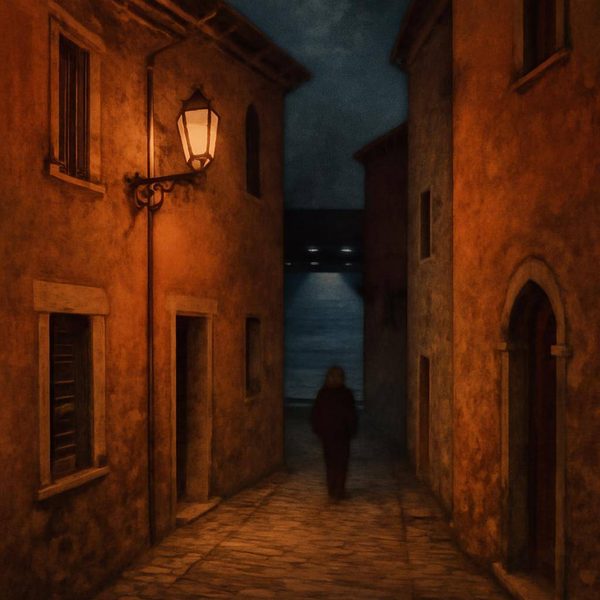
The lanes behind the square were narrow enough to require some negotiation. Compact houses stacked their terracotta rooflines toward the dark, and the sea appeared at the end of each alley without ceremony — a flat pewter strip visible between the walls, then gone again as the lane bent. On the waterfront promenade, a small number of boats sat at their moorings with the low-level patience of things that spend most of their time waiting.
The Tartini Theatre stands a short walk from the square. It opened on 27 March 1910 with the staging of the tragedy Phaedra by Umberto Bozzini — a choice that nobody, in retrospect, seems to have questioned as an opening night for a venue named after a violin virtuoso. The decorative work inside was carried out by the Trieste painter Napoleon Cozzi (1867–1916). Culture of Slovenia describes it as one of the most acoustically accomplished performance venues in the country, which is a specific claim and not the usual kind of tourist-office softening. The building has a quality that empty theatres sometimes have: the sense that sound is waiting somewhere in the plasterwork, ready to be useful again.
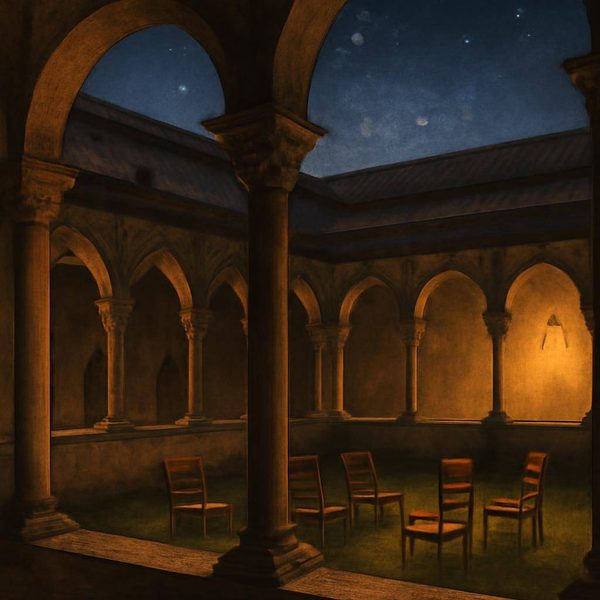
The summer concert series — the Piran Musical Evenings, organised by Portorož Auditorium — was over for the year by October. It runs in the cloister of the old Franciscan Monastery, with additional concerts at Tartini Theatre and at St George's Church on the hill above the town. Visitors who have attended describe looking upward between movements and finding a sky full of stars where a ceiling should be. That detail is worth planning for: the series runs in summer, and October is too late.
The hilltop church gave the better view. St George's Parish Church sits at the highest point of the peninsula, and from its churchyard the full layout of the town was visible in the last of the evening light — the narrow spit of land surrounded on three sides by water, the Gulf of Piran to the south and west, Strunjanski Zaliv to the northwest, Portoroški Zaliv to the northeast. The compactness of Piran only becomes comprehensible from above. From the lanes, it simply feels close and old. From the hill, it reveals itself as something a cartographer would call a peninsula and a traveller would call a good reason to miss the last bus back.
The ferry back to Venice did not run in October. That is the other thing worth checking before arrival: the seasonal service operates from approximately April to October, and the foot-passenger-only Route 828 — operated by Adriatic Lines aboard the Prince of Venice — closes for winter. The bus to Portorož, however, runs year-round on Arriva Route 1, and Portorož connects onward by coach to Koper, Trieste and Ljubljana. Getting out of Piran in the off-season is straightforward; it just requires a bus rather than a violin-maker's idea of a journey.
Frequently Asked Questions
Can you reach Piran by ferry from Venice?
Seasonal foot-passenger ferries normally link Venice and Piran in the warmer months, with the Piran terminal close to Tartini Square. Check the current operator timetable before planning around it, because winter service is reduced or absent.
Where does this Piran evening story take place?
The route centres on the waterfront arrival, Tartini Square, the Tartini Theatre, the Franciscan monastery cloister and the view up toward St George's Church. These are compact old-town locations, so the story can be followed on foot without transport once you are in Piran.
Is the story first-hand reporting?
No. It is a fictional visitor story generated from source-backed place facts and Piran cultural references. The places, transport notes and historical references are real; the visitor character and narrative scenes are invented.
This is a fictional visitor story generated from source-backed place facts, image evidence and visitor-feel signals. It is not a first-hand WorldTownGuide visit. Named places, routes and historical references are source-backed; the visitor character and narrative events are invented.
Sources
Bus and shuttle transport - Portoroz and Piran • Tartini Theatre - Culture of Slovenia • Piran Musical Evenings - Culture of Slovenia • Ferry from Piran to Venice (Venezia) - Croatia Ferries • Explore the culture and heritage of Piran - Portoroz and Piran • 20 Things to Do in Piran, Slovenia - Wander-Lush