In This Guide
Read the guide as a story
The Field of Montaperti: Walking with Siena's Ghosts
Siena, Tuscany
Few cities in Europe wear their medieval bones as confidently as Siena. Perched on three limestone ridges in the heart of Tuscany at roughly 342 metres above sea level, this compact city of 53,901 people has resisted the urge to modernise its historic core so thoroughly that walking its narrow streets can feel like stepping inside a 13th-century painting — which is, historically speaking, exactly where you are.
First Impressions and Setting
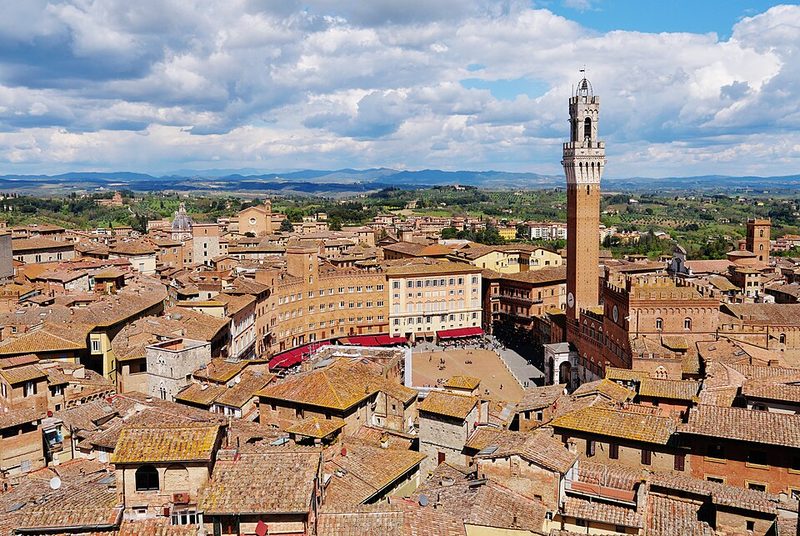
Arriving in Siena's centro storico, the first thing most visitors register is the colour. The warm reddish-brown of local brick is so distinctive that the pigment now bears the city's name: raw sienna. The streets tighten and steepen as you move away from the edges of the ridge, and then, without much warning, the city opens onto the Piazza del Campo — a vast, shell-shaped square that tilts gently toward the Palazzo Pubblico and its soaring Torre del Mangia. The Campo serves simultaneously as the city's civic heart, its favourite sun trap, and the arena for one of the most electric events in the Italian calendar. Visitors should be aware that the square's famous red brick is uneven underfoot in places; the gentle slope catches some people by surprise.
Piazza del Campo
Piazza del Campo is Siena's civic stage as much as its main square: a shell-shaped brick basin framed by the Palazzo Pubblico, the Torre del Mangia and the cafes where visitors naturally pause. The Campo is also the arena for the Palio, so its visitor appeal is architectural, political and ceremonial at the same time.
At the lower edge of the square, the Palazzo Pubblico and Museo Civico hold Simone Martini's Guidoriccio da Fogliano and Ambrogio Lorenzetti's Allegory of Good and Bad Government, two of the most important civic paintings of medieval Europe. The Torre del Mangia climb gives the classic view back over the square and the surrounding roofscape; check current access before planning around it.
Fonte Gaia, the monumental fountain on the Campo, adds another layer of provenance. Jacopo della Quercia carved the original early fifteenth-century sculptures; the fountain seen in the square today is a later copy, while original elements are preserved in Santa Maria della Scala.
Read the full Piazza del Campo guide
History and Identity
Siena's medieval character is not accidental. The city flourished as a banking and trading centre between the 12th and 14th centuries, rivalling Florence for wealth and political influence. That rivalry was shaped by genuine military conflict: in 1260 the Battle of Montaperti saw Sienese forces defeat Florence in one of the bloodiest engagements of medieval Italy, an event still cited with quiet local pride. The city's fortunes diminished after the Black Death struck in 1348, and Florentine domination followed, but the architectural legacy of the earlier golden age remained largely intact. The epidemic broke the demographic and financial momentum that had driven Siena's most ambitious building programmes, helping explain why so much of the 13th- and early-14th-century city survived rather than being overwritten by later growth. That survival is part of why UNESCO recognised Siena's historic centre as a World Heritage Site.
Central to the city's identity are the contrade, the seventeen neighbourhood districts that divide the city into fierce, loyal factions. Each contrada has its own symbol, colours, patron saint, museum and governing body.
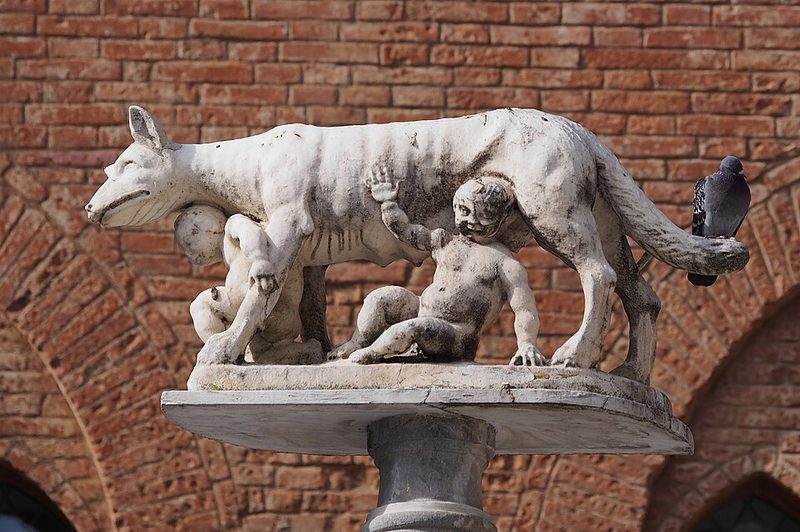
Siena's founding myth is visible in the she-wolf sculptures that appear around the city. Local tradition links Siena to Senius and Aschius, sons of Remus, who were said to have fled Rome on black and white horses carrying the Capitoline she-wolf image. The story is legend rather than documentary history, but it explains why the Roman she-wolf and the black-and-white balzana colours remain embedded in Sienese civic identity.
The Palio and the Contrade
Twice a year these neighbourhoods converge on the Campo for the Palio di Siena, a bareback horse race of extraordinary intensity that dates in its current form to 1656 but draws on much older traditions. The races run on 2 July and 16 August. The Palio is not a tourist spectacle performed for outsiders — it is a living expression of neighbourhood identity that the Sienese regard with complete seriousness. Visitors are welcome to watch from the Campo on race days, but the centre fills hours before the race; arriving early and accepting the crowd pressure is part of the experience. For those who want a quieter way into the culture, many contrade maintain their own small museums that are open outside race season and are worth seeking out.
Read the full Palio and contrade guide
The Duomo and the Sienese Painting Tradition
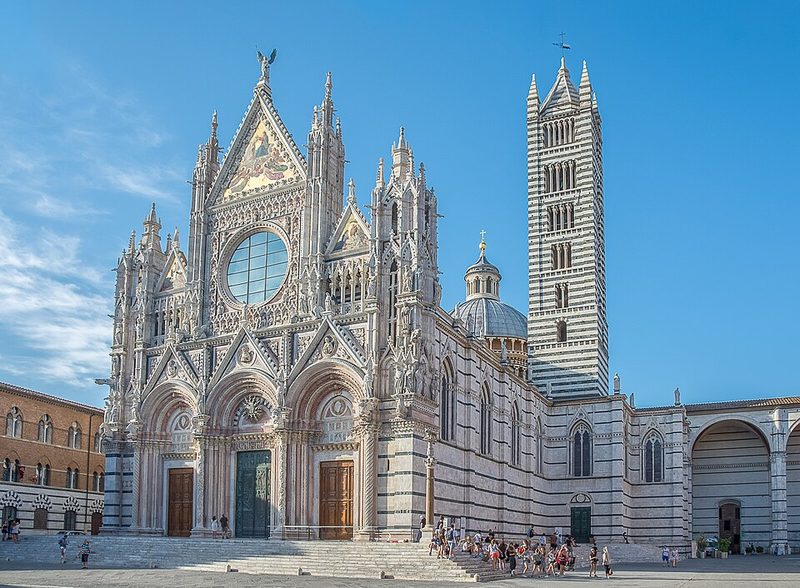
The Cattedrale di Santa Maria Assunta — the Duomo — is one of the most elaborately decorated Gothic cathedrals in Italy. Its black-and-white striped marble facade rises above a hilltop that commands views across the city. The interior is dense with craftsmanship, but the wider Duomo complex also includes the Facciatone, the unfinished facade of a nave extension that was abandoned after the Black Death of 1348 halted Siena's ambition to build the largest cathedral in Christendom. The climb to the top of the Facciatone rewards visitors with panoramic views over the roofscape and surrounding hills.
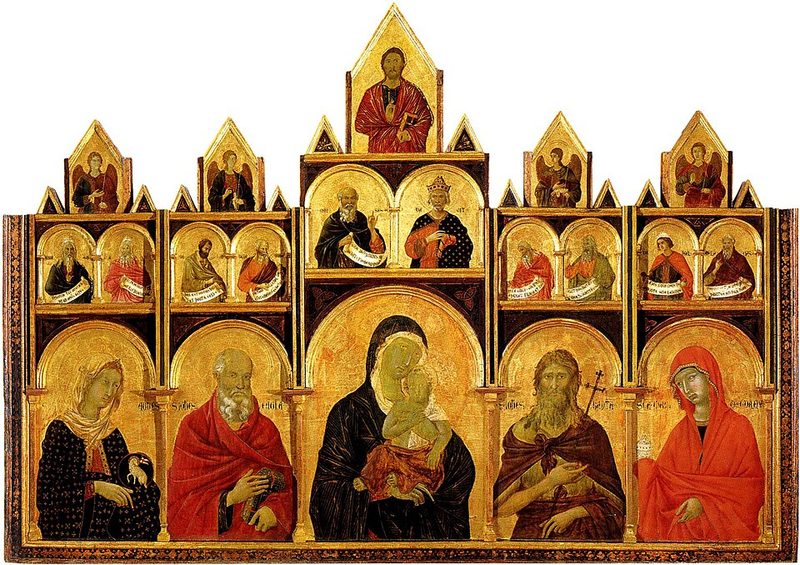
The cathedral is a natural starting point for understanding Siena's contribution to European art. The Sienese painting school pre-dates the Florentine Renaissance and produced artists of remarkable refinement. Duccio di Buoninsegna — whose Maestà altarpiece was paraded through the streets of Siena in 1311 when it was completed — established a visual language of gold-ground devotional painting that influenced workshops across Italy and beyond. Visitors to the Duomo museum will find the dismantled panels of the Maestà itself; the major civic paintings by Simone Martini and Ambrogio Lorenzetti belong to the Palazzo Pubblico visit on Piazza del Campo.
The Pinacoteca Nazionale on Via San Pietro completes that picture. Housed in the Buonsignori and Brigidi palaces, it is one of the most important collections of Sienese painting, with works from the 13th to the 17th centuries and particular depth in the golden-ground tradition that makes Siena visually distinct from Florence.
Santa Maria della Scala
Directly opposite the Duomo stands Santa Maria della Scala, a former hospital complex that operated continuously for nearly a thousand years before its conversion into a major cultural and museum space. Its frescoed halls document medieval civic life in unusual detail and form one of the more striking heritage sites in the city in their own right. It is worth treating as a separate destination rather than a footnote to the cathedral visit.
Saint Catherine of Siena
Siena holds a claim of deep religious significance through Saint Catherine of Siena, born in 1347 in the Fontebranda district of the city. A mystic, theologian and Doctor of the Church, she was later declared co-patron of Italy and of Europe. Her life and spiritual legacy are woven into the fabric of Sienese culture and are commemorated at the Basilica Cateriniana San Domenico, a large Gothic church on the city's western ridge where important relics associated with her are preserved. The birthplace in the Fontebranda neighbourhood is also open to visitors.
Other Churches Worth Seeking Out
Beyond the headline sites, several other churches reward attention. The Chiesa di Santa Maria di Provenzano holds special significance within the Palio tradition — the July race is run in her honour — and is a working church with a distinct neighbourhood feel rather than a heritage monument set apart for tourism. The streets between all these landmarks pass through neighbourhoods that feel genuinely lived-in rather than purely curated for visitors.
Music and Cultural Life
The University of Siena, founded in 1240 and one of the oldest in Europe, gives the city an academic undercurrent that tempers the heritage-tourism atmosphere. The Accademia Musicale Chigiana, established in the city, is a well-regarded institution for classical music study and performance, organising concerts and opera throughout the year with the summer season as its peak; a partnership with the Opera della Metropolitana has extended its reach into the Duomo complex itself. Siena Jazz, which reached its 54th edition in 2024, is a separate festival drawing international performers to the city in summer. Bars and live music venues in the old streets serve both students and visitors; the scene is modest by major-city standards but genuine. Visitors looking for current programming should check local listings through visitsiena.it or the Siena Jazz website directly, as venues and events shift between seasons.
Markets and Food
The principal outdoor market in Siena runs at La Lizza, adjacent to the Fortezza Medicea, and is a practical weekly event rather than a tourist set-piece. Sienese food has its own character distinct from generic Tuscan fare: panforte, a dense spiced fruit-and-nut cake, and ricciarelli, soft almond biscuits, are the products most closely identified with the city and are sold in bakeries and specialist food shops throughout the centre. The Monte dei Paschi di Siena, founded in 1472 and widely described as the world's oldest surviving bank, remains a local institution whose presence is felt across the city's commercial life.
Day Trips from Siena
The surrounding province rewards those who can extend their stay. Monteriggioni, a small walled hilltop village visible from certain points around Siena, is reachable in under 30 minutes. San Gimignano, known for its medieval towers, Montalcino — the base for Brunello wine — and the UNESCO-listed Val d'Orcia landscape are all within comfortable day-trip distance. Most of these destinations are most easily reached by car or by organised excursion, as rural bus connections can be infrequent; visitors relying on public transport should verify routes and times in advance.
Getting There and Around
Siena does not have a direct high-speed rail link. The practical approach for most visitors arriving by public transport from Florence is the bus: Autolinee Toscane operates route 131R between Florence's Autostazione bus terminal (adjacent to Santa Maria Novella station) and Siena, with a journey time of roughly 75 minutes. Train services between Siena and Florence exist but are slower and involve changes, typically taking 90 minutes to two hours depending on the connection. From Rome, coach services operated by various operators provide a direct connection; journey times are approximately three hours. Visitors arriving by air will typically use Pisa or Florence airports, both of which have onward bus connections to Siena; Siena Ampugnano Airport (SAY) handles only limited charter and private traffic and is not a practical arrival point for most international visitors. Timetables and tickets for Autolinee Toscane services can be checked at at-bus.it.
The historic centre is largely closed to private vehicles and is enforced by ZTL camera systems. This makes it quieter and more walkable than many Italian cities of comparable size, though the terrain is hilly enough that comfortable footwear matters. The city's local bus network connects the lower station area to the upper city; services OS3 and OS9 are among those that approach the area near the Piazza del Campo. Visitors arriving by car will find parking outside the walls, including at the large lot near the railway station, from which a mobile escalator provides access up toward Porta Camollia.
Practical Notes
The UK Foreign, Commonwealth and Development Office advises normal precautions for Italy, with no specific restrictions applying to Siena or its region. Standard travel insurance appropriate to your planned activities is recommended before travel. Italy is part of the Schengen Area, so passport and entry requirements apply according to your nationality; check current requirements with official government sources before travelling.
Siena is a city with genuine local knowledge running deep in its neighbourhoods and institutions. If you have first-hand experience of living or travelling here, your contributions to help keep this guide accurate and useful are welcome.