The Field of Montaperti: Walking with Siena's Ghosts
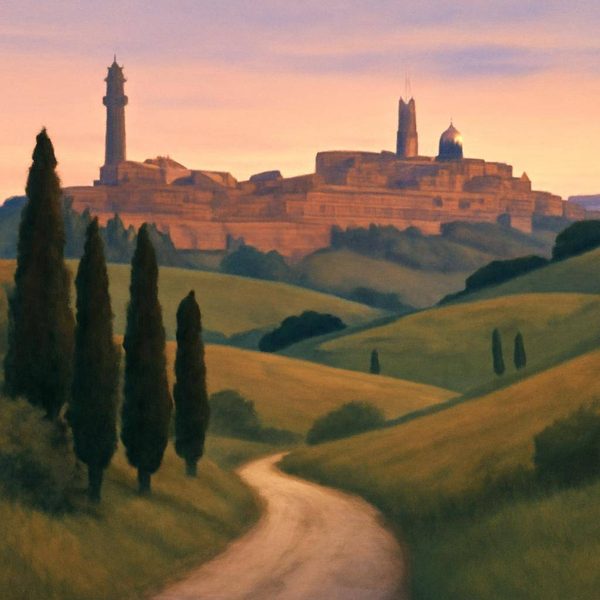
October is a reasonable time to walk out of Siena toward the east. The summer crowds that pack the Piazza del Campo for the Palio have gone; the light is lower and softer, and the red-brick lanes of the city hold their warmth longer than you might expect at this elevation. The ridge that Siena sits on — actually three ridges, joined at a point — narrows quickly as you leave the Campo behind and descends toward the valley where the Arbia river runs.
The battle that happened here in September 1260 is one of those events that a city never quite stops telling itself about. Siena's forces, allied with the Ghibelline faction and supported by German cavalry under Manfred of Sicily, met a Florentine army on the flat ground near the village of Montaperti, a few kilometres outside the city walls. What followed was, by the standards of the period, a rout. The Florentines lost thousands of men; according to medieval accounts, the Arbia ran red. Dante made the battle part of Inferno Canto 10 through the encounter with Farinata degli Uberti and the image of the Arbia coloured red, but for Siena itself the memory was one of pride rather than shame — one of the few moments when the city bested its larger, wealthier neighbour in open field.
Walking out toward the battlefield site from the Porta Romana, one of the old city gates, the landscape flattens quickly. The cypresses that line the roads out here are a familiar visual marker, but the ground is agricultural, working, and not especially dramatic. This is the thing about famous battlefields: they almost never look the part. The low ridge at Montaperti is marked, and the site draws some visitors with an interest in medieval history, but it is not a managed tourist attraction. You go there for the idea of the place as much as for the place itself.
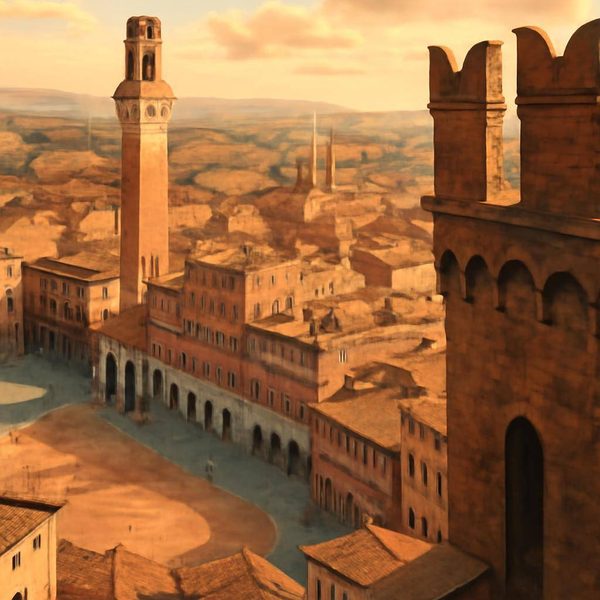
Back in the city, the memory of Montaperti is encoded in the civic fabric in subtler ways. The Palazzo Pubblico, which faces you when you sit in the Campo, was already rising in the decades after the battle; the Torre del Mangia, added in the 14th century, was a deliberate act of civic confidence and wealth-signalling. Inside the Palazzo, in the Museo Civico, Ambrogio Lorenzetti's Allegory of Good and Bad Government, painted between 1338 and 1339, is one of the most discussed images of medieval political thought — a city, its market, its countryside, rendered in careful detail as an argument for what good governance looks like. It was made at a moment when Siena believed itself capable of exemplifying that idea.
The Black Death of 1348 ended that confidence with terrible thoroughness. The population fell sharply; the vast new cathedral nave that was meant to make Siena's Duomo the largest in Christendom was abandoned mid-construction. The Facciatone — the unfinished facade of that abandoned nave — still stands beside the completed Duomo, a ghost of the city's ambition. You can climb it: 131 steps to a terrace with views over the red rooftops and, on a clear October day, south toward the Val d'Orcia.
The contrade, the seventeen neighbourhood districts that now define Sienese identity, trace their formal organisation to the period after the city's contraction, when the community turned inward and the neighbourhood became the primary unit of loyalty. Each contrada has its own patron saint, its own heraldic symbols, its own small museum — and its own account of local history, including which contrade have won the Palio most recently and which are currently owed a victory. The July race honours the Madonna of Provenzano at the church of Santa Maria di Provenzano; the August race honours the Assumption at the Duomo. Both dates have been fixed since 1656, though the traditions are older.
Walking back into the Campo in the late afternoon, it is easy to understand why the square works as well as it does. The shell-shape that tilts the brick toward the Palazzo Pubblico creates a natural amphitheatre that holds both the noise of the daily crowd and the silence of an early morning with equal ease. The Torre del Mangia rises above it, 102 metres of slender brick and stone, named — according to local tradition — after a bell-ringer who spent his wages rather than saving them. Whether the story is true or not, it is the kind of detail that cities attach to their landmarks when they want to remind visitors that the monuments belong to ordinary people, not just to history.
The field of Montaperti is a few kilometres away and easy to miss. The city built by the people who won that battle is considerably harder to overlook.
Frequently Asked Questions
What is The Field of Montaperti: Walking with Siena's Ghosts?
October is a reasonable time to walk out of Siena toward the east.
Why does The Field of Montaperti: Walking with Siena's Ghosts matter in Siena?
The battle that happened here in September 1260 is one of those events that a city never quite stops telling itself about.
How does The Field of Montaperti: Walking with Siena's Ghosts fit into a Siena visit?
The ridge that Siena sits on — actually three ridges, joined at a point — narrows quickly as you leave the Campo behind and descends toward the valley where the Arbia river runs.
This is a fictional visitor story generated from source-backed place facts, image evidence and visitor-feel signals. It is not a first-hand WorldTownGuide visit. Named places, routes and historical references are source-backed; the visitor character and narrative events are invented.
Sources: Myths and legends of Sienese Tuscany - Podere Salicotto • Sienese Legends and Ghosts - Holiday Homes Tuscany • 10 things to do in Siena - Visit Tuscany • An Insider's Guide to Siena - To Tuscany • Fun Facts about Siena - World City Trail