In This Guide
Trogir, Split-Dalmatia
Trogir is a UNESCO-listed historic town on the Adriatic coast of Croatia, built on a small island connected to the mainland and to the island of Čiovo by bridges. It sits 27 kilometres west of Split and is best known for its remarkably intact medieval architecture, its animated waterfront promenade, and Saint Lawrence's Cathedral — one of the finest Romanesque-Gothic buildings on the eastern Adriatic. Most visitors arrive as a day trip from Split, but the town rewards those who stay longer.
Setting and First Impressions
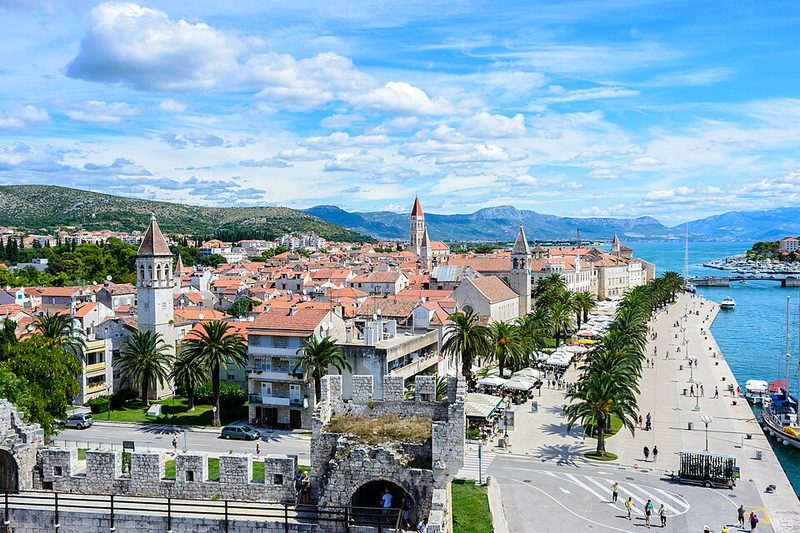
The historic core occupies a small island squeezed between the Croatian mainland and the larger island of Čiovo, giving every approach — on foot, by bus or by boat — a distinct sense of arrival. The streets are narrow enough to touch both walls in places; the stone underfoot is worn smooth by centuries of foot traffic. The harbour-front opens without warning onto a wide promenade where fishing boats and private yachts sit moored side by side.
Split Airport lies roughly six kilometres from the town centre, which means many travellers pass through or stop in Trogir on the same day they land. That proximity also means the old town absorbs a high volume of day visitors in summer — the ferry timetables from Trogir list up to eight journeys per day in high season, dropping significantly off-season, and the promenade shifts noticeably between July and October. The sheltered bay of Uvala Toć, near the settlement of Okrug Gornji on Čiovo, keeps the air soft even in the heat, and light across the rooftops draws photographers in the early morning before the crowds build.
Saint Lawrence's Cathedral and the Main Square
The Cathedral of Saint Lawrence — Katedrala sv. Lovre in Croatian — stands on Trg Ivana Pavla II, the main square, and is the single most important building in a town already dense with historic architecture. According to the UNESCO World Heritage Centre, Trogir's 1997 inscription recognised both the Hellenistic street grid and the density of Romanesque, Gothic, Renaissance and Baroque buildings that occupy it.
The most important UNESCO story is older than the cathedral. Trogir's street plan preserves the Hellenistic grid laid out by Greek colonists from Issa, modern Vis, in the 3rd century BC, so visitors walking the lanes are still following an urban plan drawn roughly 2,300 years ago. Romanesque, Gothic, Renaissance and Baroque buildings changed the city around it; the underlying Greek town plan survived.
The cathedral's west portal, carved by the sculptor Radovan in 1240, carries an inscription identifying both the artist and the date — rare for the period, and the reason scholars describe it as one of the key works of Romanesque sculpture on the eastern Adriatic. The figures include lions at the base, Adam and Eve flanking the doorway, and a dense programme of biblical and seasonal imagery above. The Chapel of Saint John, built in 1468, is considered by Visit Croatia among the finest Renaissance interiors in Dalmatia. The bell tower, built across several centuries in a visible mix of styles, rises above the rooftops and is visible from the water on approach.
Clock Tower, Loggia and the Square
Directly on the main square, the Clock Tower stands attached to the Church of Saint Sebastian — built in the 1400s, according to the VoiceMap Trogir audio guide, by the Italian builder and artist Nicholas. The tower's pale blue clock face is one of the most photographed features of the square; the Wikimedia Commons category for the tower records 54 files, reflecting how consistently it appears in visitor documentation. Adjacent to it, the fifteenth-century Loggia is documented by Frommer's as a structure that probably served as a courtroom for town trials, with civic and judicial relief carvings on its walls. The MIT Aga Khan Visual Archive holds documentary records of the loggia and tower as part of its Adriatic architectural collection. Together, the cathedral, bell tower, loggia and clock tower give the square a civic coherence unusual for a town of Trogir's size — and it is worth arriving early, before tour groups reach the island, to see it without distraction.
Trogir City Museum
The Trogir City Museum — Muzej grada Trogira — is housed in the Garagnin-Fanfogna Palace and holds collections relating to the town's long history. The museum is listed in the vimuseo.com registry of Croatian museums and has been covered in local heritage writing as a useful complement to the architectural sights outside. Visitors should check current opening arrangements locally before planning a visit, as detailed opening hours are not confirmed in current sources.
History and Identity
Trogir was founded by Greek colonists in the third century BC and passed through Roman, Byzantine, Croatian, Venetian and eventually Austro-Hungarian hands before becoming part of Yugoslavia and then independent Croatia. According to the UNESCO World Heritage Centre, criterion (ii) of the inscription recognises that Trogir demonstrates the influence of successive cultures in the Adriatic — Greek, Roman, Byzantine, Hungarian and Venetian — through its urban planning and architecture. The Venetian period in particular shaped the loggias, civic palaces and carved stone details on doorways that are still immediately readable today.
Three landmarks fill out that Venetian and civic story. Kamerlengo Fortress, at the western tip of the island, is the clearest reminder of Venetian military control, a fifteenth-century stronghold built to watch the harbour and the channel toward Čiovo. Cipiko Palace, opposite the cathedral, gives the main square its domestic Gothic-Renaissance counterweight, while the North Gate remains the old landward entrance from the mainland, marked by the figure of Blessed Ivan of Trogir, the town's patron.
Total Croatia News notes that Trogir has in recent years organised an annual Medieval fair to mark its heritage, and the Trogir Cultural Summer — LiveCamCroatia records it as having reached its 55th edition, placing the programme in the early-1970s generation of Dalmatian summer festivals if counted annually — brings music, theatre and contemporary art into the old town's squares and courtyards during the warmer months. The regional tourism board at dalmatia.hr lists it as a recurring programme. Dates and specific programming should be verified with current official sources before travel.
Evening and Waterfront
The promenade known locally as the Riva is the main social artery from spring through autumn. Bars and music venues give the town a livelier edge after dark than its medieval exterior might suggest. Multiple nightlife guides identify Kula Club as a name associated with Trogir's summer evening scene, though current operating status should be checked locally — the town's evening character is defined as much by the open-air bar culture along the Riva as by any individual venue. For contemporary art, the Ribar Gallery has been mentioned in local sources, though detailed information is limited and a visit should be confirmed locally.
The old town functions as both a living neighbourhood and a visitor destination. The early mornings and late evenings belong primarily to residents; the middle of the day in high summer belongs almost entirely to visitors arriving by bus from Split or disembarking from boats at the waterfront.
Getting There and Around
Split Airport is approximately six kilometres from Trogir. Airlines serving Split Airport include Croatia Airlines, Ryanair, easyJet, British Airways, KLM and Lufthansa among others, though route networks change seasonally — check current schedules with the relevant carriers before booking. From the airport, public bus connections link directly to Trogir; the visitokrug.com resource for the Čiovo area also notes bus and boat arrival options for the wider local area.
Bus route 37 (Promet Split) connects Trogir's bus station with Split and calls at Mastrinka on Čiovo. FlixBus includes Trogir on its Croatian coastal routes. For those travelling between the islands, ferry services from Trogir serve routes toward Drvenik Mali and Drvenik Veli via Bura Line; in high season the Trogir ferry port handles up to eight journeys per day, with fewer in the low season. The villages of Okrug Gornji and Okrug Donji on Čiovo, connected to Trogir by bridge, are within easy reach on foot or by local bus. Within the old town itself, the island is compact enough to walk end to end in a few minutes and all main sights are tightly clustered — no other transport is needed once you are inside the historic core.
Visitors arriving from or continuing to Bosnia and Herzegovina should note that the UK FCDO has flagged ongoing congestion at the Gradiška border crossing following bridge works. This does not affect coastal Dalmatia directly, but travellers with cross-border itineraries should check current conditions and allow extra time.
Practical Notes
Croatia is part of the Schengen Area; standard Schengen entry rules apply for most visitors. Both the UK FCDO and the US State Department currently advise only normal travel precautions for Croatia. There are no specific warnings relating to Trogir. For the latest entry requirements, passport validity rules and health documentation, consult the official UK FCDO Croatia advice at gov.uk or the US State Department country page before you travel.