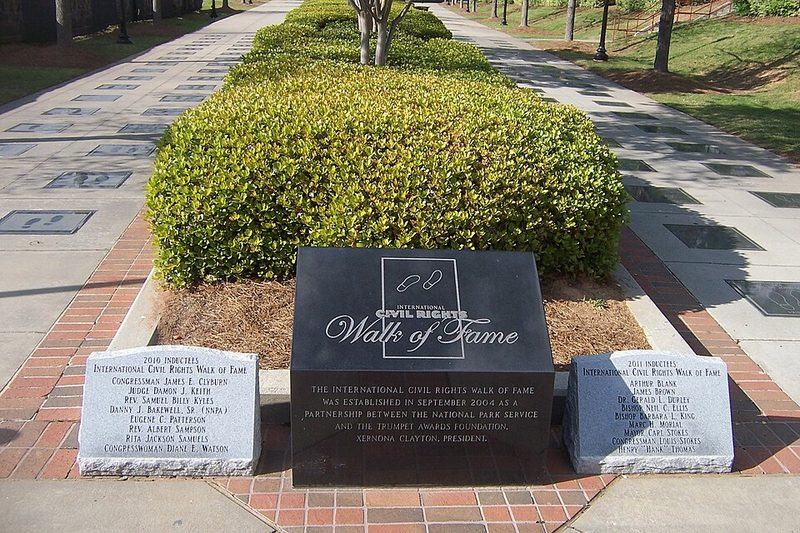
The Martin Luther King Jr. National Historical Park occupies 35 acres in Atlanta's Sweet Auburn neighbourhood, preserving the birthplace, church, and final resting place of the civil rights leader who shaped modern America. Established as a National Historic Site and later redesignated as a National Historical Park, this collection of buildings and monuments documents King's early life and the movement he led. The park is free to visit and operates Monday through Saturday from 9 a.m. to 5 p.m., with ranger-led tours available first-come, first-served.
The Birth Home and Visitor Centre
Martin Luther King Jr. was born on 15 January 1929 at 501 Auburn Avenue, in a two-storey Queen Anne-style house built in 1895. The home remained in the King family until 1941, and King lived there until age 12. Access to the birth home requires a ranger-led tour, which departs from the National Park Service Visitor Centre at 450 Auburn Avenue. Tours operate Monday through Sunday from 10 a.m. to 3 p.m. on a first-come, first-served basis, and the National Park Service recommends arriving early in the day as tour capacity fills quickly.
The visitor centre houses a museum chronicling the American Civil Rights Movement and King's role within it. Exhibits trace the arc from segregation through the campaigns for voting rights, desegregation, and economic justice. The centre provides context for understanding the sites within the park and offers an orientation for those unfamiliar with the history.
Historic Ebenezer Baptist Church
Ebenezer Baptist Church stands at 407 Auburn Avenue, a red-brick building where King was baptised, ordained, and later served as co-pastor alongside his father from 1960 until his assassination in 1968. The church was founded in 1886 and has been a fixture on Auburn Avenue since 1914, when the current building was completed. King's grandfather, A.D. Williams, served as pastor from 1894 to 1931, followed by King's father, Martin Luther King Sr., who led the congregation from 1931 to 1975.
The church is open to visitors Monday through Saturday from 9 a.m. to 5 p.m. as part of the National Historical Park. The congregation moved to a newer building across the street in 1999, and the historic sanctuary is now preserved as a museum space. Visitors can sit in the pews where King preached and where his funeral was held on 9 April 1968.
The King Centre and Crypt
The Martin Luther King Jr. Centre for Nonviolent Social Change, commonly known as The King Centre, sits adjacent to the historic church at 449 Auburn Avenue. Founded by Coretta Scott King in 1968, the centre serves as both a memorial and an institution promoting King's philosophy of nonviolence. The reflecting pool and white marble crypt hold the remains of Martin Luther King Jr. and Coretta Scott King, who died in 2006. The inscription on the crypt reads: "Free at last, free at last, thank God Almighty I'm free at last," drawn from the spiritual King quoted in his famous "I Have a Dream" speech delivered in Washington, D.C., on 28 August 1963.
Freedom Hall, also operated by The King Centre, contains exhibits on King's life, the civil rights movement, and Mahatma Gandhi's influence on King's commitment to nonviolent resistance. The building also houses King's personal papers and archives, though access to archival materials requires advance arrangement.
Sweet Auburn Context
The park sits within the Sweet Auburn Historic District, a neighbourhood that served as the commercial and cultural centre of Black Atlanta from the late 19th century through the mid-20th century. Auburn Avenue earned the nickname "Sweet Auburn" and was described in the 1950s as "the richest Negro street in the world" due to its concentration of Black-owned businesses, churches, and institutions. John Wesley Dobbs, a civic leader and grandfather of former Atlanta mayor Maynard Jackson, is credited with coining the term "Sweet Auburn." A sculpture of Dobbs stands at the corner of Auburn Avenue and Fort Street.
The Fire Station No. 6 building, constructed in 1894, is also part of the National Historical Park. Located at 39 Boulevard NE, it served the Sweet Auburn community until 1991 and now houses exhibits on the desegregation of Atlanta's fire department, along with a gift shop.
Practical Visit Information
The National Historical Park is located in the Old Fourth Ward neighbourhood, east of downtown Atlanta. Street parking is limited, and visitors should plan to use paid lots or public transport. The area is walkable, and many visitors spend two to three hours exploring the park's main sites. Combining a visit with nearby attractions along Auburn Avenue, such as the APEX Museum (dedicated to African American history) and the Sweet Auburn Curb Market (a historic municipal market dating to 1918), extends the experience.
The park receives high visitor numbers, particularly during school holidays and around the Martin Luther King Jr. Day federal holiday on the third Monday of January. Those wishing to tour the birth home should arrive at the visitor centre when it opens to secure a tour slot. All sites within the park are free, though donations to The King Centre are encouraged.
Sources: Martin Luther King, Jr. National Historical Park - National Park Service • Visit - The King Center • Ebenezer Baptist Church - National Park Service