The train from Lyon delivered me to Avignon-Centre on a Tuesday morning in October, which turned out to be good timing. July is the month everyone warns you about: tens of thousands of theatre-goers filling every courtyard and doorway, the Festival d'Avignon spilling performances into chapels, car parks and medieval warehouses. In October, those same spaces are quiet, and the honey-coloured ramparts rising at the end of the station approach have a gravity that the summer crowds must dilute considerably.
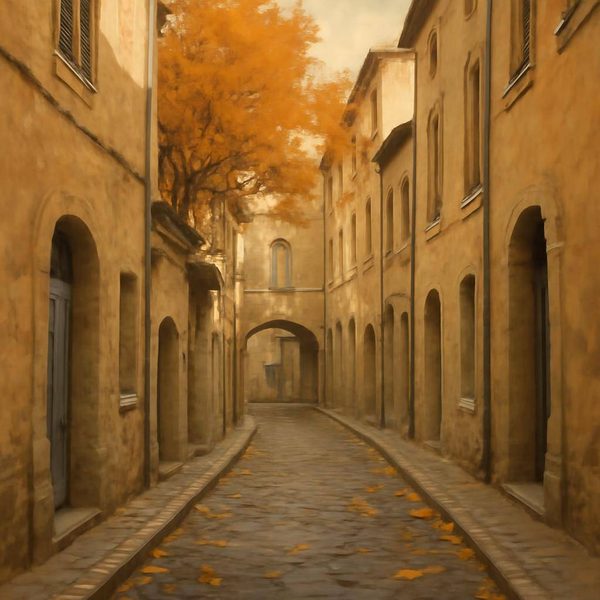
I walked through the Porte de la République and into the old town. The streets inside the walls are denser than you expect from photographs — more urban, more lived-in, with fruit stalls and pharmacies alongside the inevitable café terraces. The Palais des Papes announces itself before you reach it: the scale is genuinely startling, a fortress-palace so large it seems to have displaced everything around it. It was built because seven successive popes decided, between 1309 and 1377, that Avignon made a better base than Rome. French-born Pope Clement V started the move; his successors kept it going long enough to raise the largest Gothic structure of its kind in the world. After the papacy finally returned to Rome, the building spent centuries as a barracks and then a prison, which explains why the interior is plainer than you might expect — the frescoes that survived those uses are all the more striking for it.
The Cour d'Honneur — the great open courtyard at the palace's heart — was empty of audiences that morning. In July it becomes one of the main stages for the Festival d'Avignon's In programme. Empty in autumn, with the sky cut into a rectangle above you and the walls rising on every side, it has the atmosphere of a place waiting for something. Which, in a sense, it always is.
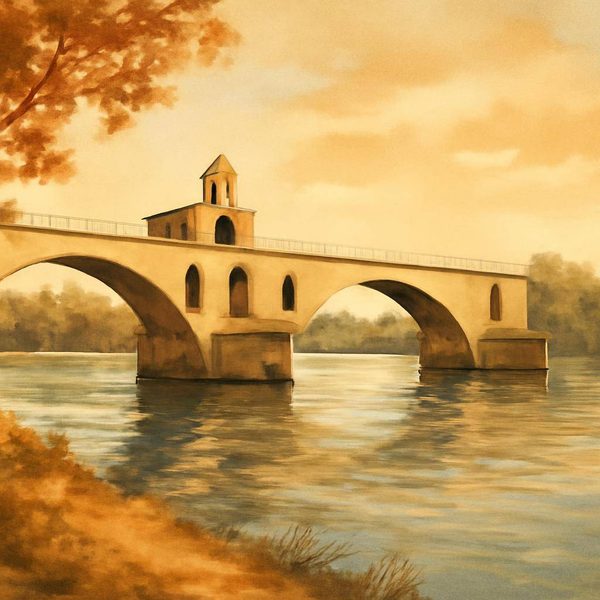
From the palace I walked to the Pont Saint-Bénézet, paying the entry fee at the gate. The bridge begins confidently enough, arching out over the fast green water, and then simply stops. Four arches survive from the original twenty-two; the rest were carried away over centuries of floods. The nursery rhyme — Sur le Pont d'Avignon — has outlasted the bridge's function by about six hundred years, which is an impressive piece of cultural longevity for what is essentially a song about dancing. Standing at the broken end, with the Rhône running hard underneath and the Gard bank visible across the water, you understand why people keep coming: not because the bridge is dramatic, but because it is oddly funny. A monument to incompleteness in a city that is otherwise exhaustingly complete.
In the afternoon I took the river shuttle across to the Île de la Barthelasse. The island is wide and flat, mostly agricultural, with paths running along the water's edge. The view back to the city from there — walls, towers, the Rocher des Doms rising above the palace, the broken bridge in the foreground — is one of those views that explains exactly why a fourteenth-century pope looked at this bend in the Rhône and decided it would do very well indeed.
Before leaving I walked south of the old centre, past the edges of the Saint-Ruf quarter, where the medieval Abbaye Saint-Ruf once stood. There is not much left to see — stones, absorbed into later buildings, the usual fate of Provençal abbeys — but the area is noticeably quieter than the palace district, with the unhurried texture of a neighbourhood that long since stopped being a tourist destination and simply got on with things.
Avignon in October is a city that has finished performing and returned to itself. The walls are still there, the palace is still there, and the bridge still ends in the middle of the river, going nowhere in particular. It is, as it has been for seven centuries, entirely sufficient.
Frequently Asked Questions
What is The Bridge That Goes Nowhere: an October Visit to Avignon?
The train from Lyon delivered me to Avignon-Centre on a Tuesday morning in October, which turned out to be good timing.
Why does The Bridge That Goes Nowhere: an October Visit to Avignon matter in Avignon?
It was built because seven successive popes decided, between 1309 and 1377, that Avignon made a better base than Rome.
How does The Bridge That Goes Nowhere: an October Visit to Avignon fit into a Avignon visit?
The Palais des Papes announces itself before you reach it: the scale is genuinely startling, a fortress-palace so large it seems to have displaced everything around it.
This is a fictional visitor story generated from source-backed place facts, image evidence and visitor-feel signals. It is not a first-hand WorldTownGuide visit. Named places, routes and historical references are source-backed; the visitor character and narrative events are invented.
Sources: Palais des Papes in Avignon (Pope's Palace) - Provence-Alpes-Côte d'Azur Tourism • Festival d'Avignon - Wikipedia • Abbaye Saint-Ruf d'Avignon - Wikipedia • Navette fluviale (bac a traille) - Avignon - Provence Guide • Things to see in Avignon: a walk in the old town - Velvet Escape