Brooklyn Botanic Garden occupies 52 acres adjacent to Prospect Park and the Brooklyn Museum in central Brooklyn, holding over 14,000 plant taxa and receiving more than 800,000 visitors annually. Designed by the Olmsted Brothers (sons of Frederick Law Olmsted) and established in 1910, the garden serves both as a public park and a botanical research and education institution. The site's origins trace to 1897 when the Brooklyn Institute of Arts and Sciences began planning a botanical garden to complement the recently opened Brooklyn Museum; formal development began after the City of Brooklyn granted land in 1910.
Japanese Hill-and-Pond Garden
The Japanese Hill-and-Pond Garden, created in 1914-15 by landscape designer Takeo Shiota, holds distinction as the first Japanese-inspired garden created at an American public garden. The three-acre landscape incorporates traditional Japanese garden design principles: a central pond with an island, viewing pavilions including the Viewing Pavilion and Waiting Arbor, stone lanterns, carefully placed rocks and plantings, and a wooden torii gate. The Kasumi-no-mine (Misty Mountain) provides an elevated viewing point overlooking the pond. A Shinto shrine, donated by the government of Japan in 1960, stands near the pond. The garden's design emphasises seasonal change, with cherry trees blooming in spring, irises and water lilies in summer, and maples providing autumn colour.
Specialised Gardens and Collections
The Cranford Rose Garden, established in 1928, displays over 5,000 rose bushes representing approximately 1,400 varieties. The garden's design features a circular layout with brick paths radiating from a central pergola, and roses are organised by type: hybrid teas, floribundas, climbers, and antique varieties. Peak bloom typically occurs from late May through June, with repeat bloomers continuing into autumn.
The Shakespeare Garden contains over 80 plants mentioned in Shakespeare's works, including primrose, crocuses, columbine, and herbs such as rosemary and lavender. Quotations from the plays and sonnets are displayed throughout the garden on plaques identifying the plants and their literary references. The Herb Garden displays culinary, medicinal, and ornamental herbs in both formal and informal plantings. The Native Flora Garden, one of the oldest continuously maintained native plant gardens in the United States, recreates habitats found in the New York metropolitan region, including woodland, meadow, and wetland environments.
Conservatories and Indoor Collections
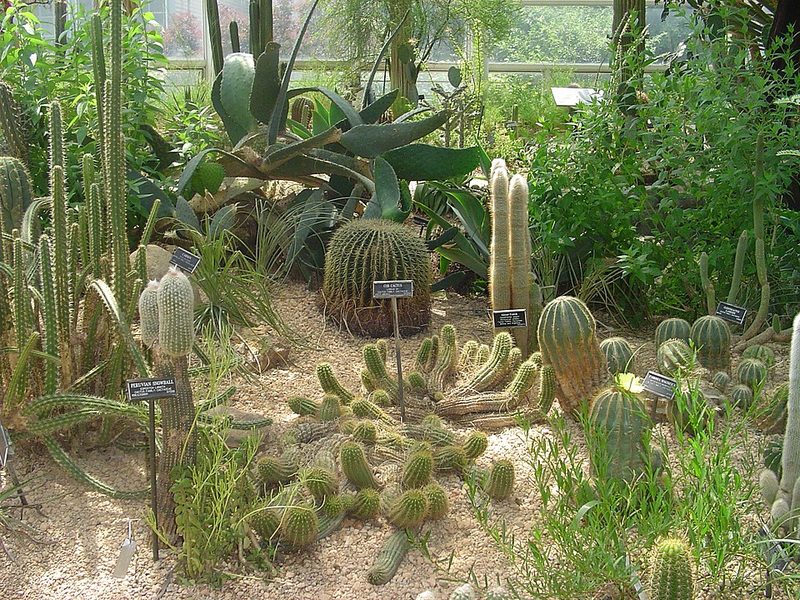
The Steinhardt Conservatory, opened in 1988, houses three climate-controlled pavilions under a glass roof structure. The Tropical Pavilion features plants from rainforest environments worldwide, including palms, ferns, orchids, and tropical fruiting plants. The Desert Pavilion displays cacti and succulents from the Americas, Africa, and Madagascar, arranged to demonstrate adaptation strategies to arid conditions. The Temperate Pavilion rotates seasonal displays and special exhibitions throughout the year. The C.V. Starr Bonsai Museum, located within the conservatory complex, displays one of the largest collections of bonsai in North America, with specimens including traditional Japanese forms and North American adaptations of bonsai practice.
Cherry Esplanade and Seasonal Interest
The Cherry Esplanade features over 200 cherry trees of several varieties, primarily flowering Japanese cherries (Prunus serrulata cultivars) planted in double rows creating a canopy effect. Peak bloom typically occurs in late April to early May, depending on weather conditions, drawing substantial crowds during the spring bloom period. The garden celebrates this annual flowering with Sakura Matsuri, a cherry blossom festival typically held on a weekend during peak bloom, featuring Japanese cultural performances, demonstrations, and vendors—this event attracts particularly large attendance and requires advance ticketing.
Visitor Centre and Access
The garden's Visitor Centre, opened in 2012, incorporates green building design including a living roof planted with 45,000 plants, geothermal heating and cooling, and rainwater collection systems. The centre provides orientation information, ticket sales, a shop stocking botanical books and gardening supplies, and restroom facilities.
The garden has three public entrances: the main entrance at 150 Eastern Parkway (near the Brooklyn Museum), the Flatbush Avenue entrance at 455 Flatbush Avenue, and the Washington Avenue entrance at 990 Washington Avenue. Subway access is provided by the B, Q, and S trains to Prospect Park station, the 2 and 3 trains to Eastern Parkway–Brooklyn Museum station, and the 2, 3, 4, and 5 trains to Franklin Avenue. Walking time from these stations to the garden entrances ranges from three to seven minutes.
Admission fees and hours vary by season, with extended hours typically offered during spring and summer months. The garden participates in reciprocal admission programmes with member institutions of the American Horticultural Society and the American Public Gardens Association. Free admission is offered on certain days; visitors should consult the garden's official website for current admission policies, opening hours, and special event schedules before visiting.
Sources: Brooklyn Botanic Garden - Wikipedia • Brooklyn Botanic Garden Official Site - Hours & Admission • Brooklyn Botanic Garden - Time Out New York