In This Guide
For a darker Bruges route, follow the Minnewater legend after dusk, when the Lake of Love becomes the setting for the city's night story. The Lake, the Legend and the Long Dark: Bruges After Hours
Bruges, Flanders
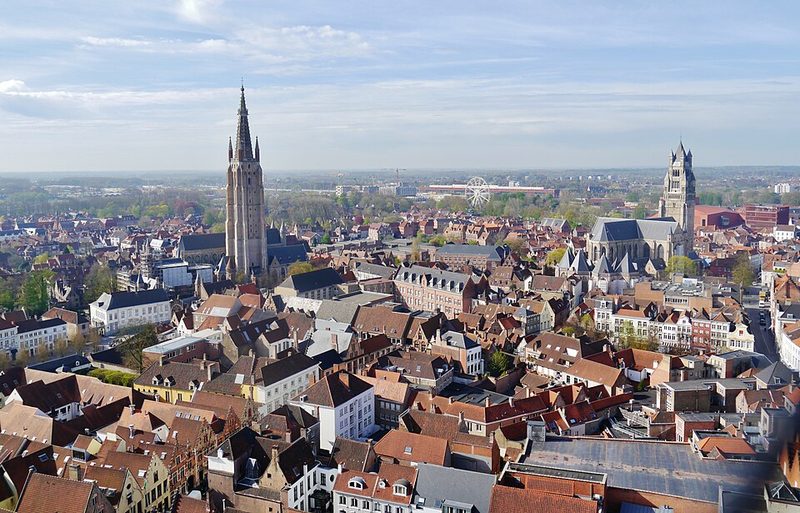
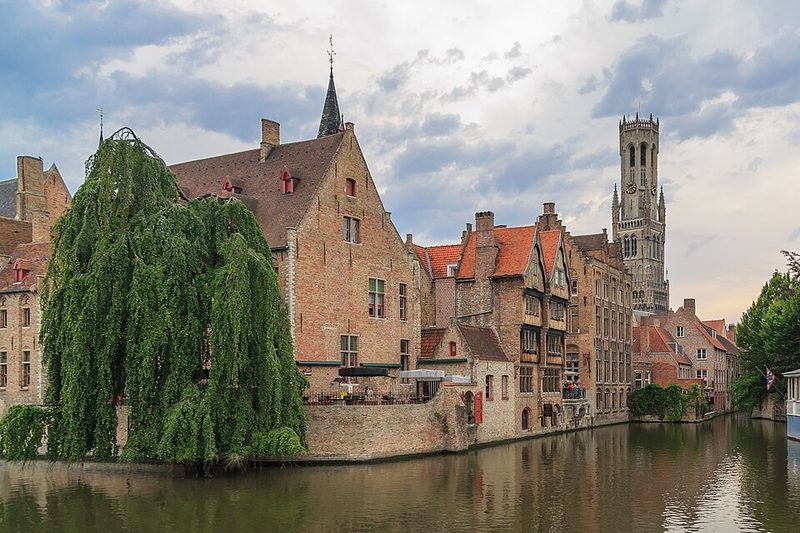
Bruges is the capital of West Flanders, home to around 118,500 people, and one of the best-preserved medieval city centres in northern Europe. Step off the train and within a few minutes you are threading through a grid of gabled rooftops, glassy canals and cobbled squares that survived the twentieth century more or less intact. The historic centre is genuinely walkable, the canal network is central to how the place looks and feels, and the Belfry tower on the Markt gives one of the most layered views in the region. It can be very crowded on summer weekends, and that is an honest caveat worth knowing before you go.
Setting and First Impressions
Bruges sits in the flat, low-lying northwest of Belgium, barely above sea level. The city does not announce itself with hills or drama: a spire appears above a roofline, a canal turns a corner, the broad cobbled expanse of the Markt opens up without warning. The predominant language is Dutch, and the Flemish character of the place is tangible in its architecture, civic institutions and the unhurried confidence of its public spaces. The station area is functional rather than scenic, but the historic centre is a short walk or bus ride away and the contrast is immediate.
History and Why the Medieval Fabric Survived
Bruges was a dominant trading city in medieval northern Europe, and its wealth is embedded in almost every street. The city's rise was tied directly to the Zwin waterway, its maritime outlet to the North Sea. As the Zwin silted up through the late medieval period, trade routes shifted, waterway access diminished, and Bruges entered a long, quiet period of reduced growth. What looks like careful conservation is partly the result of that economic stillness: the city was not rebuilt because it did not need to be.
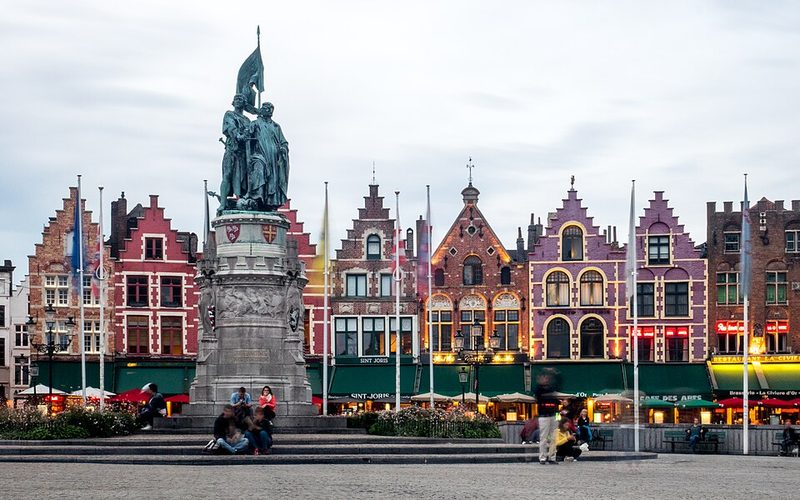
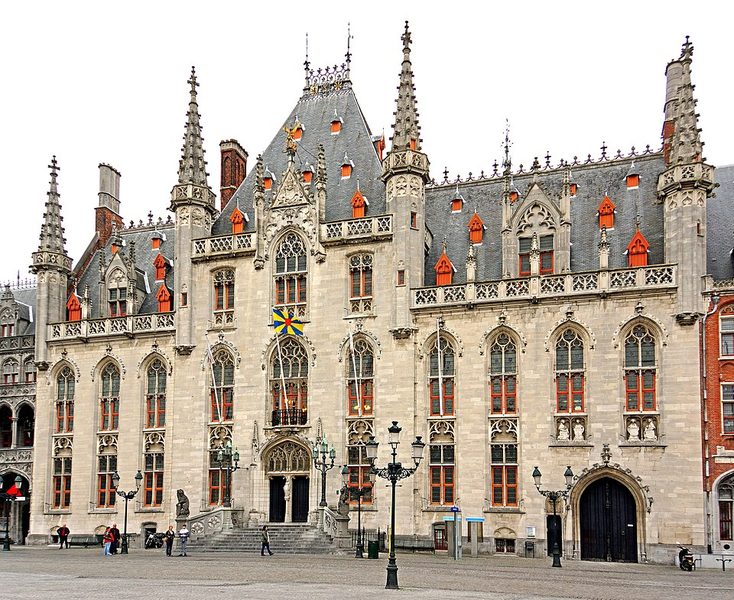
The neo-Gothic Provincial Court on the Markt is a pointed reminder that even the nineteenth-century renovation drew heavily on the medieval inheritance. According to the image evidence from Wikimedia Commons, the original water halls were demolished in 1787 and a grand new complex was built in their place. The statues of Jan Breydel and Pieter de Coninck in the centre of the Markt commemorate the Battle of the Golden Spurs in 1302, when Flemish militia defeated a French force — an event that retains cultural significance in Flemish civic identity today.
One of the most visited churches in Bruges is the Church of Our Lady (Onze-Lieve-Vrouwekerk), which houses a marble Madonna and Child by Michelangelo — one of the few works by that sculptor to have left Italy during his lifetime. The sculpture was acquired by the Bruges merchant Pieter I de Gros in the early sixteenth century and is administered today by Musea Brugge. It is a remarkable object to encounter in a neighbourhood church rather than a national museum.
Flemish Primitives, Van Eyck and Memling
Bruges was also one of the decisive cities in the history of European painting. Jan van Eyck worked here and died in Bruges in 1441, and the Groeninge Museum holds major Flemish Primitive works, including his Madonna with Canon van der Paele. Hans Memling, another defining painter of the Bruges school, is strongly associated with the Sint-Janshospitaal, where Musea Brugge presents his work in the setting of one of Europe's oldest preserved hospital complexes. This is the art-history counterpart to the Michelangelo story: Bruges was not only importing Renaissance sculpture from Italy, it was also helping change northern European painting from within.
Each year, the Procession of the Holy Blood (Heilig Bloedprocessie) has taken place in Bruges continuously since 1304, when the tradition is recorded. It carries UNESCO intangible heritage status and draws large crowds; visitors who happen to be in the city on Ascension Day will find much of the historic centre involved.
Minnewater Lake and the Lake of Love
Minnewater Lake sits at the southern edge of the historic centre and is one of the most visited open spaces in the city. The name 'Lake of Love' came not from medieval chronicle but from nineteenth-century literary romanticism: a local legend, popularised during that period, holds that the lake is named for Minna, a sailor's daughter who died in the arms of her star-crossed lover. The romantic framing is a product of its era, sharpened by Georges Rodenbach's 1892 novel Bruges-la-Morte, which helped fix Bruges in the European imagination as a melancholy, beautiful "dead city". The lake itself — calm, tree-lined, connecting naturally to Minnewater Park — is a genuine and useful alternative to the crowded central squares. The Church of Our Lady and the Beguinage (Begijnhof) are both close by, making this corner of the city one of the most rewarding for a slower circuit on foot.
Brewing, the Beer Pipeline and Local Curiosities
Bruges is known internationally for its brewing heritage. The Halve Maan brewery in the city centre has attracted attention not only for its beers but for a dedicated underground pipeline connecting the brewery to a bottling facility outside the historic centre — opened in recent years specifically to reduce lorry traffic through the old streets. According to the Halve Maan brewery's own documentation, the pipeline runs beneath the city. It is a practical solution that also happens to be an excellent story.
Canal Trips and Getting Around on the Water
Canal boat trips are one of the most consistent visitor experiences in Bruges, offering a low, water-level view of the city that reframes the architecture completely. Embarkation points are located at Huidenvettersplein and several other spots in the historic centre. The waterways are genuinely central to how the city looks and feels — not a decorative add-on — and a short boat trip covers angles and proportions that walking misses entirely.
Within the city, walking and cycling are the primary ways to cover the historic core. De Lijn operates bus services from Bruges railway station into the centre, with routes serving stops including Dijver and the Grote Markt. The city is compact and much of what visitors come to see is accessible without a car.
Music, Culture and Evenings
The Concertgebouw on 't Zand Square opened in 2002 as part of Bruges' year as European Capital of Culture and is now one of the city's primary performance spaces, drawing more than 150,000 visitors per year according to the venue's own records. Its main auditorium seats 1,289 and the building has been listed among the world's notable works of architecture. Programming covers classical music, contemporary dance and opera; current schedules are listed at concertgebouw.be.
The Cactus Muziekcentrum is the city's main venue for popular and world music, listed by Visit Bruges as a key cultural resource. The broader local scene includes smaller venues — De Republiek is noted in local music listings as a cultural hub with occasional live sessions — and the city's squares host intimate performances during warmer months. For current event listings, simplybruges.com maintains a regularly updated what's-on calendar.
Modern popular culture added another layer. The 2008 film In Bruges, starring Colin Farrell and Brendan Gleeson, used the Markt, Belfry, canals and old streets as central locations, giving many younger international visitors their first mental image of the city. It is not the whole of Bruges, but it is now part of the way the city is imagined abroad.
Getting There
Bruges is served by its own railway station, operated by SNCB/NMBS (Belgian National Railways), with direct connections to Brussels and Ghent. Train travel is the most practical way to arrive from elsewhere in Belgium or from other European cities via Brussels. The nearest airport with scheduled flights is Ostend-Bruges Airport (IATA: OST), which handles a limited selection of routes; most international visitors arriving by air use Brussels Airport and connect by train. Direct Hull-to-Zeebrugge ferry services have ceased in recent years, but Zeebrugge remains accessible from other ferry routes via nearby French and Dutch ports — P&O Ferries operates services from Hull to Rotterdam, from which a connection to Bruges is possible by road or rail.
The UK Foreign, Commonwealth and Development Office notes that strike action has been an ongoing issue in Belgium and can cause significant disruption to public transport, including international rail connections, sometimes with little notice. Travellers are advised to monitor local news and check with their transport provider before travelling.
Practical Notes
Both the UK FCDO and the US State Department maintain country-level advisories for Belgium. The UK advises normal precautions. The US has issued a Level 2 advisory citing terrorism risks, noting that attacks could occur at tourist locations, transport hubs and public areas with little warning. Neither advisory identifies Bruges specifically, but both apply across Belgium. UK advice: gov.uk/foreign-travel-advice/belgium. US advisory: travel.state.gov. The official tourism resource for the city is visitbruges.be.
Summer weekends bring significant visitor pressure to the historic centre. Visitors who prefer quieter streets will find weekday mornings or the shoulder seasons of spring and autumn more comfortable. Winter brings cold, and occasionally snow and ice, which affect walking conditions on the cobbled streets.