It was an October evening when the decision to skip the last direct train turned out to be the right one. The Markt had emptied of its daytime crowds — or nearly so — and the gas-lamp glow on the cobblestones gave the Provincial Court a weight it probably deserves and rarely gets during the rush of a summer afternoon. The statue of Jan Breydel and Pieter de Coninck stood where they had stood since the nineteenth century, commemorating the Battle of the Golden Spurs in 1302, when Flemish militia stopped a French cavalry force and handed Bruges a piece of its civic identity that it has never quite set down.
From the Markt, the route south took a good twenty minutes on foot — past the Belfry, whose tower had already gone dark above the rooftop line, and into the narrower streets where the canal network starts to dominate. In Bruges, water is rarely far away. The city was built on it, rose with it and, when the Zwin waterway silted up in the late medieval period and trade moved elsewhere, was quietly preserved by its own economic stillness. The streets that look so carefully kept were, in some sense, simply left alone.
The Church of Our Lady — Onze-Lieve-Vrouwekerk — was closed at that hour, as it would be. Inside, according to Musea Brugge's own records, sits Michelangelo's marble Madonna and Child, acquired by the merchant Pieter I de Gros in the early sixteenth century: one of the few works the sculptor allowed to leave Italy during his lifetime. It is the kind of object that changes the scale of a neighbourhood church. Worth a return visit in daylight.
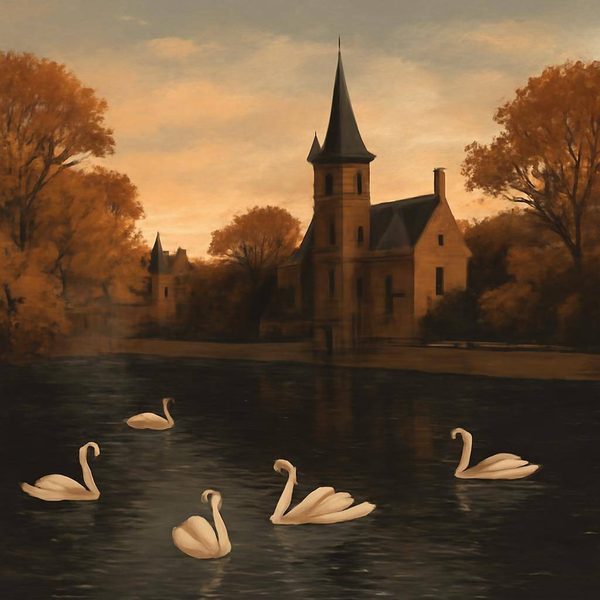
Minnewater Lake at night is another thing entirely. The name — the Lake of Love — sounds like the invention of a tourist board, and in a sense it is, though the invention is a nineteenth-century one. The legend of Minna, a sailor's daughter who died at the water's edge beside her forbidden lover, was circulated during the Romantic period and became permanently attached to the lake as Bruges was rediscovered by travellers looking for picturesque northern Europe. The story is literary rather than historical, but the lake does not need the legend to justify itself. It is calm and tree-lined even in October, the reflections of the surrounding park holding steady in the dark water, and the Beguinage walls just visible at the far edge.
There is a ghost tour that leaves from somewhere near the Markt on evenings like this one — you pass the assembled group near the Burg Square, torches already lit, a guide pointing up at a building and saying something that makes half the group laugh nervously. Bruges has the right architecture for it: narrow passages, sudden courtyards, the occasional ruin pressed up against a functioning civic building. The stories on those tours are, according to their own billing, based on true events — some surprising, some chilling. The Belfry, for instance, is said locally to be haunted by the ghost of a former guard unjustly punished; the story turns up in visitor sources without much elaboration, which is perhaps exactly right.
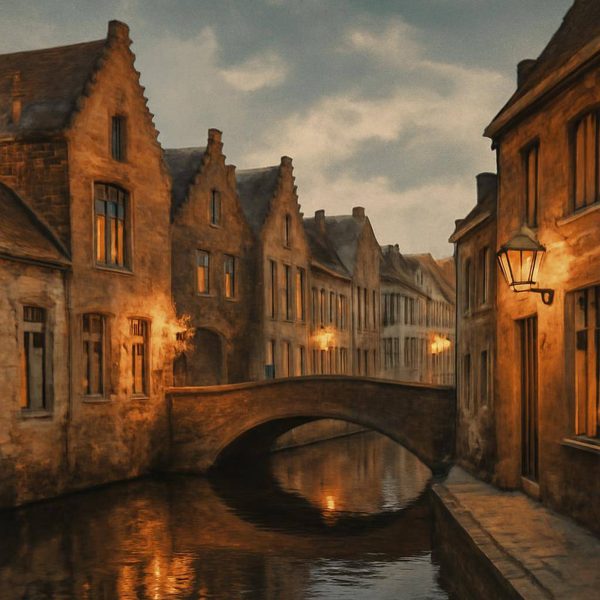
The walk back to the station takes you past the canal at Rozenhoedkaai, which at ten o'clock on a weekday has the quality of a painting left unguarded. In summer this is one of the most photographed spots in Belgium. In October, on a Tuesday evening, it belonged to three people with cameras and a couple walking a dog. The water was still. The gabled rooftops held their reflections. The train home was in forty minutes, which was enough time to stand there without needing to explain it to anyone.
Note: This story uses source-backed place anchors and local legends documented in public sources. The fictional visitor frame is a narrative device; WorldTownGuide does not claim a personal visit. Ghost tour details are drawn from publicly listed Bruges tour operators. Opening hours for the Church of Our Lady and other sites should be checked directly before visiting.
Frequently Asked Questions
What is The Lake, the Legend and the Long Dark: Bruges After Hours?
It was an October evening when the decision to skip the last direct train turned out to be the right one.
Why does The Lake, the Legend and the Long Dark: Bruges After Hours matter in Bruges?
The statue of Jan Breydel and Pieter de Coninck stood where they had stood since the nineteenth century, commemorating the Battle of the Golden Spurs in 1302, when Flemish militia stopped a French cavalry force and handed Bruges a piece of its civic identity that it has never...
How does The Lake, the Legend and the Long Dark: Bruges After Hours fit into a Bruges visit?
The statue of Jan Breydel and Pieter de Coninck stood where they had stood since the nineteenth century, commemorating the Battle of the Golden Spurs in 1302, when Flemish militia stopped a French cavalry force and handed Bruges a piece of its civic identity that it has never...
This is a fictional visitor story generated from source-backed place facts, image evidence and visitor-feel signals. It is not a first-hand WorldTownGuide visit. Named places, routes and historical references are source-backed; the visitor character and narrative events are invented.
Sources: O.L.V.-kerk Museum (Museum of the Church of Our Lady) - Visit Bruges • Minnewater (Lake of Love) - Visit Bruges • The top sights in Bruges - Visit Bruges • Bruges at Night: Murder, Mystery and Stories Tour • Fun Facts about Bruges: Hidden Gems and Local Legends