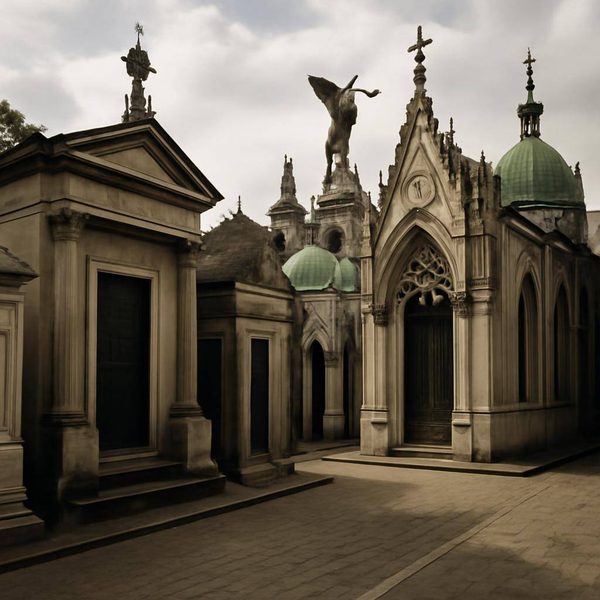

Recoleta Cemetery sits in the heart of one of Buenos Aires' most prestigious residential neighbourhoods, an unexpected landmark that surprises first-time visitors with its scale and architectural grandeur. The cemetery contains elaborate marble mausoleums constructed in Art Deco, Art Nouveau, Baroque, and Neo-Gothic styles, representing the burial sites of Argentina's political, military, cultural, and social elite. It functions simultaneously as a working cemetery, historical monument, and outdoor museum of funerary architecture.
History and Layout
The cemetery occupies land that once belonged to the Recoleta convent. When it opened to burials, it became the preferred resting place for Argentina's wealthy and influential families, who commissioned increasingly elaborate mausoleums as status symbols. The tombs showcase materials and craftsmanship from the period between 1880 and 1930, when Buenos Aires was experiencing its economic boom and European immigration.
The layout follows a grid of numbered sections and lettered pathways, creating a small city of the dead with its own streets and addresses. Maps are available at the entrance for a small fee, recommended for first-time visitors navigating the maze of tombs. The cemetery administration has marked certain routes to help visitors locate the most famous graves, though part of the experience involves wandering and discovering unexpected architectural details.
Notable Graves
Eva Perón's tomb draws the most visitors. Although she died in 1952, her body was not interred in the Duarte family mausoleum until 20 years later, following a complicated post-mortem journey. The grave, located in Section 6, Path 6, Block C, often has fresh flowers left by admirers. Evita lies in a heavily fortified crypt approximately five metres underground, constructed to protect her remains. The tomb itself appears modest compared to some of the cemetery's more ostentatious mausoleums, which surprises many visitors expecting something grander.
Other notable burials include several Argentine presidents—Domingo Faustino Sarmiento, whose educational reforms shaped modern Argentina, and Bartolomé Mitre, among others. Raúl Alfonsín, Argentina's first democratically elected president after the military dictatorship, was interred here as well. Cultural figures buried in Recoleta include writers and scientists who contributed to Argentine intellectual life, and boxer Luis Ángel Firpo, known internationally in the 1920s.
Architecture and Atmosphere
The architectural diversity reflects changing tastes across generations of Buenos Aires elite. Some families commissioned tombs resembling miniature temples or palaces, complete with stained glass, sculptures, and decorative metalwork. The contrast between elaborate monuments and simpler family crypts illustrates the social hierarchies that persisted even in death.
The cemetery has acquired a population of stray cats, which residents and regular visitors feed. These cats have become an unofficial feature of visits, adding an unexpected element to the otherwise solemn atmosphere. The combination of monumental architecture, tree-shaded pathways, and wandering cats creates a distinctive environment unlike typical cemeteries.
Visiting Practicalities
The cemetery is open daily from 08:00 to 18:00. Admission is free, though some sources indicate possible fees for international tourists—visitors should verify current policy at the entrance. The location at Junín 1760 in the Recoleta neighbourhood is accessible by public transport and walking from nearby areas.
Free guided tours in Spanish operate at 11:00 and 14:00 Tuesday to Friday, and at 11:00 and 15:00 on Saturdays, Sundays, and public holidays, according to the official Buenos Aires tourism site. Some operators offer English-language tours at 11:00 on Tuesday, Thursday, and Saturday, though availability and pricing should be confirmed locally. Walking tour companies also include the cemetery in broader Recoleta neighbourhood tours, providing historical context beyond the burial site itself.
Wheelchair-accessible paths reach major tombs, though the uneven historic paving may present challenges in some areas. Photography is permitted throughout, though visitors should remain respectful of the cemetery's function as an active burial ground. Flash photography is generally acceptable, though discretion is advised near funeral services.
Visitors should allow at least an hour for a basic visit, longer for those interested in architecture or specific historical figures. The cemetery connects naturally to exploring the wider Recoleta neighbourhood, which contains museums, cafés, and parks within walking distance.
Sources: Recoleta Cemetery - Buenos Aires Official Tourism • La Recoleta Cemetery - Wikipedia • Recoleta Cemetery Visitor Guide 2025 • Grave of Evita Perón - Free Tour Buenos Aires