Millennium Park opened in 2004 as a 24.5-acre public space in the Loop, transforming former rail yards and parking lots into what became one of Chicago's most visited attractions. The park sits between Michigan Avenue and Columbus Drive, bounded by Randolph Street to the north and Monroe Street to the south, placing it at the centre of the city's lakefront museum campus and within walking distance of the Art Institute of Chicago.
Cloud Gate: The Bean
Cloud Gate, universally known as "The Bean," stands as the park's signature sculpture. British artist Anish Kapoor designed the 110-ton elliptical sculpture, which was installed between 2004 and 2006. The work measures 33 feet high, 42 feet wide, and 66 feet long, constructed from 168 stainless steel plates welded together and polished to create a seamless, mirror-like surface. The highly reflective exterior captures and distorts the Chicago skyline, the surrounding park, and visitors themselves, creating a constantly changing visual experience that has made it one of the most photographed public artworks in the United States.
The sculpture sits in AT&T Plaza at the park's centre. Visitors can walk around and underneath the structure, where a 12-foot-high concave chamber, known as "the omphalos" (Greek for navel), creates unusual acoustic and visual effects. The name "Cloud Gate" references the way the polished surface reflects the sky, though the "Bean" nickname, which Kapoor reportedly dislikes, has become the popular designation.
Other Park Features
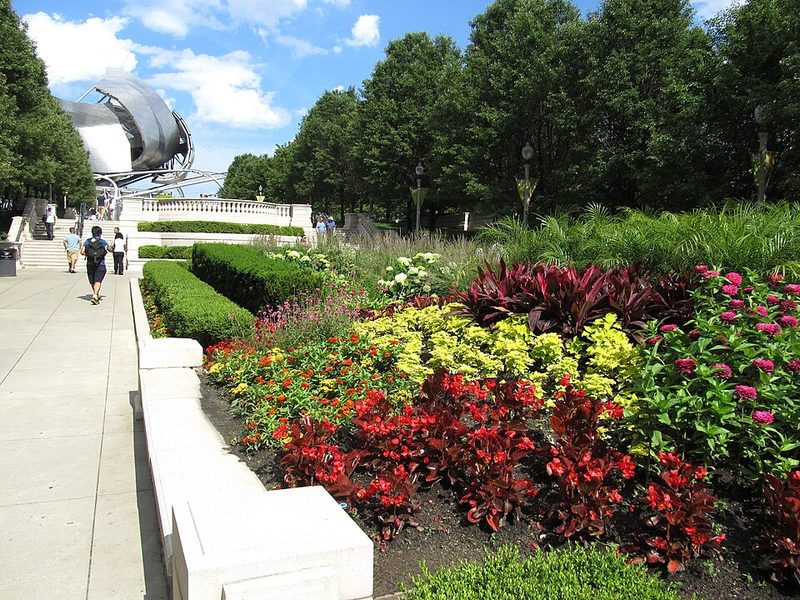
The Jay Pritzker Pavilion, designed by architect Frank Gehry, serves as the park's outdoor concert venue. The bandshell features distinctive curved stainless steel ribbons that rise 120 feet and frame the stage. The pavilion hosts the Grant Park Music Festival's free classical concerts during summer months, along with other performances throughout the year. The Great Lawn accommodates 7,000 seated guests, with an additional 4,000 capacity on the surrounding lawn.
The Crown Fountain, created by Spanish artist Jaume Plensa, consists of two 50-foot glass block towers at opposite ends of a shallow reflecting pool. LED screens behind the glass display video images of Chicago residents' faces, with water spouting from their mouths during warmer months—a feature particularly popular with children. The fountain operates from mid-spring through mid-autumn, weather permitting.
The Lurie Garden occupies 2.5 acres at the park's southern end, designed as a modern interpretation of Illinois prairie landscape. The garden's design references Carl Sandburg's description of Chicago as the "City of the Big Shoulders," using perennial plantings, grasses, and a "shoulder" hedge to create seasonal interest throughout the year. The space provides a quieter alternative to the busier areas near Cloud Gate and the pavilion.
Visiting Practicalities
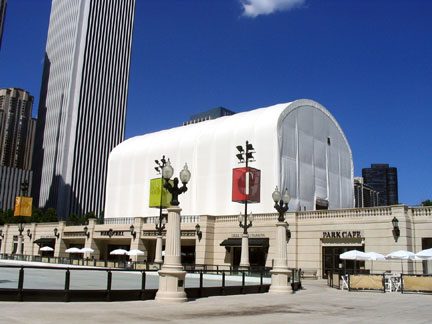
Millennium Park remains open year-round, with access from multiple points along Michigan Avenue and from the Randolph Street Metra station. The park connects to Maggie Daley Park to the east via the BP Bridge, another Gehry design. Winter brings ice skating to the McCormick Tribune Ice Rink, which operates from November through March, weather permitting. Visitors should check current schedules for the rink, fountain operation, and concert programming before arrival, as all are seasonal or weather-dependent.
The park's location makes it a natural starting point for exploring other Loop attractions. The Art Institute of Chicago sits directly across Monroe Street, Grant Park extends to the south, and the Chicago Cultural Center—a 1897 landmark building with free exhibitions—is one block north on Washington Street. The Chicago Riverwalk and theatre district lie within a short walk to the north and west.
Sources: Millennium Park - Wikipedia • What is the Bean in Chicago? Cloud Gate Name, Meaning & Location • Cloud Gate - Wikipedia