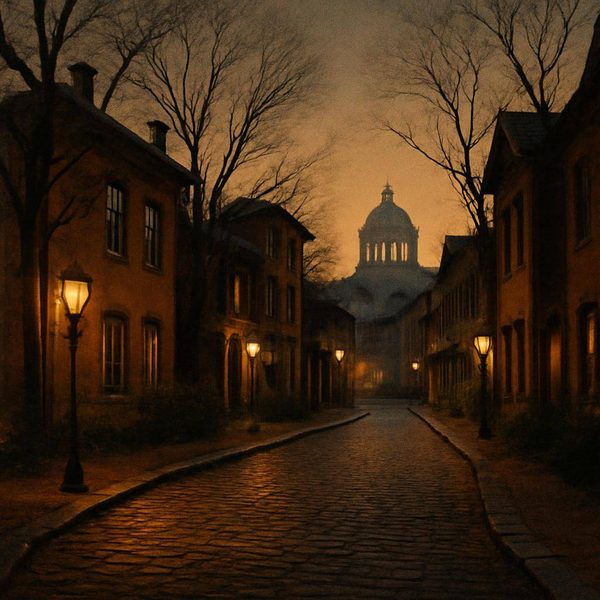
The evening starts, as many Columbus evenings do, near Capitol Square. The Statehouse dome catches the last light above the rooflines, and the office workers who ate lunch on the lawn a few hours ago have long since gone home. At this hour the square belongs to people who are going somewhere else — to the Short North, to the riverfront, or, on a particular October evening, to a neighbourhood south of downtown where the streets are brick and the houses were built for German immigrants who are now more than a century gone.
Columbus Ghost Tours has been leading people through the city's darker history for years. E.R. Cutright, the organisation's founder, has documented a city full of cemeteries and old buildings where the past sits close to the surface. Ohio, it turns out, has more of these stories than most states care to admit, and Columbus — with its institutional buildings, its long residential history, and its nineteenth-century neighbourhoods — has more than its share.
The house at 77 Jefferson Street is the obvious starting point for anyone interested in Columbus and the supernatural. James Thurber, the author and cartoonist whose comic vision of American life shaped a generation of readers, lived there in 1915. That was the year, according to a 2025 account published by WOSU Public Media, when Thurber became convinced he heard a ghost moving on the stairs. Whether he did or not is beside the point. Thurber turned the experience into writing, as he turned everything into writing, and the house has carried that association ever since. The Thurber House is now a literary centre — the ghost story, in this case, has had a better afterlife than most.
Walking south from downtown in October puts you in German Village when the light is already low by five in the afternoon. The brick streets here are not a reconstruction or a theme park; they are the actual nineteenth-century fabric of a neighbourhood that survived by being too well-built to demolish easily. The German Village Society's preservation work, formally recognised in 1974 with a National Register of Historic Places listing, means that what you walk through tonight is what people walked through a hundred years ago, more or less. The houses are smaller than you expect. The streets are quieter than they have any right to be, this close to a city of nearly a million people.
Columbus Ghost Tours moves through neighbourhoods like this one, stopping at buildings where local memory and documented history overlap. The organisation has published material on Ohio's cemeteries and the stories attached to them — not the manufactured scares of a commercial haunted house, but the slower, more unsettling kind of history that accumulates when a place has been inhabited long enough for things to go wrong in it.
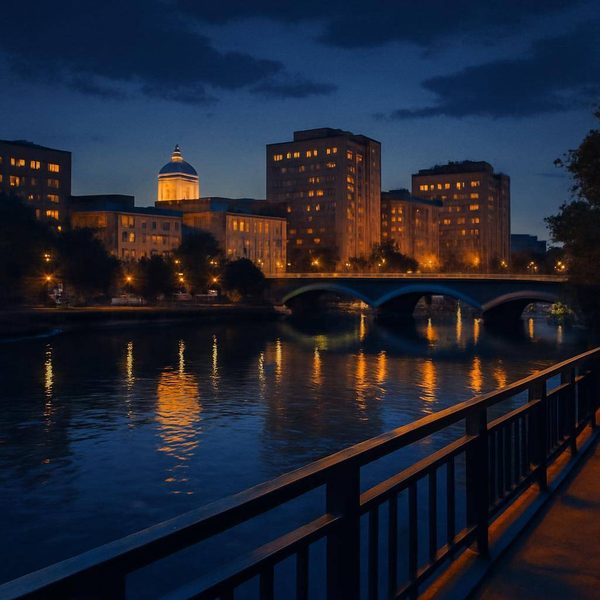
By the time the walk circles back toward the riverfront, the Scioto is dark and the lights of Battelle Riverfront Park reflect in the water below the Main Street Bridge. This is where Columbus looks most like a city conscious of its own image: the skyline arranged behind the water, the parks groomed and lit. It is not where the ghost stories live. The ghost stories live on the brick streets to the south, in a house on Jefferson Street, in the kind of staircase noise that a twenty-three-year-old writer in 1915 decided to take seriously.
October is, of course, the right month for this. The city fills for Ohio State football on autumn Saturdays, and the Short North gets loud on Friday nights. But on a quieter Tuesday in the middle of the month, walking south from the Statehouse into German Village and back along the river, Columbus offers the thing that mid-sized American cities occasionally manage when they are not trying too hard: a sense that the place has a history that predates your visit, and that some of it is still, in some form, present.
This is an editorial travel story drawing on source-backed facts about Columbus, James Thurber, Columbus Ghost Tours, and German Village. It is not a first-hand WorldTownGuide visit. Named places, people and historical references are drawn from the research sources listed below. Fictional atmosphere is the writer's own.
Frequently Asked Questions
Is Thurber House a real Columbus stop?
Yes. Thurber House is a literary centre at 77 Jefferson Street, where James Thurber lived in 1915 and where later accounts connect the house with Columbus ghost-story lore. Check Thurber House directly for current tours, events and opening arrangements.
Does this story describe an official ghost tour route?
No. The story uses source-backed Columbus places and ghost-history context to create an editorial walking narrative. Visitors who want a hosted tour should check Columbus Ghost Tours or current local operators before travelling.
Which Columbus areas does the story connect?
The route links Capitol Square, Thurber House, German Village and the Scioto riverfront, giving visitors a way to read Columbus through literature, preservation and older neighbourhood streets rather than only through downtown landmarks.
This is a fictional visitor story generated from source-backed place facts, image evidence and visitor-feel signals. It is not a first-hand WorldTownGuide visit. Named places, routes and historical references are source-backed; the visitor character and narrative events are invented.
Sources: German Village - Wikipedia • For the love of ghost stories: a look at two of Columbus' haunted historic homes - WOSU Pu • Haunted and Paranormal - Arcadia Publishing (Ohio titles)