


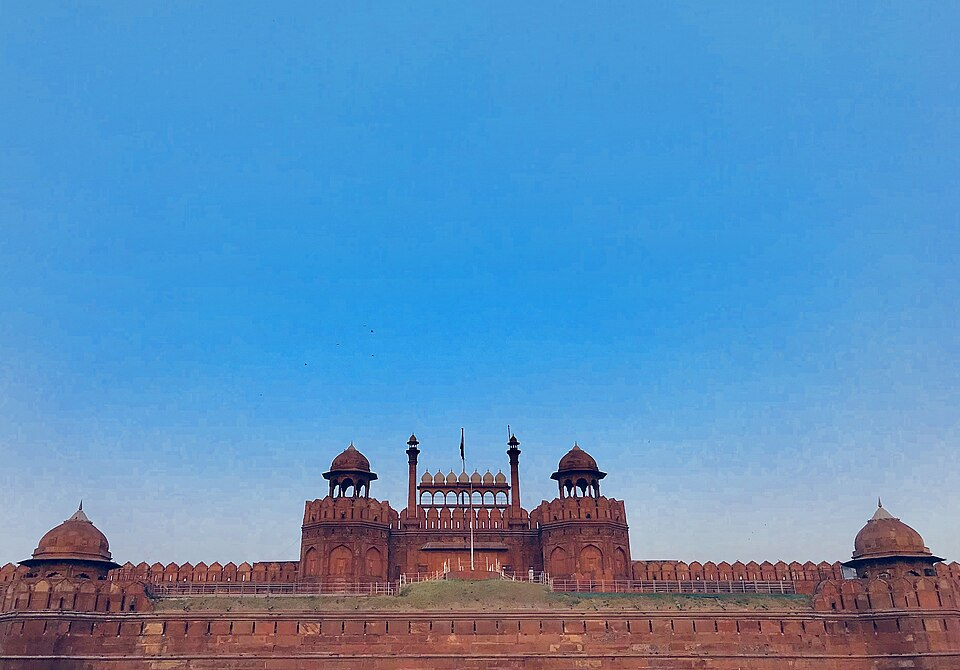
Red Fort and Mughal Heritage
The Red Fort (Lal Qila) is the most prominent physical remnant of the Mughal city of Shahjahanabad and one of the most visited monuments in India. Built by the emperor Shah Jahan and completed in 1648, it served as the main residence of the Mughal emperors for over two centuries. The fort is classified as a UNESCO World Heritage Site, jointly with the adjacent Salimgarh Fort.
What the Red Fort Is
The fort takes its name from the red sandstone used for its outer walls, which stretch for approximately two kilometres around the complex. The main entrance for visitors is the Lahori Gate, facing Chandni Chowk. Within the walls, the complex contains a series of pavilions, audience halls, gardens and service quarters that reflect the scale and organisation of a Mughal imperial court. The Diwan-i-Aam (Hall of Public Audience) and the Diwan-i-Khas (Hall of Private Audience) are among the most documented structures inside the complex. The fort also holds significance as the site from which India's Prime Minister addresses the nation on Independence Day each year.
The Salimgarh Fort, connected to the Red Fort by a bridge and sharing the UNESCO designation, was built in 1546 by the Sur dynasty ruler Islam Shah Suri, predating Shah Jahan's city by over a century. It was later used as a prison and military installation through the Mughal, Maratha and British periods.
Visiting the Red Fort
The Red Fort is managed by the Archaeological Survey of India and charges an entry fee, with different rates for Indian and foreign nationals. The fort is closed on Mondays. A sound-and-light show operates in the evenings. Visitors should confirm current admission fees, timings and show schedules directly with the ASI or through the official India tourism portal before visiting, as these details are subject to change. The nearest Delhi Metro station is Chandni Chowk on the Yellow Line, from which the Lahori Gate is within walking distance.
The fort can be very busy during public holidays, Republic Day and Independence Day periods, and during major festival seasons. Early morning visits on weekdays generally involve smaller crowds.
Heritage Context
The Red Fort sits at the eastern terminus of Chandni Chowk, and understanding the two together provides a clearer picture of what Shahjahanabad was: a planned imperial capital with the fort at one end and a commercial city stretching west from its gates. The Jama Masjid, one of India's largest mosques, was also commissioned by Shah Jahan and stands a short distance south of the fort, completing the core of the original Mughal city. Delhi Tourism and Incredible India both identify the Red Fort as the centrepiece of Delhi's Mughal heritage offer.
Sources: Delhi Tourism - Heritage - World Heritage Monuments • Red Fort in Delhi - A Historic Monument of India - Incredible India • Red Fort - Wikipedia