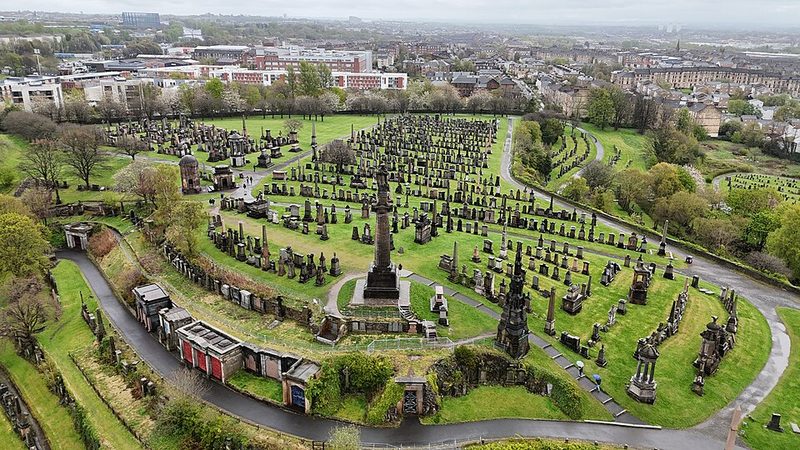
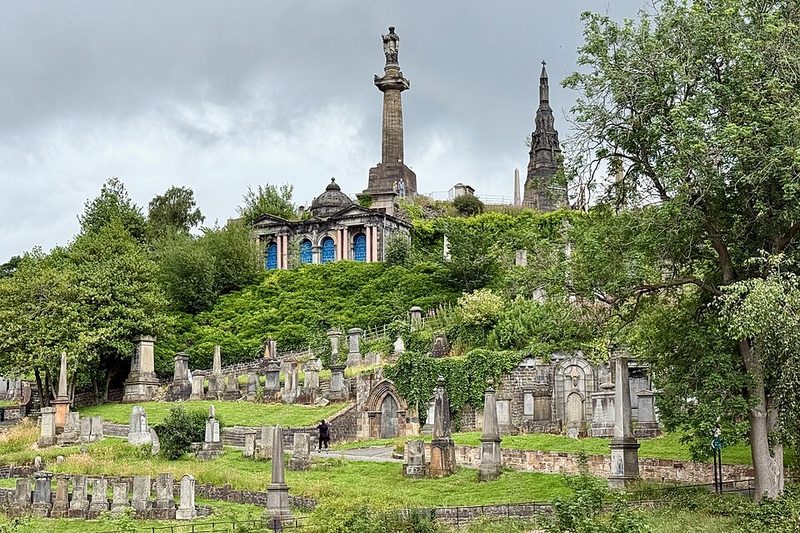
The Glasgow Necropolis spreads across 37 acres on a hillside overlooking the city centre, adjacent to Glasgow Cathedral. Modelled on Père Lachaise Cemetery in Paris, this Victorian garden cemetery opened in the 1830s and holds approximately 50,000 burials within its gates. The site functions as both a historical monument and a public green space, where visitors encounter ornate Victorian funerary architecture against a backdrop of city views.
Layout and Architecture
The cemetery follows the informal park layout typical of early Victorian cemeteries, avoiding the rigid grid patterns of later burial grounds. The complex topography of the hillside shapes the experience—paths meander upward toward the summit, where larger monuments cluster around the John Knox Monument, a prominent stone column visible from multiple points in the city. James Stevens Curl described the Necropolis as "literally a city of the dead," a reference to the density and variety of funerary structures that populate the landscape.
The architecture represents mid-19th century tastes and ambitions. Mausoleums, obelisks, Celtic crosses, and elaborate headstones display the craftsmanship and commemorative styles of the Victorian era. Many structures bear the marks of Glasgow's merchant and industrial wealth, monuments commissioned by families who prospered during the city's economic expansion.
Historical Context
The Necropolis dates to 1833, a period when Glasgow's rapid population growth created demand for new burial grounds. The cemetery was conceived as a garden cemetery, reflecting contemporary ideas about landscape, commemoration, and public health. Its location next to Glasgow Cathedral connects it to the city's medieval religious centre, though the Necropolis itself was a commercial venture rather than a church burial ground.
The site holds the remains of merchants, industrialists, artists, and ordinary residents. The monuments tell stories of individuals who contributed to Glasgow's development during its industrial peak, though many graves now stand weathered and partially obscured by vegetation.
Visiting Practicalities
The Glasgow Necropolis is open to the public most days from 7am until dusk. In winter months, dusk arrives around 3pm or 4.30pm depending on the source, and visitors should check current access times before planning a visit. Entry is free. The main entrance is located on Castle Street, behind St Mungo's Museum of Religious Life and Art.
The Friends of Glasgow Necropolis, a charity founded in 2005, maintains and restores the site. The organisation has raised over £100,000 for conservation work and, as of June 2025, had 140 volunteer members. Guided walking tours are available and provide introduction to the cemetery's history, architecture, and notable interments. Tours can be arranged through the Friends of Glasgow Necropolis.
The terrain is hilly and paths are uneven in places. Comfortable footwear is advisable. Visitors should be prepared for Scottish weather, particularly wind and rain, as the exposed hillside offers little shelter. The elevated position provides views across the city centre and toward the River Clyde, making the summit a notable vantage point for orientation and photography.
What Visitors Notice
The Necropolis rewards slow exploration. The concentration of Victorian monuments, the layered inscriptions and symbols, and the interplay of stone, vegetation, and weather create an atmosphere distinct from contemporary cemeteries. The site functions as an outdoor museum of 19th-century funerary art and a green space within the urban fabric. It is neither a traditional tourist attraction nor simply a burial ground, but occupies a category of its own—a historically significant landscape that remains accessible and atmospheric.
Sources: The Friends of Glasgow Necropolis • Glasgow Necropolis - Wikipedia • Glasgow Necropolis - VisitScotland