The Hospicio Cabañas stands as one of Guadalajara's most significant cultural landmarks—a UNESCO World Heritage site that combines architectural ambition with one of Mexico's most important mural cycles. Built between 1805 and 1845 to house orphans, the elderly and the sick, this sprawling neoclassical complex has evolved into the Instituto Cultural Cabañas, preserving both its architectural heritage and the monumental work of muralist José Clemente Orozco.
The Architecture and Original Purpose
The Hospicio Cabañas was designed as a unique architectural solution to social needs of early 19th-century Mexico. The complex consists of 23 courtyards connected by corridors and buildings arranged in a symmetrical layout, all unified under a distinctive domed chapel at the centre. UNESCO recognises the building for its outstanding architectural subtlety and humanity in responding to requirements for housing vulnerable populations. The building functioned as a hospice and orphanage for more than 150 years before its transformation into a cultural institution.
Located in Plaza TapatÃa in the historic centre, the complex occupies a full city block at Calle Cabañas No. 8, Colonia Las Fresas. The building's scale and the clarity of its neoclassical design make it one of the most architecturally significant structures in Jalisco.
Orozco's Mural Cycle
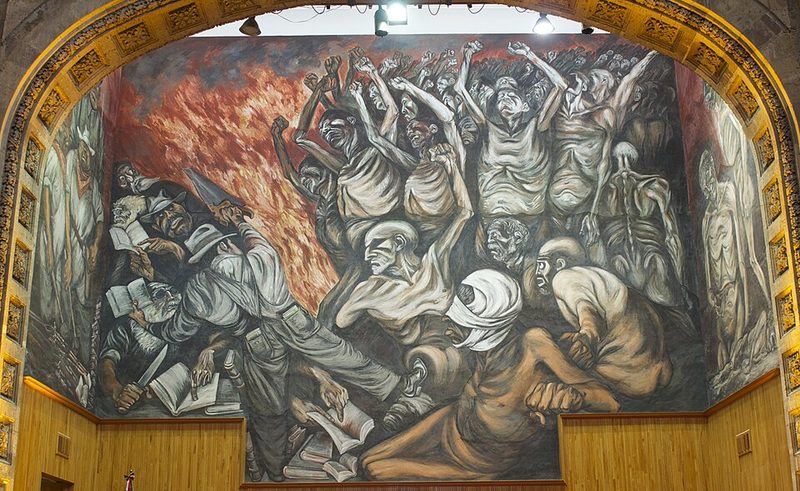
Between 1938 and 1939, José Clemente Orozco—born in 1883 in Zapotlán el Grande (now Ciudad Guzmán), Jalisco—created a cycle of 57 murals throughout the Hospicio Cabañas. These works represent the culmination of Orozco's artistic vision and are considered among the most significant mural projects in Mexican art history. The murals depict themes of conquest, human struggle, and transformation, rendered in Orozco's characteristic bold, angular style.
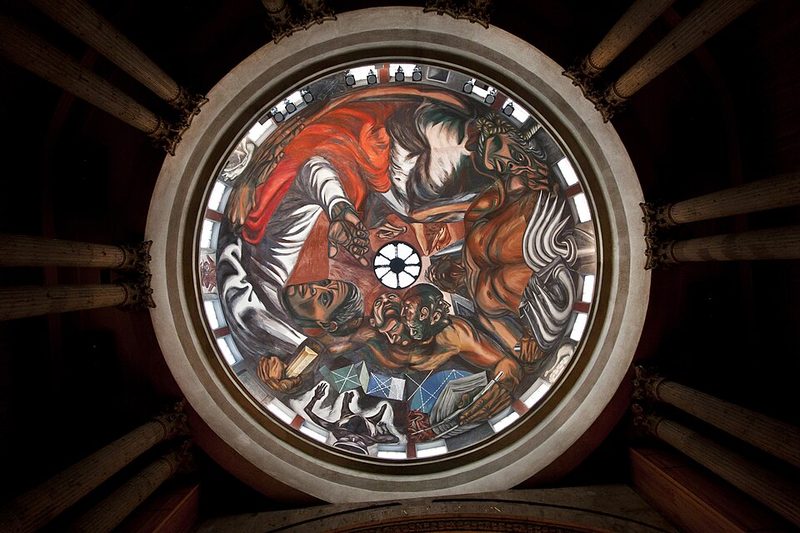
The centrepiece of the mural cycle is El Hombre en Llamas (Man of Fire), painted on the interior of the chapel dome. This powerful image of a human figure engulfed in flames has become an iconic representation of human transcendence and sacrifice. The quality of this work and the broader mural cycle were instrumental in the building's 1997 UNESCO World Heritage designation. The site is sometimes referred to as the Sistine Chapel of the Americas, though this comparison oversimplifies Orozco's distinct artistic vision.
Orozco painted murals throughout Mexico and the United States between 1922 and 1948, working in Mexico City, New York, New Hampshire and California, but his Guadalajara work—particularly at the Hospicio Cabañas and the Palacio de Gobierno—represents his most concentrated and mature output in his home state.
The Museum Collection
Beyond Orozco's murals, the Museo Cabañas maintains a collection of 340 pieces documenting Orozco's mural and graphic work from throughout his career. This represents one of the most comprehensive collections of a single Mexican muralist's output, spanning his artistic development from early works through his final projects.
Visiting Practicalities
The Hospicio Cabañas operates as the Museo Cabañas, open Tuesday to Sunday from 10:00am to 5:00pm (some sources indicate hours extending to 6:00pm; visitors should verify current schedules). The museum is closed Mondays. Tuesdays offer free admission for all visitors, making it a popular day to visit though potentially more crowded. On other days, admission fees apply and tickets are typically available at the entrance with minimal queuing, particularly on weekdays.
The museum is located in the Plaza TapatÃa area of central Guadalajara, within walking distance of the Cathedral and other historic centre landmarks. The site is accessible via the Guadalajara light rail system; Plaza Universidad station serves the area. Visitors should allow at least 90 minutes to two hours to properly view the murals and explore the courtyards and exhibition spaces.
A buffer zone of 18 urban blocks (37.26 hectares) surrounds the Hospicio Cabañas, bounded by Federación Street to the north, Javier Mina to the south, Mariano Jiménez to the east, and Calzada Independencia to the west, protecting the historic context of the site.
Sources: Hospicio Cabañas - UNESCO World Heritage Centre • Museo Cabañas Official Site • José Clemente Orozco - Wikipedia