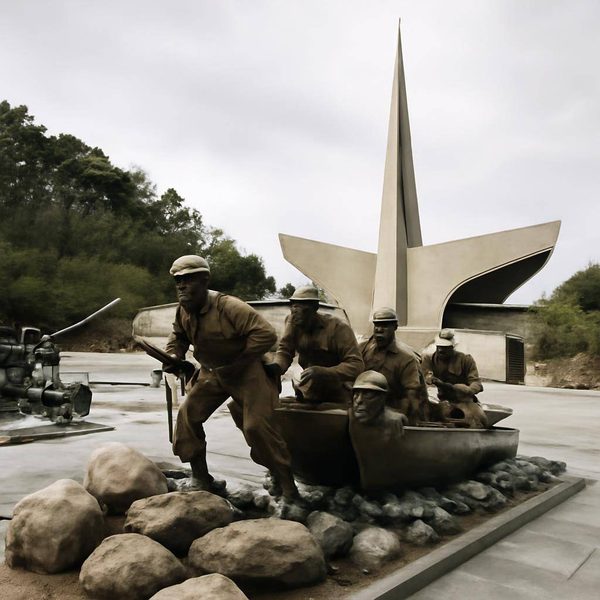

The Memorial Hall for Incheon Landing Operation commemorates the amphibious assault conducted on 15 September 1950 by United Nations and South Korean forces under the command of General Douglas MacArthur. The operation, executed during the early months of the Korean War when North Korean forces had pushed South Korean and UN troops into a defensive perimeter around Busan, succeeded in recapturing Incheon and subsequently Seoul, fundamentally altering the war's trajectory. The memorial functions as both historical museum and commemorative site, documenting the operation's planning, execution, and strategic consequences.
Historical Context and Strategic Significance
By September 1950, North Korean forces controlled most of the Korean Peninsula following their invasion in June. South Korean and UN forces held only the southeastern Pusan Perimeter. General MacArthur, serving as Supreme Commander of UN Forces, proposed an amphibious landing at Incheon to cut North Korean supply lines and enable a breakout from the Pusan Perimeter. The operation faced significant challenges: Incheon's extreme tidal variations (up to 10 meters), narrow approach channels, and fortified positions made it a high-risk target.
The landing commenced on 15 September 1950 with naval bombardment followed by Marine and Army assaults on Wolmi Island and the Incheon waterfront. Despite initial skepticism from military planners about the operation's feasibility, the landing succeeded with relatively limited casualties compared to the strategic gain. Within days, UN forces had recaptured Incheon and began the advance toward Seoul, which fell on 28 September. The operation effectively severed North Korean forces in the south from their supply bases, forcing a retreat northward and shifting the war's momentum.
Memorial Development and Purpose
The Memorial Hall for Incheon Landing Operation was built to commemorate the soldiers who participated in the operation and to document its historical significance for South Korea's survival as an independent state. The facility serves multiple functions: museum exhibitions detailing the operation's planning and execution, commemorative spaces honoring UN and South Korean casualties, and educational programming for Korean students studying the Korean War period.
The memorial is located in Yeonsu District, accessible within Incheon's metropolitan area. It marks the 100-year anniversary period of Incheon Port's opening (1883) and connects the city's modern history as an international gateway to its pivotal role in the Korean War.
Exhibition Content and Visitor Experience
The memorial's exhibitions include military equipment from the period, documentary materials related to the operation's planning, photographic records of the landing and subsequent Seoul recapture, and interpretive displays explaining the strategic context. The facility presents the operation within the broader narrative of the Korean War's first year, emphasizing the operation's role in preventing complete North Korean control of the peninsula.
Visitor experience focuses on understanding the operation's military complexity and its consequences for Korean history. The memorial presents General MacArthur as the operation's architect and commander, reflecting his prominence in South Korean historical memory of the war. The facility also acknowledges the participation of forces from multiple UN member nations, particularly the United States, which provided the majority of naval and air support for the landing.
Location and Access
The Memorial Hall for Incheon Landing Operation sits within Incheon's developed urban area, accessible by public transport from Seoul and central Incheon. Specific transit routes and operating details should be verified with local sources, as the memorial's visitor services and hours may vary. The site functions as a component of historical itineraries focused on Korean War heritage within the Seoul Capital Area.
Cultural and Educational Role
The memorial occupies a particular place in South Korean historical consciousness. The Incheon Landing represents one of the clearest turning points in the Korean War, demonstrating how military action preserved South Korea's existence as an independent state. For Korean visitors, particularly younger generations with no direct memory of the war, the memorial serves an educational function, conveying the precariousness of the early war period and the international intervention that prevented North Korean victory.
For international visitors, particularly those from nations that contributed forces to the UN command, the memorial acknowledges their countries' participation in the conflict. The site reflects South Korea's official memory of the Korean War as a defensive action supported by international coalition against aggression, a narrative that emphasizes alliance relationships central to South Korean security policy since 1953.
Visitor Considerations
The memorial functions primarily as a historical education site rather than a general tourist attraction. Visitors interested in military history, the Korean War period, or 20th-century Korean history will find substantive content. Those with limited background knowledge of the Korean War should expect exhibitions that assume some familiarity with the conflict's basic chronology and the geopolitical context of Cold War-era East Asia.
The memorial's interpretation reflects South Korean official historiography of the war, which emphasizes North Korean aggression, UN intervention as defensive and legitimate, and the war's unresolved status following the 1953 armistice. Visitors should be aware this represents one national perspective on a conflict that remains politically sensitive and subject to contested interpretations across the Korean Peninsula and internationally.
Sources: Yeonsu-gu Tourism - Memorial Hall for Incheon Landing Operation • Visit Korea - Memorial Hall for Incheon Landing Operation • Incheon Metropolitan City - Tourist Attractions