


In This Guide
This story guide follows Karachi by Rail: A Time-Slip Through the City's Layers in Karachi, giving the narrative route a clear starting point from the hub.
Read the guide as a story
Karachi by Rail: A Time-Slip Through the City's Layers
National Museum of Pakistan
The National Museum of Pakistan is the country's principal national museum, located in Karachi and documented by the Directorate of Antiquities, Government of Pakistan as one of the country's significant heritage institutions. Its collections cover Pakistani archaeological, historical, and cultural heritage across several galleries, with holdings that include material from the Indus Valley civilisation — one of the world's earliest urban cultures, whose sites at Mohenjo-daro and Harappa fall within Pakistan's territory.
Collections
The museum's galleries are documented as covering prehistoric and Indus Valley material, Gandharan Buddhist sculpture, Islamic art and calligraphy, coins, manuscripts, and ethnographic collections representing Pakistan's diverse regional cultures. The Directorate of Antiquities lists the museum among the country's primary public heritage facilities. A visiting hours and practical guide is available at audiala.com for orientation, though current hours and admission should be confirmed with the museum directly before visiting.
Practical Notes
The museum is in central Karachi. As with all sites in the city, travellers should consult current official travel advisories before visiting and verify current opening arrangements. This guide does not hold confirmed current admission or hours data.
Sources: National Museum Karachi - Visiting Guide - audiala.com
Nigar Craft Burns Garden
Nigar Craft is a documented craft retail destination in Karachi, located at or near Burns Garden — a public garden in the city that is listed in Wikipedia and referenced in postcard and travel sources as a named green space. The craft outlet is referenced by its own authoritative domain (nigarcraft.com.pk) and is included in Nigar Craft's own published guide to notable places in Karachi, where it appears among recommended visitor destinations.
Burns Garden
Burns Garden is named in Wikipedia as a public garden in Karachi. Its positioning near the craft retail outlet makes it a functional orientation anchor for visitors heading to the area. The garden is referenced in postal and travel documentation as one of the city's named public spaces, current visitor facilities should be verified before planning around it.
Practical Notes
Visitors should verify the current opening arrangements of Nigar Craft directly with the outlet before visiting; this guide does not hold confirmed current opening hours or retail inventory. The nigarcraft.com.pk domain is listed as an authoritative source for current status. As with all sites in Karachi, current official travel advisories should be consulted before travel.
Sources: Burns Garden - Wikipedia • 100 Best Places to Visit in Karachi - Nigar Craft • Burns Garden Karachi - paperjewels.org
Clifton Beach and Coastal Areas
Clifton Beach — widely known locally as Sea View or Seaview — is Karachi's most visited public coastal area and one of the most frequented open spaces in the city. Located in the Clifton district in southern Karachi, the beach has served as the primary public gathering space by the sea for city residents across generations. Entry to the beach is free.
Location and Setting
The beach lies within the Clifton area, which together with the adjacent Defence Housing Authority (DHA) district forms part of Karachi's affluent southern coastal zone. The Nishan-e-Pakistan monument and the Dolmen Mall are noted as nearby landmarks. Seaview Apartments, a gated residential development, sits directly across from the beach and is considered among the more prominent property addresses in the city. The Clifton area is part of Karachi South District, which also encompasses the historic Saddar town centre and its markets.
Activities and Character
The beach offers a range of leisure activities that have made it a longstanding feature of Karachi's popular culture. Available sources document camel rides, horse rides, buggy rides, and plastic plane flying as among the activities on offer. Street food vendors are a consistent presence along the seafront.
Sources: Clifton Beach, Karachi - Wikipedia • Karachi South District - Wikipedia • Sea-View Beach Guide - Kupi • Clifton Sea View 2026 Local Guide - Qoshe • Port Grand food festival - Truly Pakistan
Quaid-e-Azam House (Flagstaff House)
The Quaid-e-Azam House, also known as Flagstaff House, is a house museum in Karachi dedicated to the personal life of Muhammad Ali Jinnah, the founder of Pakistan. It is the former residence in which Jinnah lived from 1944 until his death in 1948, and it preserves the domestic setting of one of the defining figures in South Asian history within a building that has remained largely intact since that period.
History and Significance
Muhammad Ali Jinnah occupied Flagstaff House from 1944, using it as his primary Karachi residence through the final years of his leadership of the Pakistan independence movement and through the period immediately following Partition in 1947. The house therefore connects directly to the most consequential phase of Jinnah's public life — the creation of Pakistan — and to his relatively brief tenure as the country's first Governor-General before his death in September 1948. Jinnah's sister, Fatima Jinnah, lived in the house after his death. The building was designed by British architect Moses Somake, and its design reflects the residential architecture favoured by Karachi's prominent inhabitants in the early to mid-twentieth century.
The Museum
The house functions today as a museum displaying personal belongings of Muhammad Ali Jinnah.
Sources: Quaid-e-Azam House Museum - VisitSilkRoad • Quaid-e-Azam House - Wikipedia • Inside the Quaid's House - Dawn • Exploring History - Quaid-e-Azam House Museum - Graana
Arrival and Getting Around
Karachi is served by Jinnah International Airport (IATA: KHI), which handles both international and domestic routes. Airline operators including Qatar Airways are among those serving the airport; for a current list of routes and carriers, consult the airport's official schedules directly, as this guide does not publish live timetable data. On arrival, the city's scale and traffic density can be striking; allow extra time when connecting onward, and confirm any onward transport arrangements in advance.
City Railway Station is the main rail terminus, connecting Karachi to other major Pakistani cities via Pakistan Railways. The station is approximately 1.6 kilometres from the urban core and is a functional rather than decorative arrival point; it serves as the practical anchor for travellers arriving overland.
Within the city, taxis and ride-hailing apps are among the most practical options for point-to-point movement in Sindh and across Karachi's spread-out districts; agree fares in advance with conventional taxis, and verify that any app-based service is currently operating in the area you need before relying on it. The Sindh Mass Transit Authority also operates bus services on a number of routes. Source-backed route evidence identifies services including Route 1 (Dockyard to Khokrapar, calling at Kalaboard, Malir Halt, Colony Gate, Nata Khan Bridge and Saudabad), Route 5 (Custom House to Manghopir and New Karachi Nai Abadi, calling at Lee Market, Juna Market, Gandhi Garden, Purani Golimar and Pakistan Colony), and Route 3 (Surjani Town services, calling at Surjani KDA, Karimi Chowrangi, Hyderi Market and others). Route R3 covers Hawks Bay, Malir Halt, and Tower stops. These route descriptions are drawn from available sources and are not a live timetable; verify current services and operating status with the Sindh Mass Transit Authority or the Transport Department, Government of Sindh (transport.sindh.gov.pk) before travel.
A new international ferry terminal has been inaugurated in Karachi ahead of a Pakistan-Iran passenger service to Chabahar. The Ministry of Maritime Affairs issued Pakistan's first international ferry licence in August 2025. Schedules, fares, and operational status for this service are subject to change; check with the operator (pakiranferry.com) and official sources before making arrangements. Ferry and bus terminals are distinct entities; do not conflate the new ferry terminal with Karachi Bus Terminal.
Food and Markets
Karachi Biryani is among the most distinctive of the city's culinary contributions and is widely regarded as one of the defining regional styles of this dish in South Asia, characterised by spicing and preparation methods that differ from Lahori or other Pakistani variants. Numerous restaurants and street stalls across the city serve biryani, and it is considered an essential part of understanding Karachi's food culture.
Zainab Market is one of Karachi's most documented retail destinations, particularly noted for affordable clothing and export-quality goods. Its roots are described in multiple sources as extending back centuries, tied to Karachi's long history as a trading port. The market is listed in Wikipedia's Karachi heritage index and in the Heritage of Sindh database. It continues to function as a working commercial market; visitors should be aware that market conditions and access can vary, and that current safety context (see above) affects all movement in the city.
Nigar Craft at Burns Garden is a documented craft retail location in Karachi, referenced by the authoritative domain nigarcraft.com.pk and in the Burns Garden Wikipedia entry. Burns Garden itself is a public garden in the city. Nigar Craft is one of the better-documented specialist craft destinations available in current sources; verify current opening arrangements before visiting.
Culture and Events
The Karachi Literature Festival (KLF) is described in multiple sources as Pakistan's longest-running and largest literary festival, held annually and recognised as one of the foremost events of its kind in South Asia. It was first organised in March 2010 by Oxford University Press Pakistan in collaboration with the British Council, with the involvement of the late Sabeen Mahmud of Peace Niche. The 17th edition was held in February 2026. The festival runs as a multi-day programme of panel discussions, book launches, poetry readings, and author talks, and has consistently attracted prominent Pakistani and international writers and academics. For current scheduling, consult the official site at karachiliteraturefestival.com.
The city's cultural life extends beyond formal institutions. Arif Hasan's documented account of Karachi's mid-20th-century music scene describes ballroom dancing institutes, dance competitions — most famously at the Railway Club — and a jazz scene that drew packed crowds in the 1950s. That particular era has passed, but it gives some sense of how culturally layered the city's history is beneath its current urban scale.
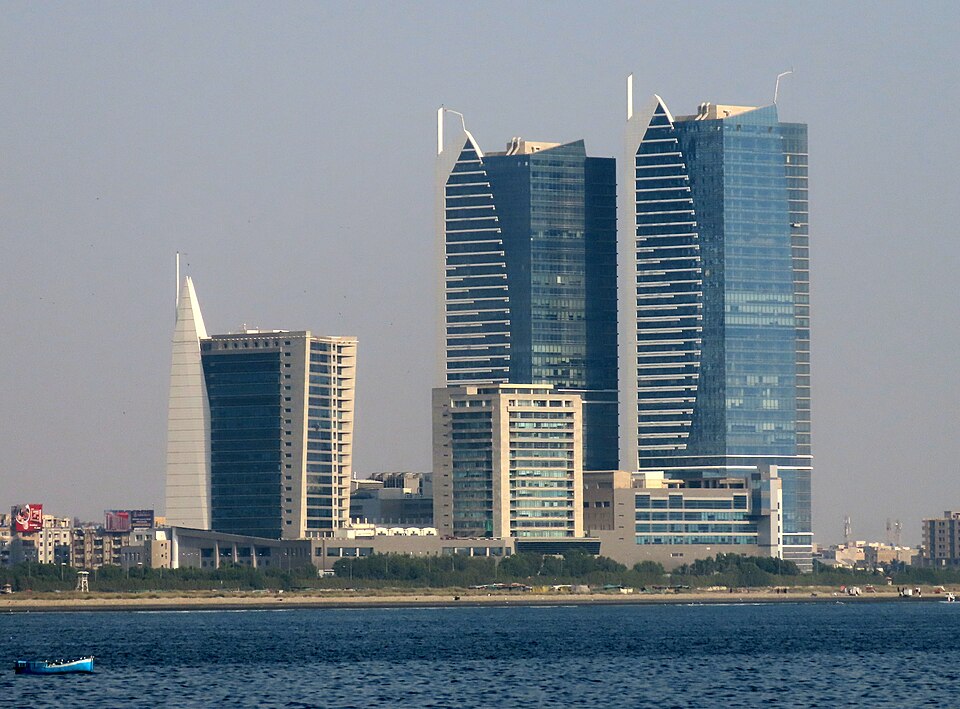
Bahria Tower (also referred to as Bahria Icon Tower in some sources) is a prominent feature of the contemporary Karachi skyline, documented in Wikipedia and in local reporting. Available sources support treating it as a skyline landmark. Deeper visitor context should be verified with current local sources.
Economy and Working Life
Manufacturing, finance, and trade are the three pillars of Karachi's economy, and their concentration here makes the city unlike any other in Pakistan. The port handles the large majority of Pakistan's seaborne trade, and the city's industrial zones — including those at SITE (Sindh Industrial and Trading Estate) — have historically drawn migrants from across the country. The financial sector is anchored by the Pakistan Stock Exchange and the headquarters of major national and international banks. This economic weight underpins much of the city's infrastructure investment and cultural output, and shapes the rhythm of daily life for the millions who work here.
Practical Notes
Anyone travelling to or within Karachi should check current official government travel advice before proceeding. The UK FCDO Pakistan travel advice is at gov.uk/foreign-travel-advice/pakistan. The US State Department advisory is at travel.state.gov. Medical facilities in Karachi include Civil Hospital of Karachi, Eidgah Civil Hospital, and Spencer Eye Hospital, all referenced in available geographic records. Entry requirements, health precautions, insurance and local transport status should be verified through official and current sources. Pakistan's currency is the Rupee (PKR). The city observes Pakistan Standard Time (Asia/Karachi, UTC+5).