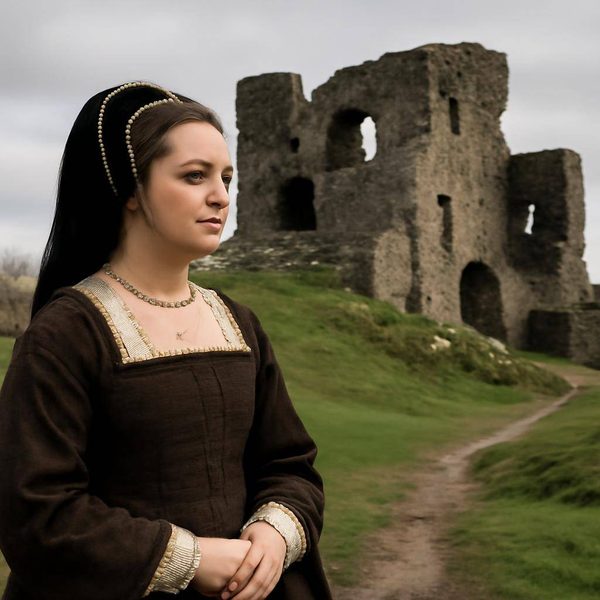
Kendal Castle stands on a glacial drumlin east of the town centre, its ruined walls visible from the valley below. Built in the early 13th century as the seat of the Barony of Kendal, the castle served as the administrative and military centre for the region for over two centuries. The structure comprised six towers linked by curtain walls, with a deep dry moat surrounding the complex. The Parr family, who controlled the barony in the 15th century, are the best-known of the castle's baronial occupants, largely due to their most famous descendant: Catherine Parr, sixth and last queen of Henry VIII.
The Catherine Parr Birth Question
Local tradition long held that Catherine Parr was born at Kendal Castle. Street names in the town reflect this belief, and the association between Kendal and the Tudor queen remains embedded in the town's identity. However, modern historical research has demonstrated that the castle was already in a state of disrepair by 1512, the year of Catherine's birth. Evidence confirms the castle was ruined by the early 16th century, and historians now believe she was most likely born in Blackfriars, London, where the Parr family maintained a residence.
The Parr family certainly owned Kendal Castle at the time of Catherine's birth, and the barony remained part of their holdings. William Parr's widow remarried in 1486 and left Kendal for Northamptonshire, which contributed to the castle falling out of use. By 1572, records describe the structure as being in a state of dilapidation, with "all in a state of decay." Despite the historical evidence, the local connection persists, and Kendal continues to claim Catherine Parr as a daughter of the town, if not of the castle itself.
The Castle's History and Structure
The castle was built around 1200-1241 to replace an earlier wooden motte-and-bailey fortification on the opposite side of the River Kent at Castle Howe. The stone structure was designed to serve as both a residence and a defensive position, reflecting the strategic importance of Kendal in the medieval period. The Barony of Kendal itself was granted to William de Lancaster around 1150, and ownership passed through several notable northern families—including the Brus, Lindsay, Ros, and Thweng lines—before coming to the Parr family at the end of the 14th century.
The castle's position on a drumlin provided a commanding view over the town and the River Kent valley. The six-tower design with curtain walls was substantial for a baronial residence, indicating the wealth and importance of the Kendal barony. The dry moat surrounding the castle added to its defensive capabilities, though the structure appears to have been more administrative seat than active military fortress by the later medieval period.
Visiting the Castle Today
Kendal Castle is now managed by South Lakeland District Council and is open to the public. The ruins consist of parts of the wall shield, the old manor hall, and one surviving tower. Footpaths lead through fields and woods below the hill, and the walk to the castle offers views over Kendal and the surrounding countryside. Parking is available on nearby streets, including Parr Street, from which the castle is a short walk.
The site is free to access, and no official opening hours restrict entry to the grounds. The ruins themselves are not staffed, and interpretation on site is limited. Visitors should be prepared for uneven ground and exposed conditions, as the hilltop location is open to weather. The castle is not accessible by car; a footpath from the town centre leads up the drumlin, taking approximately 15-20 minutes.
Cultural and Historical Significance
Kendal Castle functions as a visible marker of the town's medieval past. The ruins serve as a reminder that Kendal was not merely a market town but also a centre of baronial power, administration, and landownership. The Parr family's association with the castle—and Catherine Parr's status as Henry VIII's final queen—adds a Tudor dimension to Kendal's history, even if the biographical details have been clarified by later scholarship.
The castle was purchased by the town of Kendal in 1896 to mark Queen Victoria's Diamond Jubilee, a symbolic act that transferred the site from private decay to public heritage. Today, the castle serves as a walking destination for residents and visitors, offering a tangible connection to the region's layered history and a vantage point over the grey-stone town and the River Kent valley below.
Sources: Kendal Castle - Wikipedia • Katherine Parr - Kendal Town Council • Kendal Castle - Visit Cumbria • Kendal Castle Visitor Information