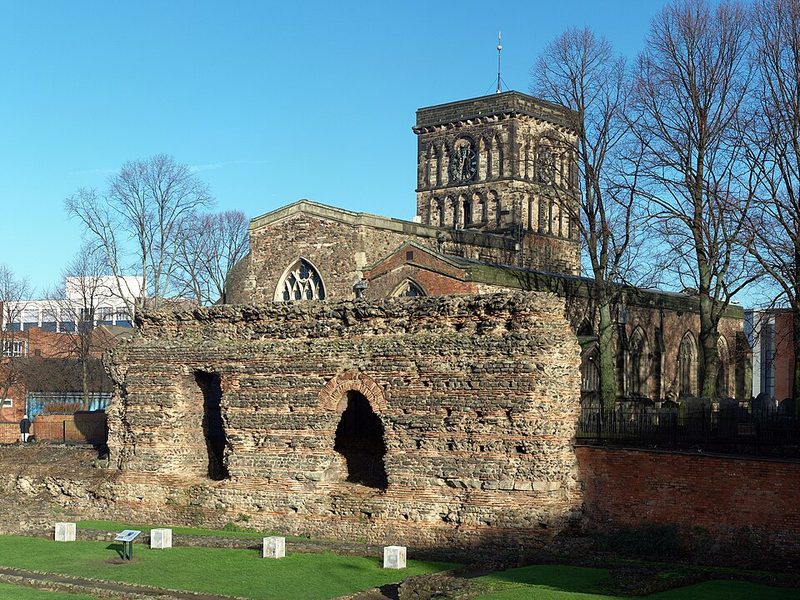
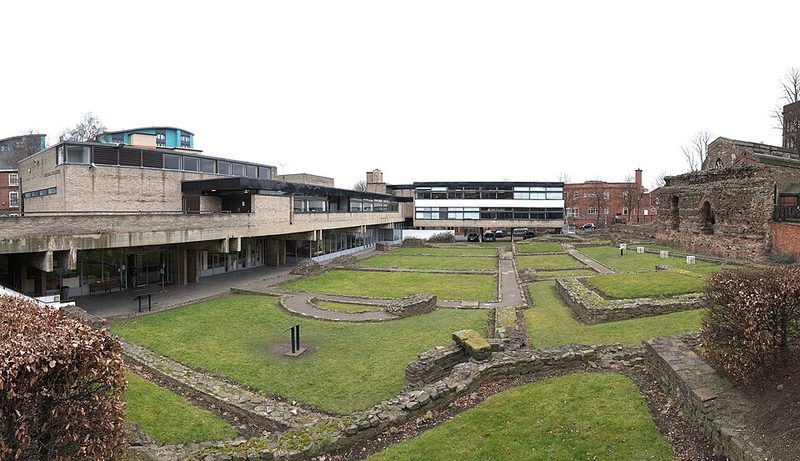
Leicester was a significant Roman town known as Ratae Corieltauvorum, and the evidence of that occupation is more substantial here than in most English cities. The Jewry Wall — one of the tallest surviving sections of Roman masonry in Britain — still stands near the city centre, and the bath house ruins immediately beside it represent one of the largest surviving Roman bath house sites in the United Kingdom. In July 2025, after an extensive redevelopment project, the Jewry Wall Museum reopened to the public as a newly configured visitor attraction built around those ruins.
The Wall and What It Was
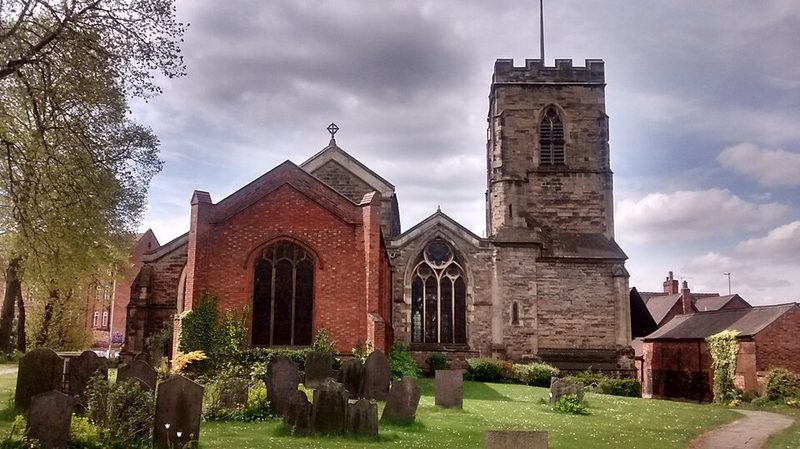
The Jewry Wall itself is the remains of a ceremonial entrance porch that once connected the town's exercise hall to its public baths. Standing to a considerable height, it survived largely because later builders incorporated it into the fabric of the adjacent church of St Nicholas. The Roman bath house whose foundations lie directly to the west formed part of a large public complex at the civic heart of Ratae Corieltauvorum. The wall can be viewed at no cost from St Nicholas Walk, which is wheelchair accessible, though the ground surrounding the bath house ruins is uneven.
The 1930s Excavation
The true extent of the site was only established through excavation. Between 1936 and 1939, archaeologist Kathleen Kenyon — then early in a career that would later make her one of the most significant field archaeologists of the twentieth century — led four seasons of digging here. The excavations took place, somewhat unusually, in preparation for the construction of a new public swimming baths on the adjacent site. Kenyon's work demonstrated that the ruins were part of a major bathing complex rather than, as had previously been assumed, the town forum. The methodology she developed at Leicester influenced how urban Roman sites were investigated for decades afterwards.
The Reopened Museum (2025)
The Jewry Wall Museum reopened on 26 July 2025 after a redevelopment that integrated the bath house ruins more directly into the visitor experience. The revamped attraction includes a new multi-media exhibition, and according to Leicester City Council's official announcement, a café overlooking the remains of the Roman bath house is open to the public from 10am every day without the need to buy an admission ticket. The museum's opening hours run Monday to Friday and Sunday from 10am to 4pm, though visitors should check the official site at jewrywall.com for current details, as hours and arrangements may vary. A 90-metre interactive wall within the museum covers both the archaeological story and Kenyon's contribution to the excavation, as well as more recent finds from Leicester's ongoing Roman research programme.
Context in the City
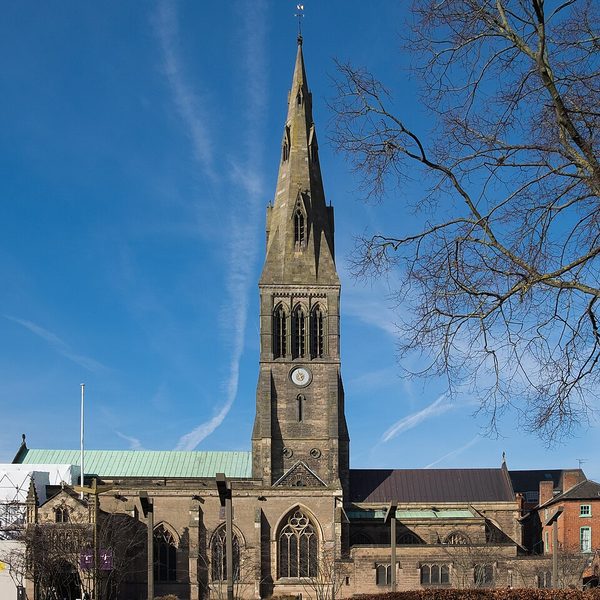
The Jewry Wall site sits close to the church of St Nicholas — itself one of Leicester's surviving medieval buildings — and within comfortable walking distance of Leicester Cathedral and the King Richard III Visitor Centre. For visitors with an interest in the full arc of Leicester's history, the cluster of sites in this part of the city centre allows the Roman, medieval and early modern layers to be read in sequence. The combination of a recently refreshed museum, freely visible Roman masonry and an accessible city-centre location makes this one of the more substantive Roman visitor sites in England.
Sources: Leicester's revamped Jewry Wall Museum to open in July - Leicester City Council • Leicester's new Roman visitor attraction ready to open its doors - Leicester City Council • Jewry Wall Museum - official site • Jewry Wall - Wikipedia • Jewry Wall - English Heritage history • Jewry Wall Roman Baths - Story of Leicester