It was an October afternoon when the fictional traveller — call her M., a researcher with a week in the capital — first noticed the gap.
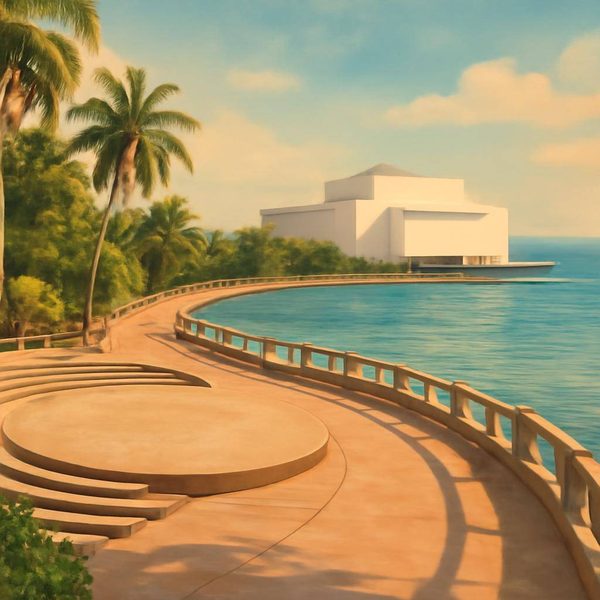
She had been walking the lakeshore path between the Plaza Juan Pablo II and the Teatro Nacional Rubén Darío, which Rough Guides describes as Managua's main cultural venue, perched like a white futurist bird at the edge of the lake. The afternoon heat off Lago Xolotlán — Lake Managua — was considerable. She had been told to come here for the view of the water, and the view was indeed there: enormous, flat, the city's western horizon given over entirely to the lake.
But what she found herself thinking about was what was missing.
Monument Lab, an organisation that documents public memory and contested monuments, published an account of La Concha Acústica — a name that translates roughly as the acoustic shell. It was an outdoor amphitheatre commissioned under the administration of Mayor Herty Lewites, designed for the kind of open-air performance that fits the climate and the character of a city that has always done some of its living outside. It stood between the plaza and the theatre, close to the water. And then it was gone.
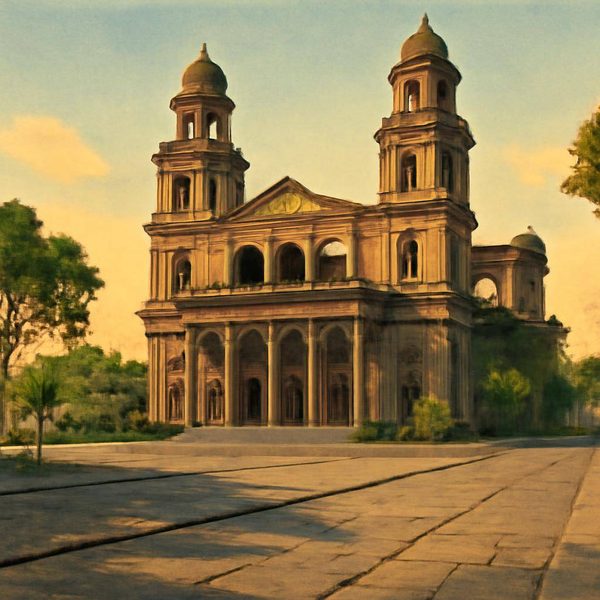
Monument Lab calls it a ghost monument. The phrase has particular resonance in Managua. This is a city that already has one famous architectural ghost: the old cathedral, damaged in the earthquake of 1972 and left standing in partial ruin as a kind of deliberate memorial. The city's decision not to demolish it — to let the ruin remain as the ruin — is one of the most striking urban choices in Central America. You walk past it on Avenida Bolívar and it stands against the sky, roofless, its shell still telling the shape of what it was.
Two ghost monuments in one city. Two absences that the city has decided to hold onto in different ways. One preserved in stone; one surviving only in documentation, in memory, in the accounts of people who saw performances there and in the record kept by institutions that think about what cities choose to remember.
M. walked back toward the market. Mercado Roberto Huembes is a few kilometres from the historic centre, large and active, serving both the daily needs of residents and — as a place where goods from across the country converge — a practical introduction to the way Managua works as a national hub. She bought something she didn't need and ate something she did, and thought about cities that have been forced to rebuild their relationship with their own past not once but several times over.
The 1972 earthquake. The revolution of 1979. The conflicts of the 1980s. And now a political situation that has, according to official advisory sources, seen more than 5,300 civil society organisations closed since 2018. Each disruption leaves its own category of absence. Some absences become monuments. Most just become ordinary empty space.
Nicaragua's musicians have historically found ways to speak about exactly this kind of pressure. A Vice report on the country's rock scene documents how performance and social commentary became intertwined in the Managua music world, with the Teatro Nacional and spaces like La Concha Acústica forming part of the infrastructure that made that possible. When the physical venues change or disappear, the tradition continues in whatever space is available — a smaller room, a different city, a recording made somewhere else.
M. was not a music journalist. She was not here to find the scene or to write about it. She was here because her work required it, and she had a meeting the next morning, and the afternoon was her own. She stood at the edge of the lakeshore for a while longer, looking at where something used to be, in a city that has more practice than most at standing in front of an absence and deciding what to do next.
Frequently Asked Questions
What practical route does this Managua story follow?
It follows source-backed places and route anchors from the guide, giving orientation and atmosphere while leaving live transport and opening details to the linked sources.
Which live details should I check before using this Managua route?
Check current transport, access, opening and weather information from the linked official or operator sources before travelling.
What does this route help visitors understand about Managua?
It turns source-backed places, route anchors and local context into a readable visitor route, so the story supports the main guide rather than replacing practical planning.
This is a fictional visitor story generated from source-backed place facts, image evidence and visitor-feel signals. It is not a first-hand WorldTownGuide visit. Named places, routes and historical references are source-backed; the visitor character and narrative events are invented.
Sources: Nicaragua travel advisory - US State Department • Managua - Wikipedia • Nicaraguan Ghost Monuments - La Concha Acustica - Monument Lab • Managua and around - Rough Guides Nicaragua Travel Guide • Music With a Message - Nicaragua's Socially Conscious Rock Scene - Vice