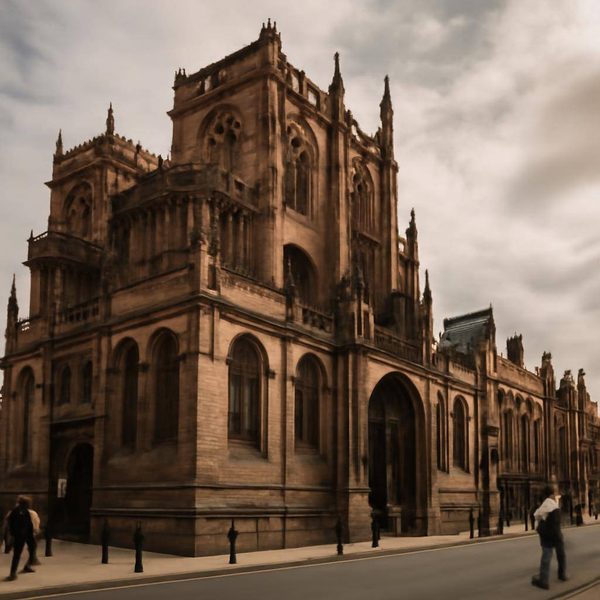
The John Rylands Library stands as one of Europe's finest examples of neo-Gothic architecture and houses collections that range from the earliest fragments of the New Testament to medieval manuscripts and rare printed books. Opened in 1900, the building was commissioned in 1890 by Enriqueta Rylands as a memorial to her late husband John Rylands, who died in 1888 as one of Manchester's most successful industrialists with a personal fortune of £2.75 million. The library was purpose-built to provide public access to world-class collections, a gift to the city that reflected Victorian philanthropic traditions and the wealth accumulated through Manchester's industrial dominance.
The Building and Architecture
The library's Gothic Revival design creates an atmosphere more cathedral than reading room, with vaulted ceilings, carved stone details, and tall windows that filter light through the interior spaces. The architecture deliberately evokes medieval European learning whilst serving modern library functions. Located in the city centre, the building remains one of Manchester's most distinctive Victorian structures, contrasting sharply with surrounding commercial and modern development. The library forms part of The University of Manchester Library system but maintains its character as a public cultural institution with free admission.
The Collections
The library holds roughly 2,000 Greek papyri among its special collections, including the Rylands Library Papyrus P52, commonly known as the St John Fragment. Dating from between 100 and 160 CE, this fragment from a papyrus codex contains portions of the Gospel of John and is generally accepted as the earliest extant record of a canonical New Testament text. The recto (front) contains parts of verses from John 18:31-33, whilst the verso (back) contains fragments from John 18:37-38. Although the papyrus's exact dating remains subject to scholarly debate, its significance to biblical scholarship and textual history makes it one of the library's most important holdings.
Beyond the St John Fragment, the collections include the Rylands Papyrus iii.458 (Papyrus 957), the earliest surviving fragment of the Septuagint (the Greek translation of the Hebrew Bible), and Papyrus 31, a fragment of an Epistle manuscript. The breadth of rare books, manuscripts and archives reflects the library's founding ambition to create a research collection of international importance.
Visiting the Library
The John Rylands Library operates with free admission, allowing visitors to explore both the architecture and the collections on display. Special exhibitions rotate periodically, drawing on the library's holdings to present focused topics. The library functions simultaneously as a working research facility for the University of Manchester and a public attraction, though visitors should note that opening hours vary and the library undergoes periodic closures. Checking current visiting information through the library's official website before planning a visit is essential, as access may be restricted during certain periods for conservation, academic use, or building maintenance.
Victorian Philanthropy and Industrial Wealth
The library's existence illustrates the pattern of Victorian philanthropy in industrial cities. John Rylands made his fortune in cotton textile manufacturing, the same industry that defined Manchester's 19th-century identity and global economic influence. His widow's decision to create a memorial library reflected both personal tribute and the Victorian belief in public cultural institutions as markers of civic achievement. The building, collections, and public access model represent the convergence of private industrial wealth and public cultural benefit that characterised this period in Manchester's development. The connection between cotton wealth and the library's founding cannot be separated from the broader context of Manchester's industrial economy and its links to Atlantic slavery, themes the city's museums now address directly.
Context and Significance
For visitors interested in Manchester's Victorian era, the John Rylands Library provides both architectural substance and insight into how industrial wealth translated into cultural infrastructure. The building itself rewards extended viewing, whilst the displayed collections offer accessible entry to rare materials that would typically remain in restricted archives. The library operates as one of Manchester's clearest expressions of its 19th-century identity, preserved and functioning more than a century after construction. Visitors should allocate at least an hour for a meaningful visit, with more time appropriate for those interested in the exhibitions or detailed exploration of the building's spaces.
Sources: John Rylands Library - University of Manchester • John Rylands Library - Manchester City Council • Rylands Library Papyrus P52 - Wikipedia • The St John Fragment - History of Information