This is a fictional visitor story based on source-backed facts about Morecambe. It is not a first-hand WorldTownGuide visit.
The train from Lancaster takes less than ten minutes. You leave the city's stone and spires behind and arrive at something different: a branch-line terminus, a walk of a few minutes, and then the bay opens in front of you.
It was November when this story is set, which matters. In summer, Morecambe's promenade carries families and ice cream and the ordinary business of a seaside day. In November, the visitor numbers drop sharply and the bay reasserts itself. The water had retreated far out — far enough that the sand and mudflat stretched to what felt like the horizon, pale and flat under a grey sky. It was not a comfortable landscape in any conventional sense, but it was not supposed to be.
The walk from the station to the waterfront takes about ten minutes at an unhurried pace. The promenade, when you reach it, runs in both directions along the shore. To the north, on a clear day, the hills of the Lake District sit above the water's edge. In November, they were shapes rather than details — suggested rather than seen.
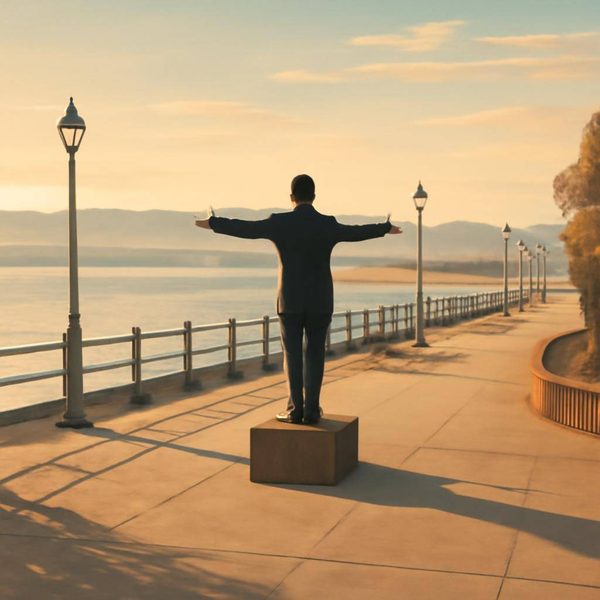
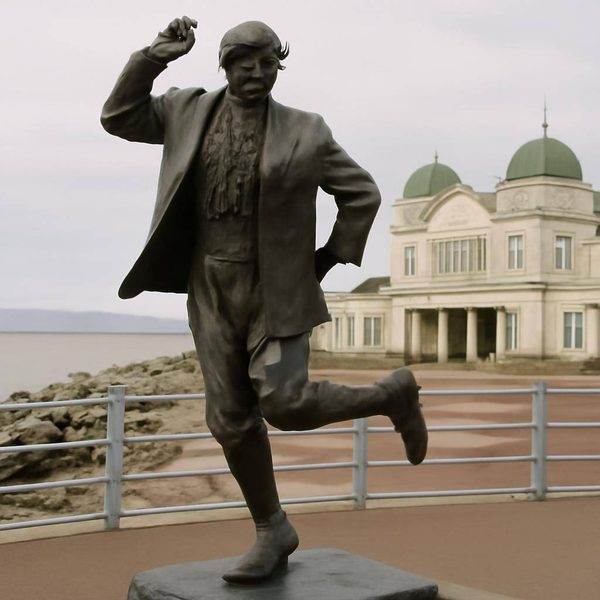
The statue is there, of course. Eric Morecambe stands in mid-pose on the promenade, arms out, as if caught in the middle of one of the physical routines that made him famous. He was born Eric Bartholomew in this town in 1926 and took the place's name as his own — a straightforward civic pride that the statue returns, with considerable warmth. Visitors photograph it at all times of year; in November, the only other person nearby was a man walking a dog who did not look up.
The Midland Hotel stands nearby, facing the water. The building dates from the 1930s, a white Art Deco structure that the Twentieth Century Society has listed as architecturally significant. It was built to serve railway passengers arriving for the resort — the Midland Railway's ambition made solid and curved. In winter light it looks almost spectral, too white for the grey around it, too confident for a November afternoon on a quiet promenade.
Walking south, the promenade gives way to views across towards Heysham, where the headland carries early medieval remains above the shore. The port area, beyond that, has a ferry terminal serving the Isle of Man. These are not the same Morecambe — they are the quieter, older, more industrial hinterland of a town that was always more than its resort identity suggested.
The tide would come back. By late afternoon the water had begun its return — still far out, but moving, the channel lines shifting in ways that made it clear why walking the open sands without a guide is not wise. The bay's tidal behaviour is one of those things that requires watching rather than reading about. The cross-sands tradition — guided walks across the estuary on a fixed route — has a long history here, but that route and those conditions belong to a guided context, not an independent walk on a grey November afternoon.
Back at the station, the Lancaster train arrived on time. It is a short journey, but the gap between the two places felt larger than the map suggested: Lancaster's stone city, and then Morecambe's open bay, its promenade, its statue, its hotel that belongs to a different decade. Both are worth the visit. In November, Morecambe gets the better of the light.
Sources: Morecambe Station - National Rail • Eric Morecambe Statue - Lancaster and Morecambe Bay • The Midland Hotel, Morecambe - The Twentieth Century Society • Morecambe Beach - Lancaster and Morecambe Bay • Public transport Morecambe Bay - Morecambe Bay Partnership