The ferry from Algiers Point delivered me to the Canal Street terminal just as the October light was going flat. On the West Bank side, the city had looked composed and distant — a skyline of towers above the levee wall, the river doing its slow, commercial work between us. On this side, it felt immediate.
I had come to New Orleans partly because of a line I had read in the city archives: In 1728, a group of young women set sail from France to New Orleans for the purpose of wedding colonists already living in the New World. They carried their belongings in small chest-shaped trunks — cassettes in French. The colonists called them the filles à la cassette: the casket girls.
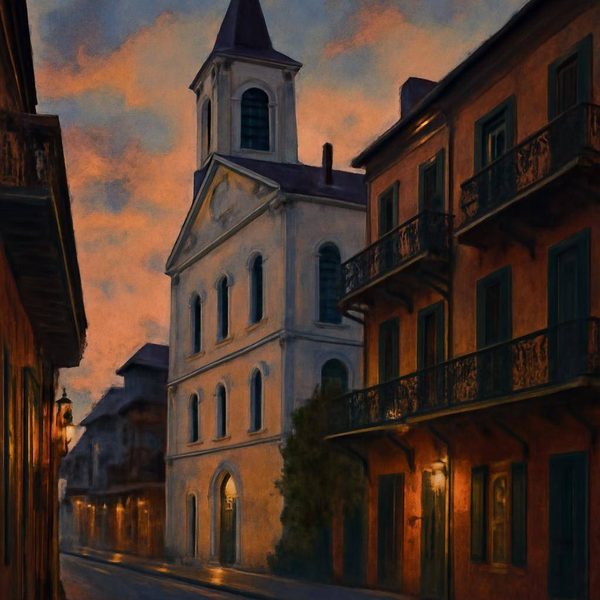
The Ursuline Convent, where the women were said to have been housed on arrival, still stands on Chartres Street. It is among the oldest surviving buildings in the lower Mississippi Valley, and it has the kind of solid, whitewashed gravity that makes it easy to understand why stories accumulate around it. The legend — told and retold, embellished in each generation — holds that the trunks the women carried were not full of clothes at all. That what the Ursulines locked away in the upper floors were not linens but something considerably more dangerous. No serious historian endorses this version. The city archives catalogue it plainly as folklore. And yet the story persists, attached to specific walls and a specific address, which is exactly how the best folklore works.
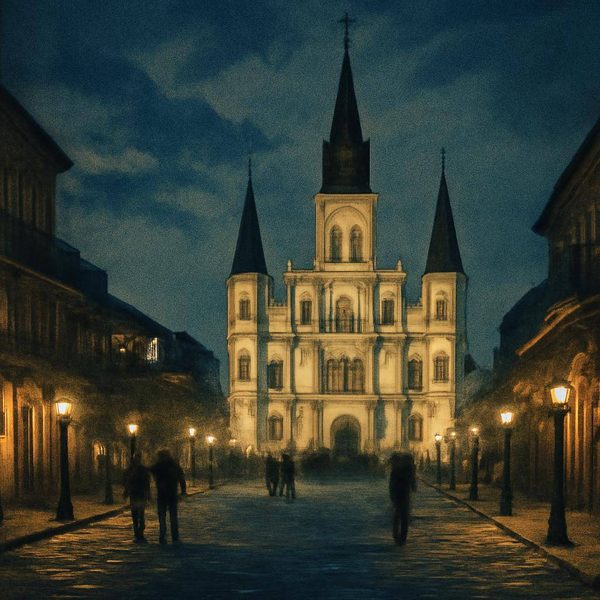
From the Ursuline Convent I walked up toward Jackson Square. The Cathedral Basilica of Saint Louis faces the square on the upriver side, its three spires lit against the evening sky. The church has stood in one form or another on this site since the first structure was dedicated on Christmas Eve 1727 — one year before the casket girls arrived. That original building was destroyed by fire in 1788. The current cathedral was built on the same ground. So many things in New Orleans have been built on the same ground as something that burned or flooded before it.
The square was still busy in the October evening. Tarot readers and portrait artists had set up along the iron fence of the cathedral garden, and a brass band was doing something complicated with a standard at the far end. None of it felt staged, exactly. It felt like a place that had been doing this long enough that it had stopped performing and started just being.
I turned off Bourbon Street quickly — the Historic New Orleans Collection on Royal Street felt more useful than the neon strip — and found Frenchmen Street as the neighbourhood quietened into the Marigny. The music here was live and close and came through open doors rather than from speakers positioned at tourists. A pianist was working through something unhurried. A couple at the bar were not looking at their phones. This is what the packet means when it says jazz is a living tradition here rather than a tourist attraction, and it was easier to hear it at this distance from the Quarter.
New Orleans has other legends that the Historic New Orleans Collection documents with more rigour than the casket girls receive. There is the 1915 hurricane — a Category 4 storm that flooded the town — and the folk memory of hoodoo that accumulated around it. There is the musician John "Scarface" Williams, known later as John the Nite Tripper, whose name alone suggests the city's talent for layering the gothic onto the real. These are stories about a place that has flooded, burned and rebuilt itself so many times that its residents developed a particular relationship with the idea of what stays and what goes.
Walking back toward Canal Street, I passed the block where Storyville used to be — a legally defined district for prostitution, abolished by federal order in 1917 and largely demolished in the decades that followed. Nothing marks the spot in any obvious way. The neighbourhood is there; the district is not. This is common in New Orleans. The city is full of addresses where something significant happened and left only a name.
October is a reasonable time to visit: the worst of the summer heat is gone, and the crowds of Mardi Gras and Jazz Fest are months away in either direction. The afternoon rain had been brief and warm. By the time I reached the streetcar stop on Canal Street, the pavement was already drying.
This is a fictional visitor narrative based on source-backed historical research. The route, places and historical facts are drawn from the New Orleans City Archives, the Historic New Orleans Collection and the guides referenced below. WorldTownGuide did not personally visit New Orleans for this piece.
Frequently Asked Questions
What practical route does this New Orleans story follow?
It follows source-backed places and route anchors from the guide, giving orientation and atmosphere while leaving live transport and opening details to the linked sources.
Which live details should I check before using this New Orleans route?
Check current transport, access, opening and weather information from the linked official or operator sources before travelling.
What does this route help visitors understand about New Orleans?
It turns source-backed places, route anchors and local context into a readable visitor route, so the story supports the main guide rather than replacing practical planning.
This is a fictional visitor story generated from source-backed place facts, image evidence and visitor-feel signals. It is not a first-hand WorldTownGuide visit. Named places, routes and historical references are source-backed; the visitor character and narrative events are invented.
Sources: Visit New Orleans - Official Tourism Website • New Orleans Ghost Stories - City Archives and Special Collections • Four Real New Orleans Legends that Put Ghost Stories to Shame - Historic New Orleans Colle • New Orleans Ghost Stories: Legends, Hauntings and Folklore - Big Easy Magazine • Navigating New Orleans - neworleans.com