
The VIA Rail train from Montréal arrives into Gare du Palais in the late afternoon. October light in Québec City has a particular quality — low and white, the kind that turns stone buildings into something almost luminous. The station is less than a kilometre from the old walled city. You are immediately closer to the historic core than most cities allow a railway traveller to be.
The walk from the station into the lower town is short, but the city starts asserting itself immediately. The cliff above you — Cap-Diamant — holds the upper town back from view until you find the right angle. Then the Château Frontenac appears: its green copper roofs catching the afternoon light, the building sitting on the highest point of the promontory exactly as Bruce Price designed it in 1893 — visible from the river, visible from the south shore, visible from here. It was meant to be seen. It is.
The upper town is reached by the funicular or by the steep staircases the locals use as a matter of daily routine. In October the summer crowds have thinned. The Terrasse Dufferin — the long wooden boardwalk running along the clifftop in front of the château — has space to walk without negotiating a crowd. The view across the St. Lawrence to Lévis on the south shore is wide and clear. A line of benches faces the river. Nobody is rushing.
The Plains of Abraham lie to the west of the old city, reached on foot through the fortifications. This is where, in September 1759, British and French forces fought the engagement that decided the fate of New France in less than an hour. The Wolfe-Montcalm Monument stands in the park — a rare thing, a memorial to both commanders on the same stone. In October the plateau is quiet and open, the grass starting to go soft with autumn. The Joan of Arc Garden, maintained by the National Battlefields Commission as part of the park's horticultural history, is tidy and uncrowded. The Martello towers stand at the perimeter, functional military structures built in the early 19th century as a precaution against American invasion. History here is layered in ways that keep catching you out.
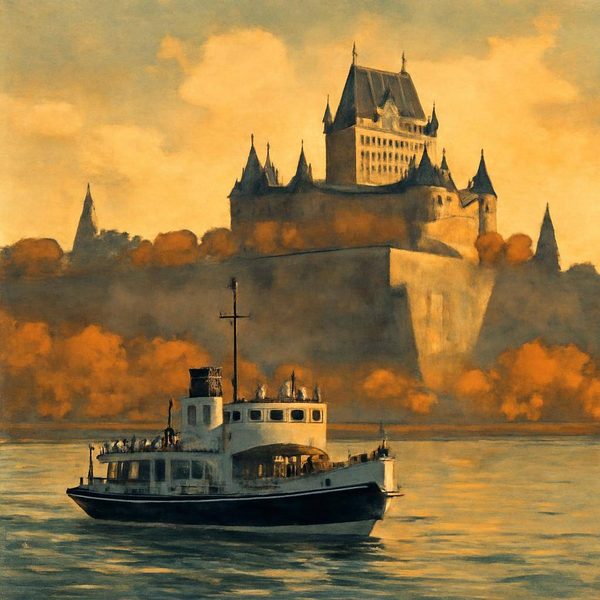
On the second morning, take the ferry to Lévis. The Société des Traversiers du Québec service crosses the St. Lawrence in about ten minutes. From the water the city makes complete sense as a place: the cliff, the château above it, the fortifications running along the clifftop, the lower town packed in at the base. This is the view the arriving passenger steamers had. It is still one of the better arguments for Québec City that the city makes on its own behalf.
Back in the lower town that evening, Saint-Roch is a different register — less tourist-dense, more neighbourhood. The city's French-language music culture has a presence here that the upper town's heritage hotels can obscure. The Palais Montcalm across the city programmes concerts through the autumn season. The folk roots of Québécois music — the same tradition that produced the chasse-galerie legends and the songs carried through generations of French settlers — surface in the local scene in ways that feel current rather than preserved.
October is a reasonable time to visit. The peak-summer crowds on the Terrasse Dufferin and in the old city's narrow streets have eased. The winter carnival is months away. The city is going about its own business, and a visitor moving quietly through it can feel something of the texture of the place rather than just its surface.
The train back to Montréal leaves from Gare du Palais in the morning. The station is exactly where you left it, close enough to the old city that the stone still feels present on the walk down. Some places stay with you as photographs; Québec City tends to stay as a physical sensation — the weight of the cliff, the cold coming off the river, the particular narrowness of a street in the upper town in the low light of an October afternoon.
Frequently Asked Questions
What practical route does this Québec story follow?
It follows source-backed places and route anchors from the guide, giving orientation and atmosphere while leaving live transport and opening details to the linked sources.
Which live details should I check before using this Québec route?
Check current transport, access, opening and weather information from the linked official or operator sources before travelling.
What does this route help visitors understand about Québec?
It turns source-backed places, route anchors and local context into a readable visitor route, so the story supports the main guide rather than replacing practical planning.
This is a fictional visitor story generated from source-backed place facts, image evidence and visitor-feel signals. It is not a first-hand WorldTownGuide visit. Named places, routes and historical references are source-backed; the visitor character and narrative events are invented.
Sources: French Canadian Folktales (chasse-galerie) - Salem State Digital Repository • Quebec Palace Station (Gare du Palais) - Vandvoyage • Plains of Abraham - National Battlefields Commission • Joan of Arc Garden - National Battlefields Commission • Québec-Lévis ferry - Société des Traversiers du Québec • Château Frontenac - History - Fairmont