The train from Valencia pulled in just after nine on a morning in late September, the light already bright but not yet hot. Sagunto Station is a working commuter stop — nothing especially grand — and the walk into town takes less than ten minutes. The castle was visible immediately, a long pale ridge above the rooftops, the kind of thing that makes you recalibrate your understanding of where you are. This is not a backdrop. It is the point.
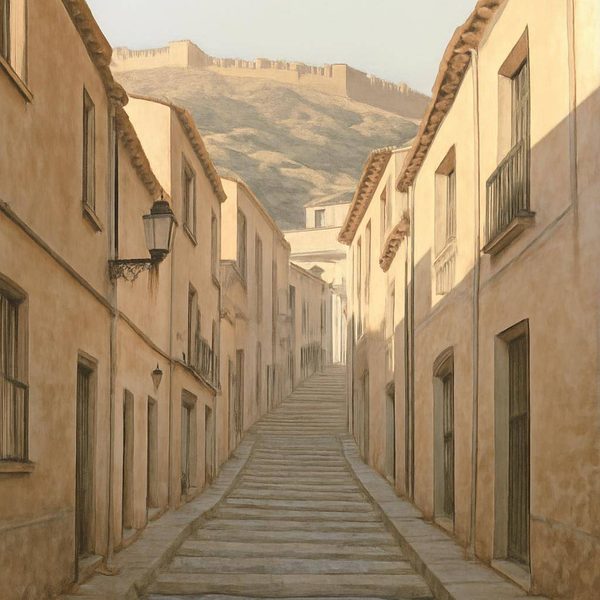
The old town climbs toward the hill. Streets narrow and the gradient increases; whitewashed walls, a few bars with their chairs still stacked, a couple of residents pulling shopping trolleys past a fountain. The Roman forum appears almost without announcement: a set of columns and worn stone paving set into an open space, the surviving civic heart of ancient Saguntum. There is no elaborate entry structure, no café franchise in the foreground. You simply stand in what was once the administrative centre of a Roman provincial town and try to account for the distance between that fact and the quiet morning around you.
In 219 BC, Hannibal's Carthaginian army besieged this settlement for eight months. The town's alliance with Rome and its refusal to yield became one of the proximate causes of the Second Punic War — the conflict that would eventually bring Roman legions across the Alps and threaten the city of Rome itself. Saguntum was destroyed. Rome declared war. The consequences stretched across the Mediterranean for two decades. It is a significant amount of history for a quiet Wednesday morning.
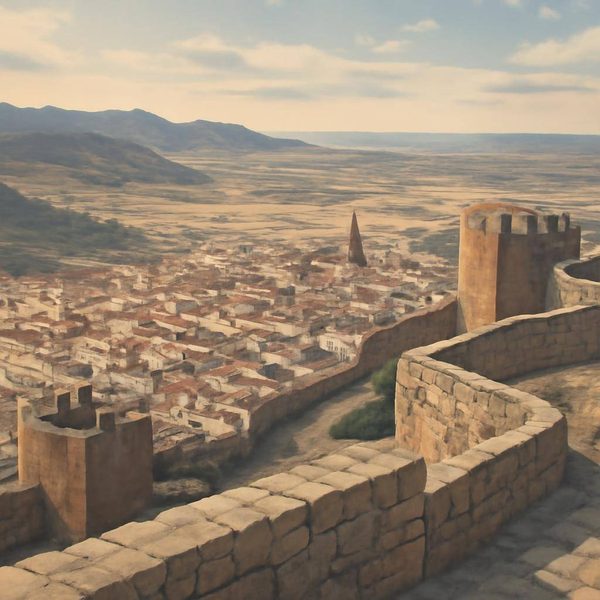
The path to the castle continues uphill. The climb is not technical but it is sustained, and in October warmth the best advice is to start early. The castle complex unfolds slowly: walls in different stone, different mortar, different centuries. Iberian foundations. Roman courses. Moorish additions. A medieval Christian rebuild over all of it. The site is declared a Monumento Nacional, and walking its length — the ridge is long — takes the better part of two hours if you are paying attention. The views from the far end of the walls are the reward: the Camp de Morvedre plain laid out below, the citrus groves and market gardens giving way to the coastal strip, and somewhere beyond that the Mediterranean.
On the way down the hillside, the Roman theatre sits in a natural hollow below the castle walls. The ancient seating curves in a proper semicircle; the stage wall is the controversial element, a modern stone and concrete structure inserted by architect Giorgio Grassi in the 1990s, subsequently the subject of legal challenges and partial reversal. The debate was sharp enough to reach international architectural press. The theatre still performs: the Sagunt a Escena festival runs each summer, organised by the Institut Valencià de Cultura, and the idea of watching live theatre in a Roman-era venue on the same hill that Hannibal besieged is the kind of thing that makes the ticket worth finding.
By early afternoon the light had turned hard and the upper town was quiet. In the Judería — the medieval Jewish quarter preserved in the old town's street layout — the lanes are narrow and shaded, a different texture from the Roman sites above. Sagunto is listed in the Caminos de Sefarad, Spain's network of Sephardic heritage communities, and the quarter is a reminder that the town's historical significance did not end with the Romans or the medieval castle builders.
The C-6 commuter train back to Valencia runs through the afternoon. Standing on the platform, the castle ridge still visible above the town, it is easy to understand why Sagunto does not need to oversell itself. The hill did that work two thousand years ago.
Sources: Sagunto Castle - Wikipedia • Sagunto Roman Theatre - Wikipedia • Sagunt a Escena festival - Institut Valencia de Cultura • Sagunto Jewish Heritage - JGuide Europe • Sagunto - Wikipedia