
Pike Place Market opened on 17 August 1907 as a public farmers' market where Seattle residents could purchase produce directly from local growers, bypassing commission houses. The Seattle City Council, under Council President Thomas Revelle, passed Ordinance 16636 establishing the market on the west side of Pike Place. More than a century later, it remains one of the oldest continuously operated public farmers' markets in the United States, overlooking Elliott Bay on Puget Sound.
The Market's Evolution and Character
By the 1960s, plans emerged to demolish the historic market entirely and redevelop the site. This threat sparked an unprecedented preservation campaign by Seattle residents who rallied to save the institution. In 1973, following a public vote, the City of Seattle created the Pike Place Market Preservation and Development Authority (PDA) by charter—a not-for-profit organisation that owns and manages the market's day-to-day operations. This structure has allowed the market to maintain its original character while adapting to changing times.
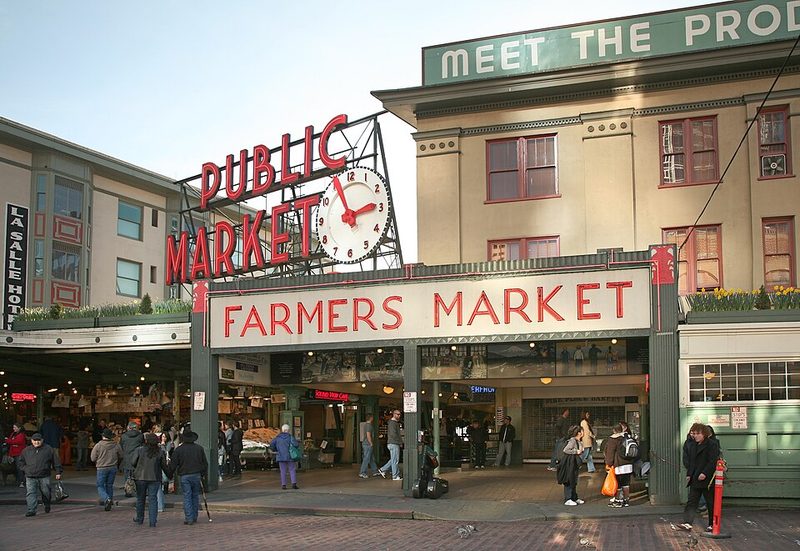
The market now spans multiple levels and buildings, hosting nearly 500 residents who live in eight buildings throughout the complex. The upper street level features the covered arcades where fishmongers, fresh produce stands, and craft stalls operate. Local farmers and craftspeople rent tables daily from the Market PDA, preserving the founding principle of allowing consumers to "Meet the Producer." Below the main arcade, visitors find antique dealers, comic book shops, collectible stores, small family-owned restaurants, and one of Seattle's oldest head shops.
Fish Throwing and Market Traditions
The fish-throwing tradition at Pike Place Fish Market has become one of Seattle's most recognised spectacles. When a customer purchases fish, workers toss it from the front display to fishmongers behind the counter for wrapping and preparation. This practice occurs throughout the day during business hours, which begin at 7 a.m. Visitors typically see king salmon and Alaskan halibut flying through the air—never rockfish, which are too spiky for safe throwing. A sign in the area reads "Caution: Low Flying Fish." Occasionally, workers throw foam fish into the crowd or invite customers to participate. The tradition became widely known through a 1998 documentary film and accompanying book titled FISH!
Landmarks and Features
The Public Market Center sign with its neon clock marks the main entrance at 1st Avenue and Pike Street. Here stands Rachel the Piggy Bank, a bronze sculpture that serves as both landmark and mascot. The Gum Wall in Post Alley began in the 1990s when patrons and performers at Unexpected Productions stuck their used gum on the brick wall. The wall has grown piece by piece to cover an enormous expanse and continues to expand, becoming a quirky public art installation despite—or perhaps because of—its unconventional nature.
The original Starbucks cafe, dating to the company's 1971 founding, operates within the market. Street performers and musicians add to the daily atmosphere. More than 225 local artisans sell their wares throughout the complex, and the diverse collection of eateries reflects Seattle's culinary range. The Athenian Inn gained wider recognition when scenes from the film "Sleepless in Seattle" were filmed there.
Visiting Practicalities
Pike Place Market functions as essential Seattle infrastructure rather than merely a tourist attraction, though it serves both purposes effectively. The market's position overlooking Elliott Bay provides water views from many vantage points. Visitors should plan for several hours to explore the different levels, shops, and food vendors adequately. The Link Light Rail from Seattle-Tacoma International Airport stops at Westlake Center downtown, a short walk from the market's main entrance. The market's operation as a working public market means it maintains genuine commercial activity alongside its role as a major visitor destination.
Sources: Pike Place Market - Wikipedia • Pike Place Market History - Official Site • Pike Place Market Visitor FAQ - Official Site • Pike Place Market Centennial - Seattle City Archives