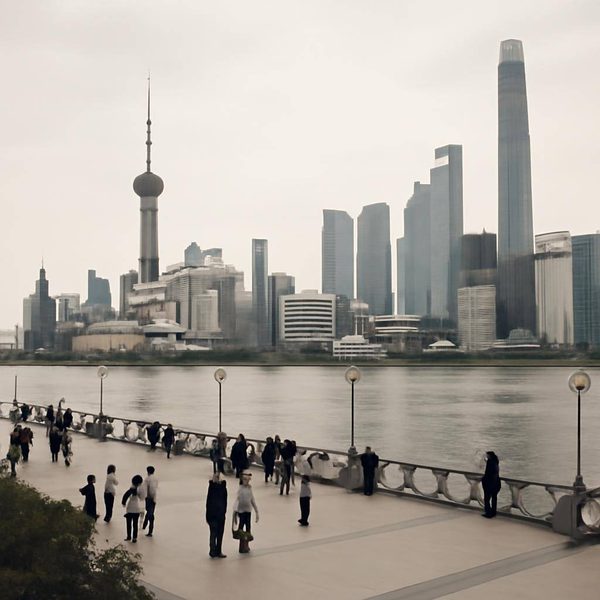
The Bund occupies the western bank of the Huangpu River in central Shanghai, a waterfront stretch roughly 1.5 kilometres long running along Zhongshan Road East No. 1. The name derives from the Anglo-Indian term for an embankment, reflecting the international settlement history that shaped this district. Across the river, the Pudong skyline rises from what was, until the 1990s, primarily agricultural and industrial land—a contrast that encapsulates Shanghai's dramatic transformation over the past three decades.
Architectural Heritage
The buildings lining the Bund date primarily from the 1920s and 1930s, though some structures are older. This collection represents various Western architectural styles—Art Deco, Beaux-Arts, Romanesque, Gothic, Renaissance, and Neo-Classical—adapted to Shanghai conditions and built to house banks, trading houses, hotels, and consulates. The result is often described as a living museum of colonial-era architecture, though that phrase simplifies both the buildings' origins and their current functions.
The structures were commissioned by institutions from Britain, the United States, France, Russia, Germany, Japan, the Netherlands, and Belgium, among others. Many continue to function as banks, hotels, or commercial offices, giving the Bund a working character rather than serving purely as heritage preservation. The scale and solidity of these buildings reflected the economic confidence of the international settlement period, and they survived both the war years and subsequent political changes with varying degrees of alteration.
The Pudong Development
Across the Huangpu River, Pudong's development began in earnest during the 1990s as part of China's economic opening. The Oriental Pearl Tower, completed in 1994, became the earliest iconic structure in the new skyline. Its distinctive pink spheres and lattice structure represented a deliberate contrast to the Bund's heritage architecture. Subsequent development brought the Jin Mao Tower, Shanghai World Financial Center, and Shanghai Tower—the latter completed in 2015 and rising to approximately 632 metres, making it among the world's tallest buildings.
The Lujiazui financial district now occupies the section of Pudong directly opposite the Bund. This concentration of towers houses offices, hotels, observation decks, and commercial space. The district functions as Shanghai's primary financial center, a role that has shifted from the Bund's historical position to this purpose-built development.
The River and Waterfront Access
The Huangpu River remains a working waterway carrying container ships, ferries, and tour boats. Ferries cross between the Bund and Pudong throughout the day, providing functional transport as well as perspective on the contrasting architecture of both banks. The Bund promenade allows pedestrians to walk along the waterfront, though crowd levels vary significantly depending on time of day and season.
River cruises operate on various routes along the Huangpu, typically passing landmarks including the Oriental Pearl Tower, Shanghai World Financial Center, Jin Mao Tower, and extending as far as the Yangpu and Nanpu bridges. Departure points include Shiliupu Pier near the southern end of the Bund. Specific schedules and routes change, so current details should be verified locally rather than planned from outdated information.
Viewing and Orientation
The Bund stretches from Waibaidu Bridge in the north to Shiliupu Pier in the south. The bridge itself carries historical significance as the location where the Suzhou Creek meets the Huangpu River and marks the northern extent of the main Bund promenade. Walking the full length takes perhaps 30 to 40 minutes without stops, though the density of architectural detail and river views typically extends that considerably.
Evening brings lighting displays on both the heritage buildings of the Bund and the Pudong towers. The specific timing varies by season—sources indicate summer displays from approximately 19:00 to 23:00 and winter displays from around 17:00 to 21:00, though these schedules should be confirmed locally. The lighting transforms both architectural character and crowd levels; expect significantly higher visitor numbers during evening hours.
Practical Access
Metro access to the Bund area comes via East Nanjing Road Station on Lines 2 and 10. Connections to other parts of Shanghai are straightforward given the central location. The waterfront is exposed to weather—summer heat, winter wind, and typhoon season rain all affect the experience of walking the promenade.
Sources: The Bund - Wikipedia • Historical Buildings of the Bund, Shanghai - Travel China Guide • Huangpu River Cruise: Tickets Price, Traveling Route, Duration - Travel China Guide • The Bund Shanghai - China Xian Tour