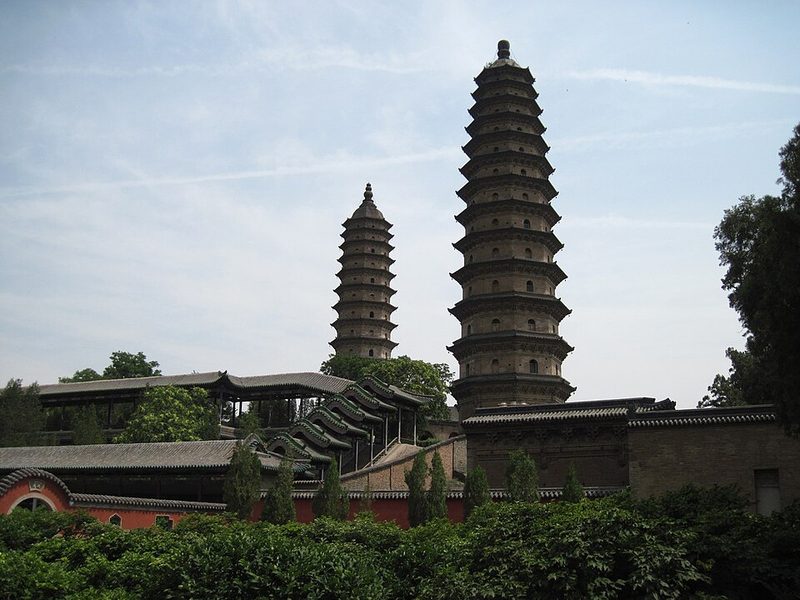

The Twin Pagoda Temple, officially named Yongzuo Temple, occupies a site in southeastern Taiyuan where two 13-storey octagonal brick pagodas rise 53-54 metres above the Nansha River valley. Built during the Ming Dynasty—the eastern Xuanwen Pagoda completed in 1597 and the western Wenfeng Pagoda shortly after—these structures have functioned as both religious monuments and navigational landmarks for the city for more than four centuries.
Construction and Historical Context
The pagodas were constructed during the Wanli period of the Ming Dynasty (1572-1620), an era when pagoda building experienced a revival across China following earlier periods of Buddhist persecution. The temple complex that originally surrounded the pagodas served as an active Buddhist monastery, though much of the original temple architecture has been lost or rebuilt over subsequent centuries, leaving the pagodas as the primary surviving Ming Dynasty structures on the site.
Historical records indicate the pagodas were built both as religious dedications and as feng shui structures intended to improve the fortunes of Taiyuan by addressing perceived imbalances in the local landscape. The twin configuration—two pagodas of nearly identical height and design standing in close proximity—is relatively uncommon in Chinese architecture, where single pagodas or groups of three or more are more typical arrangements.
Architectural Features and Design
Each pagoda stands approximately 54.7 metres tall and features 13 storeys in an octagonal floor plan. The brick construction employs techniques characteristic of Ming Dynasty pagoda architecture, with each level featuring projecting eaves supported by brick corbelling rather than the wooden bracket systems used in earlier periods. The octagonal plan creates eight faces at each level, allowing for varied decorative treatments and multiple window openings that lighten the visual mass of the structures.
The pagodas feature wind bells suspended from the corners of each level's eaves, a traditional element that produces sound when air currents move through the valley. These bells serve both aesthetic and symbolic functions—their tinkling creates an acoustic presence that extends the pagodas' impact beyond their visual footprint, while Buddhist tradition associates bell sounds with the dissemination of dharma teachings.
The Xuanwen Pagoda (eastern pagoda) is accessible to visitors who can climb its internal stairs, though the ascent requires navigating narrow passages and steep steps typical of historic pagoda architecture. The Wenfeng Pagoda (western pagoda) is not open for internal access. The climbing experience in the eastern pagoda offers progressively changing views of Taiyuan and the surrounding mountains, though the physical demands of the ascent and the condition of the interior should be considered when deciding whether to climb.
Site Context and Landscape Setting
The temple grounds occupy a raised position south of the Nansha River in southeastern Taiyuan, providing clear sight lines to the pagodas from various points in the city. The visual prominence of the twin structures has made them an enduring symbol of Taiyuan, appearing in historical paintings, photographs, and contemporary city branding. The elevation and relative isolation from dense urban development mean the pagodas remain visible despite the city's growth and vertical development.
The current temple grounds feature landscaping with shrubs, trees, and pathways that create a managed park environment around the historic structures. While little remains of the original Yongzuo Temple buildings beyond the pagodas themselves, later reconstruction efforts have added prayer halls and support structures that maintain the site's function as an active religious space, though the primary draw for most visitors is the pagodas rather than the temple's religious activities.
Visiting Information and Practical Details
The Twin Pagoda Temple operates with regular opening hours, typically from 8:30 to 17:30, though these times may vary seasonally. Admission fees are charged and differ between peak season (April to October) and off-season (November to March), generally ranging between 20 and 30 RMB. These details should be confirmed before visiting, as policies and pricing can change.
The site is accessible via multiple city bus routes that serve the southeastern district of Taiyuan. Specific bus numbers and routes should be confirmed using current Taiyuan public transport information, as service patterns change over time. Taxis and ride-sharing services offer more direct access for visitors unfamiliar with the bus system or travelling from hotels in other parts of the city.
The temple grounds are suitable for visitors of most mobility levels, though climbing the eastern pagoda requires moderate physical fitness and comfort with enclosed spaces and steep traditional stairs. The exterior grounds offer photographic opportunities and viewing of the pagodas' architecture without the physical demands of the interior ascent. English signage is limited, so visitors seeking detailed historical or architectural information will benefit from advance research or guidebook resources.
Cultural Significance
The Twin Pagoda Temple functions as a symbol of Taiyuan's historical identity, the pagodas serving as a visual reference point that connects contemporary city residents to the Ming Dynasty era. The structures' survival through subsequent centuries—including periods of warfare, political upheaval, and rapid urban development—has made them landmarks in both the literal and metaphorical sense, representing continuity amid change.
The pagodas appear in local art, literature, and photographic traditions, their distinctive twin profile making them immediately recognisable markers of place. This visual distinctiveness has practical value for orientation and wayfinding within the city, while also functioning as a focus for collective identity and historical memory among Taiyuan residents.
Sources: Twin Pagoda Temple - Wikipedia • Twin Pagoda Temple - Travel China Guide • Yongzuo Temple - China Tripedia • Twin Pagoda Temple - Lonely Planet