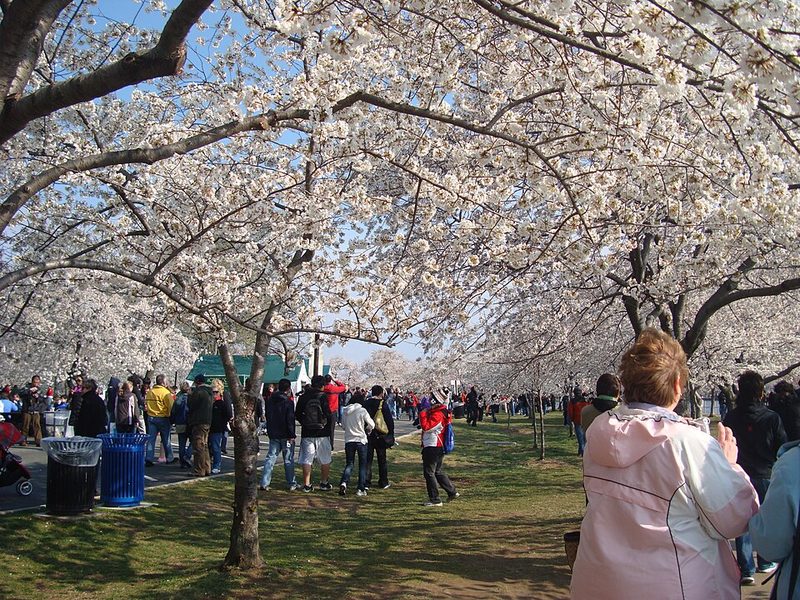
The cherry trees around the Tidal Basin represent one of Washington's most recognized seasonal events. Each spring, thousands of visitors arrive to see the pale pink and white blossoms that frame the water and surrounding monuments. The trees were a gift from Japan in 1912, and the annual bloom has become embedded in the city's identity.
The 1912 Gift and Early History
On 27 March 1912, Helen Herron Taft, wife of President William Howard Taft, and Viscountess Chinda, wife of the Japanese Ambassador, planted two Yoshino cherry trees on the northern bank of the Tidal Basin, approximately 125 feet south of what is now Independence Avenue, SW. This ceremony marked the arrival of 3,020 flowering cherry trees sent from Tokyo to the United States capital. An earlier shipment in 1910 had been infested and destroyed, making the 1912 gift the successful second attempt at establishing the trees.
The first festival-like celebration occurred in 1927, when a group of school children reenacted the original tree planting. This event established a pattern that would eventually grow into the National Cherry Blossom Festival, which now runs annually for several weeks in spring.
Peak Bloom and Timing
The National Park Service monitors the trees and announces peak bloom dates each year. Peak bloom is defined as the day when 70 percent of the Yoshino cherry blossoms are open. This typically occurs in late March or early April, though exact timing varies by several weeks depending on winter and early spring temperatures. The blossoms remain at their best for approximately four to ten days, weather dependent.
Visitors should note that the trees signal the beginning of Washington's spring with an explosion of life and color that surrounds the Tidal Basin in a sea of pale pink and white blossoms. The timing remains unpredictable year to year, and the Park Service provides updated bloom predictions on its website as the season approaches.
The Tidal Basin Circuit
The Tidal Basin itself is a 107-acre reservoir located between the Potomac River and the Washington Channel. The cherry trees line a walking path that circles the basin, creating a 2-mile loop that takes visitors past several major memorials. The Jefferson Memorial sits on the southern edge of the basin, while the Martin Luther King Jr. Memorial and Franklin Delano Roosevelt Memorial are positioned along the western shore. The proximity of these monuments to the cherry trees means that spring visitors encounter both the blossoms and significant historical sites on the same circuit.
Early morning and weekday visits offer the best chance of avoiding peak crowds. The most concentrated plantings are along the northwest and northeast edges of the basin, though trees also extend into East Potomac Park and along the Washington Channel.
The National Cherry Blossom Festival
The festival honors the 1912 gift and has evolved into a multi-week celebration. The Japanese government remains involved in the care of the trees and in the annual festival celebrations. Events during the festival period include cultural performances, art exhibitions, and a parade, though specific programming changes year to year. Visitors planning to attend should check current festival schedules and event details with the official National Cherry Blossom Festival organization.
Practical Considerations
The Tidal Basin area is accessible via the Smithsonian metro station (Orange, Blue, and Silver lines) or the L'Enfant Plaza station. Street parking is extremely limited during peak bloom, and visitors are advised to use public transport. Bike share stations operate near the basin, and the flat terrain makes cycling a practical option for those comfortable navigating urban traffic.
The walking path around the Tidal Basin is fully accessible, though it can become congested during peak bloom weekends. Portable toilets are added during the festival period. Food vendors and food trucks typically operate near the basin during the festival, though permanent dining options are limited in the immediate area.
Photographers should note that early morning light provides the best conditions for capturing the blossoms, and sunrise visits avoid the midday crowds that gather during the festival period. The trees are also lit during evening hours, creating a different visual effect, though specific lighting schedules should be confirmed locally.
Sources: Cherry Blossom Festival - U.S. National Park Service • History of the Cherry Trees - National Park Service