
Louis Riel's legacy permeates Winnipeg through museums, historic sites, monuments, and the ongoing presence of the Métis community he fought to defend. Riel, born October 22, 1844 in St. Boniface, became a founder of Manitoba and the central figure in two resistance movements against Canadian government expansion into Métis territories. His execution on November 16, 1885 transformed him into a contested symbol—hero to Métis and Franco-Manitobans, controversial figure in Canadian national memory, and subject of continuing historical reassessment.
Historical Context: The Red River Resistance
The Red River Resistance of 1869–1870 emerged when Canada prepared to acquire Rupert's Land from the Hudson's Bay Company without consulting the approximately 12,000 people—primarily Métis, but also First Nations and European settlers—who lived there. When Canadian surveyors arrived to divide land according to a square township system that ignored the Métis river-lot holdings, Louis Riel and fellow Métis established a provisional government to negotiate terms of entry into Confederation.
Riel's provisional government controlled the Red River Settlement through winter 1869–1870, operating from Fort Garry at the confluence of the Red and Assiniboine rivers—the site that became central Winnipeg. The resistance succeeded in securing negotiations that led to the Manitoba Act of 1870, which created Canada's fifth province with provisions meant to protect Métis land rights, bilingual institutions, and religious freedoms. However, the promised land grants for Métis families faced immediate challenges in implementation, leading to displacement as settlers from Ontario arrived in large numbers.
The North-West Resistance and Riel's Execution
By 1884, Riel was living in Montana with his family when Saskatchewan Métis requested his help negotiating with the Canadian government over similar land and rights issues. Riel saw opportunity to establish a Métis homeland, but the Canadian government responded with military force rather than negotiation. The North-West Resistance of 1885 resulted in armed conflict, government victory, and Riel's capture.
His trial for treason became a national spectacle. Riel's defence attempted to prove insanity, but Riel rejected this strategy, instead delivering articulate statements about Métis rights and his political motivations. The jury found him guilty with a recommendation for mercy. Prime Minister John A. Macdonald ignored the recommendation, and Riel was hanged in Regina on November 16, 1885. His execution inflamed tensions between French and English Canada, with Quebec viewing him as a martyr and Ontario largely supporting the government's actions.
Riel House National Historic Site
Riel House, located at 330 River Road in south St. Vital, operates as a National Historic Site managed by the St. Boniface Historical Society. The building was constructed in 1880–1881 for the Riel family, though Louis Riel himself never lived there—he was in exile and later imprisoned during the house's active period. The site interprets the history of the Riel family and Louis Riel's life and accomplishments through its summer programming.
Parks Canada describes Riel House as a gateway to understanding Manitoba's founding story within the broader context of Métis rights and resistance. The house connects to 6,000 years of human presence at what Winnipeg calls "the Meeting Place"—the river confluence that made the location strategically important long before European contact. Tours operate from late June through August, with bookings available through the Louis Riel Institute. Visitors should verify current schedules, as the site operates seasonally.
Le Musée de Saint-Boniface Museum
Le Musée de Saint-Boniface Museum, temporarily relocated to 219 Provencher during building renovations, houses permanent Louis Riel exhibits alongside broader Franco-Manitoban and Métis history collections. The museum building itself holds significance—previously located at 494 Tache Avenue in what locals call "the little white house," the structure served the community for over 170 years and has operated as a museum since 1967.
The museum's Riel collection includes artifacts, documents, and interpretive materials that trace his life from his St. Boniface birth through his education, political leadership, exile periods, and final resistance. The institution functions as essential context for understanding Riel within the broader story of Manitoba's founding and the struggles of French-speaking and Métis communities to maintain cultural and political rights within English-dominated Canada.
Monuments and Commemorative Sites
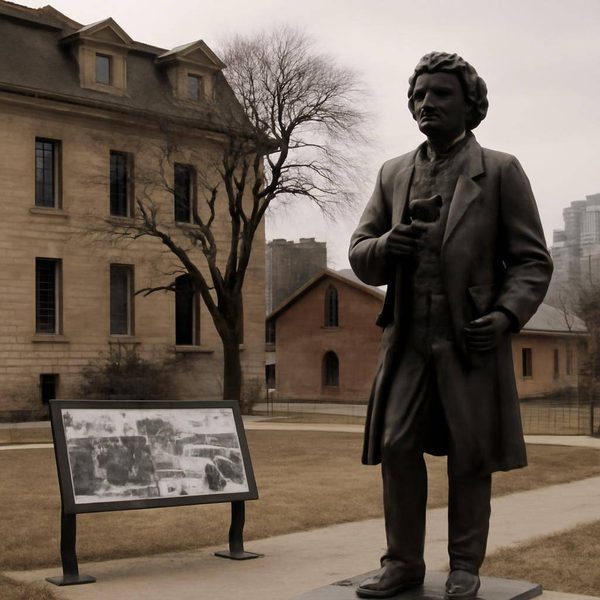
Multiple monuments throughout Winnipeg commemorate Riel and Métis history. A statue stands on the south grounds of the Legislative Building, erected by the Manitoba Métis Federation to complement existing monuments and assert Métis presence in provincial civic space. Another Riel statue stands at St. Boniface College, whilst his gravesite in St. Boniface Cemetery remains a site of pilgrimage and commemoration.
Riel millstones—the circa 1851 millstones used by Louis Riel Sr., Louis Riel's father—are displayed on the front grounds of the St. Boniface Museum at 474 Avenue Taché. These artifacts connect the younger Riel to his father's economic initiatives and the practical realities of Métis settlement life in the mid-nineteenth century.
Contemporary Métis Presence
Winnipeg sits on Treaty One Territory, traditional lands of the Anishinaabe, Ininew, and Dakota peoples, but the city's Métis population remains substantial and politically organised. The Manitoba Métis Federation operates as the representative body for Métis citizens in the province, advocating for rights, land claims, and cultural recognition that trace directly to the issues Riel fought for in the 1860s and 1880s.
St. Boniface, where Riel was born, retains its identity as Winnipeg's French quarter and serves as the cultural centre for Franco-Manitobans. The neighbourhood's institutions—including the museum, cathedral, and cultural organisations—maintain French language and Métis heritage through education, festivals, and public programming. This living cultural presence makes Riel's legacy tangible rather than purely historical.
Visiting Riel-Related Sites
The Province of Manitoba maintains an online guide to sites commemorating Louis Riel in Winnipeg, providing locations, historical context, and visiting information for multiple monuments and institutions. Travel Manitoba promotes "In Louis Riel's Footsteps" as a heritage tourism theme, encouraging visitors to explore the history of Manitoba's founding through sites connected to his life and political activities.
Most Riel-related sites concentrate in St. Boniface, making walking tours feasible for visitors who want to encounter multiple locations in a single outing. The sites function as entry points to larger questions about Canadian confederation, Indigenous and Métis rights, language politics, and the tensions between federal authority and regional autonomy that defined prairie settlement. Riel's execution occurred 140 years ago, but the questions his resistances raised remain active in Canadian politics and identity.
Sources: Sites Commemorating Louis Riel in Winnipeg - Province of Manitoba • Riel House National Historic Site - Parks Canada • Le Musée de Saint-Boniface Museum • Louis Riel in Winnipeg - Travel Manitoba